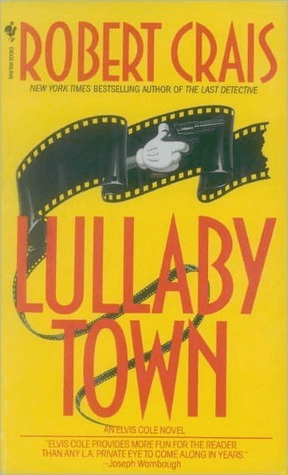
It’s often fun to drop in near the beginning of a new series, and such is the case with private detective novel Lullaby Town by Robert Crais. The early 1990s seems in some ways a distant time now. No smart phones. Not even any cell phones. At least none mentioned in this novel. No ubiquitous laptop computers and the best ones were dummy terminals tied to mainframes.
Anyway, Hollywood’s erratic but supposedly brilliant action / adventure director Peter Alan Nelson hires private detective Elvis Cole to find his ex-wife and young son who disappeared almost a decade ago. As Elvis searches the country to find these two, he finds other trouble as well. Peter’s wife has established herself in a small town in Connecticut. Unfortunately, despite working her way up at a local bank to a respectable position, she also has some unwanted, and quite nasty, mob connections. Extricating the ex and keeping the erratic (and emotionally immature) director from interfering make for more than simple search and find assignment for Elvis and his taciturn partner, Joe Pike. An entertaining and fun read — including Elvis’s snarky remarks about other fictional private eyes. Definitely a 4 star and maybe a 4.5 star book.
I rarely give a book five stars, because that would mean it is perfect. While this book is not perfect, it deserves its high rating because of the focus, the breath, and the aim of the book. Part social history. part commentary. This review of American exceptionalism (in both senses of the word) is based around the concept of what Andersen refers to as the Fantasy Industrial Complex, and how for both good and ill, that complex has shaped America, and how, at present, it is undoing America. The style of the book is readable. It is far from a “dry tome.” It goes back as far as the Puritans and comes up to the present and the election of the Fools Gold president currently occupying the Oval Office. A book worth your time.
The novelist reveals how the store she co-owns in Nashville is making, and remaking, plans to get books to readers who want them more than ever.
We closed Parnassus Books, the bookstore I co-own in Nashville, on the same day all the stores around us closed. I can’t tell you when that was because I no longer have a relationship with my calendar.
All the days are now officially the same. My business partner Karen and I talked to the staff and told them if they didn’t feel comfortable coming in that was fine. We would continue to pay them for as long as we could. But if they were OK to work in an empty bookstore, we were going to try to keep shipping books.
In the first week we did kerbside delivery, which meant a customer could call the store and tell us what they wanted. We would take their credit card information over the phone and then run the books out to the parking lot and sling them into the open car window. Kerbside delivery seemed like a good idea but the problem was, so many people were calling that the staff wound up clustered around the cash registers, ringing up orders. No good. We reassessed and decided that all books would have to be mailed, even the books that were just going down the street.
We make our plans. We change our plans. We make other plans. This is the new world order.
Our bookstore is spacious and tidy, with rolling ladders to reach the highest shelves, a long leather sofa, and a cheerful children’s section with a colourful mural featuring a frog telling a story to a rapt pack of assorted animals. The backroom is the polar opposite, a barely contained bedlam jammed with desks, towering flats of broken down boxes, boxes full of new releases, boxes of books to be returned. There are Christmas decorations, abandoned spinner displays, dog beds, day-old doughnuts. We are squashed in there together, forced to listen to one another’s private phone conversations and sniff one another’s perfume.
It is not the landscape of social distancing.
But in the absence of customers coming to browse, the backroom folks have moved to the capacious store front, setting up folding tables far away from each other to make our private spaces. We crank up the music. We pull books off the shelves. The floor is a sea of cardboard boxes – orders completed, orders still waiting on one more book. We make no attempt to straighten anything up before leaving at night. We have neither the impetus nor the energy. There are bigger fish to fry. Orders are coming in as fast as we can fill them.
I think of how I used to talk in the pre-pandemic world, going on about the importance of reading and shopping local and supporting independent bookstores. These days I realise the extent to which it’s true – I understand now that we’re a part of our community as never before, and that our community is the world. When a friend of mine, stuck in his tiny New York apartment, told me he dreamed of being able to read the new Louise Erdrich book, I made that dream come true. I can solve nothing, I can save no one, but dammit, I can mail Patrick a copy of The Night Watchman.
At least for now. We’re part of a supply chain that relies on publishers to publish the books and distributors to ship the books and the postal service to pick up the boxes and take them away. We rely on our noble booksellers filling the boxes to stay healthy and stay away from each other. So far this fragile ecosystem is holding, though I understand that in the distance between my writing this piece and your reading it, it could fall apart. Today is what we’ve got, this quiet day in which finally there is time to read again. So call your local bookstore and see if they’re still shipping. It turns out the community of readers and books is the community we needed in the good old days, and it’s the community we need in hard times, and it’s the community we’ll want to be there when this whole thing is over.
Chris Bailey, its author, calls for kindness when you catch your attention slouching on the job. Why be hard on yourself? We’re all swimming in a sea of distractions and it’s not our fault if we get carried off by a current several times in a day.
“Your mind will always wander, so consider how that might present an opportunity to assess how you’re feeling and then to set a path for what to do next,” he writes in the just-published book.
One way he has trained his mind to keep its finite amount of attention on whatever task he has designated for it is through an “awareness chime.” Using any number of apps, you can set up your computer or laptop to chime hourly. That gentle, pleasing sound will nudge you to take a second and ask yourself, “Am I doing the thing I’m supposed to be doing right now?”
Bailey actually suggests posing many other questions, including one about the quality of your attentional flow, distractions you might be able to remove from your environment, and whether you’re ignoring something that is more important than what you’re doing, even if you’re technically on schedule.
“If you’re anything like me, your hourly awareness chime may at first reveal that you’re usually not working on something important or consequential. That’s okay—and even to be expected,” he writes. In time, however, like Bailey, you probably won’t need the chimes to stay on track.
The hourly chime hack is not new. But usually it’s recommended as a mindfulness tool that can help you remember to breathe or sit quietly for a few minutes, or as a reminder to stand and walk around the office, or just stretch.
Several years ago, Daniel Pink, who writes on the science of motivation and time management, featured a chimes tip on his blog as a productivity hack. He quoted Peter Bregman, an advisor to CEOs and the author of 18 Minutes, who described how beeps can help a person snap to attention every hour. At first it seemed counterintuitive, Bregman wrote: “Aren’t interruptions precisely what we’re trying to avoid?”
But the beeps are productive if they take you off of autopilot, Bregman said. “This isn’t all about staying on plan. Sometimes the beep will ring and I’ll realize that, while I’ve strayed from my calendar, whatever it is I’m working on is what I most need to be doing.”
Then he shuffles priorities on his calendar, if necessary, and makes decisions about what is going to be left undone.
As the chime-marked hours pass, you’ll naturally recognize patterns in what you’re caught doing when the bells sound. (And we definitely prefer bells to startling beeps.) It’s one of the benefits to any time-awareness exercise: the heightened attention it brings to what’s stealing your time.
“The only problem she had was men, who constantly bothered her”: this might be the motto of Jami Attenberg’s latest novel. The line is uttered by Twyla, the daughter-in-law of a dying misogynist gangster named Victor Tuchman. She’s not alone in feeling this way about men in general, and Victor in particular. His wife, Barbra, and his daughter, Alex, have also gathered to see whether the man who made their lives miserable will die, and to figure out how much they really care. This story is about them.
The bulk of the novel takes place over a single day, just after Victor has been for a heart attack. The setting is present-day New Orleans, where Victor and Barbra have moved after a long, mansion-bound life in Connecticut, ostensibly to be near their son, Gary, and his wife and daughter, Twyla and Avery. But Victor is a deceptive man, even to his children. He is also a bad man.
Though we’re never given the exact nature of his crimes, we learn that he was a New Jersey gangster, more or less of the Sopranos variety. He was also an abusive husband and father, a philanderer and a tyrant and likely a rapist. Whatever the details of his life, their implications have long been clear to Alex: “Her gut told her he should be in jail right now.”
It is the women around Victor – Barbra, Alex and Twyla – who must endure the hurricane of his life, who must try to love him, to make him happy, to cover up for him, and who are all upbraided and assaulted by him. Much like Attenberg’s 2012 book The Middlesteins, this novel is uncompromising in its penetrating treatment of the ties that bind a family together.
Attenberg weaves her narrative with a scintillating and often wry prose; her love for her characters, and her keen interest in their joys and longings, never fails to shine through. Often she sets scenes with the terseness of a screenplay, but periodically she plunges into rich description, as when Twyla, crying, looks in the mirror and notices “lips in distress, cracked at the edges, only half the color left behind, the other half disappeared, god knows where, absorbed into skin, into air, into grief”.
These tears are not just for Victor’s victims. Alex must plead with her ex-husband, Bobby, not to expose their daughter to his compulsive lechery. Twyla has lived the bulk of her life trying not to wither beneath the male gaze, and now finds herself more distanced from Gary than ever. Barbra struggles to understand why she still loves her husband, after all this time. And all of them live under the shadow of another, casually destructive man: as Alex thinks every day, “our president [is] a moron and the world [is] falling apart”. The varied experiences of these characters make it clear that the bad man is not an exception to the rule of manhood; he merely defines its borders.
Jami Attenberg
The novel is not only concerned with gender politics: it also frequently returns to questions of socioeconomic class. And yet, it is weaker on this topic. We get cursory moments of virtue-signalling, when the narrative pauses briefly on working people – a cashier, a waitress, a tram driver – to tell us about the second job they’re forced to hold, or about how much they hate privileged tourists. The novel tells us about mass graves for the indigent, and gives us 30 pages with Sharon, a black woman only tangentially related to the plot, who lifts up her neighbourhood while suffering the effects of white gentrification.
But none of these people is a protagonist, none of their lives is centred. The novel points to them, wants them to be recognised; but it refuses to perform that recognition itself. “Whatever we do tonight, let’s not talk about politics,” Alex says to a man she meets at a bar, just after an altercation with a homeless man on the street. Despite the book’s signals to the contrary, this might be its other motto.
• All This Could Be Yours is published by Serpent’s Tail.








 Booker's Blog