Monthly Archives: January 2020

Photo finish Friday (and haiku): “Protesters in the rain”

Remember your heart

when you take your mind and storms

for a rainy walk.

Leave a comment

Filed under 2020, photo by David E. Booker, Photo Finish Friday, Poetry by David E. Booker

Haiku to you Thursday: “Hangnail”

It’s gone to his head.

That’s what the foot doctor said.

Hangnail of the mind.

Leave a comment

Filed under 2020, Haiku to You Thursday, Poetry by David E. Booker

7 Morning Habits That Can Affect Your Entire Day

It can be easy to fall into a morning routine without considering how it impacts you later in the day.

Source: 7 Morning Habits That Can Affect Your Entire Day

While not directly related to writing, I thought I would pass along. I don’t endorse any of these suggestions, and some I don’t agree with, such as coffee. Some or all might work for you.

Your morning routine is like setting up a string of dominoes: You line everything up for success, but one false move can cause it all to come tumbling down. In order to set the right tone for the rest of your day, experts say you should adjust the following seven habits.

  1. Hitting the Snooze Button

It’s tempting to steal a few more minutes of sleep, but hitting snooze has a negative impact on your physical and emotional well-being, says Joanna Kleinman, owner of The Center for Extraordinary Relationships. “Physically, hitting the snooze button actually sets you up to be groggy and less productive because you are repeatedly waking yourself out of a deep sleep,” Kleinman says. “Emotionally, you set yourself up to be late, rushed, and stressed in the morning.”

The obvious solution, Kleinman says, is getting out of bed right away (even if it seems impossible). “If we listen to our minds telling us what we feel like doing, we will never be able to make the positive changes we need to,” Kleinman says.

  1. Checking Your Phone

Doing this first thing in the morning stimulates self-criticism and judgments in your mind, Kleinman says. “Your emails and texts are all about things to do, things to buy, things to add to your to-do list,” she says. “This amounts to either the stuff that other people want you to be paying attention to, or what your mind says you should be paying attention to.”

Even if you leave your inbox alone and stick to Instagram, you can do harm to your psyche because social media causes you to compare yourself to other people. Bottom line: Checking your phone first thing can awaken your inner critic. To stop yourself from opening Twitter immediately after turning off your alarm, charge your phone in another room. Begin your day instead with a self-affirming habit like journaling or meditation.

  1. Planning Your Day

If you wake up and have no idea what’s on your schedule, where you have to be, or what you’re going to wear, then your day is already off to a frantic start. Psychologist and Certified Master Coach Joel Ingersoll recommends organizing your day the night before. This way, you’ll feel refreshed and ready to go in the morning.

  1. Drinking Water…

You may be craving a cup of coffee as soon as your feet hit the floor, but what your body really needs is a glass of water, Ingersoll says. Since you haven’t had any liquids in your system for at least six (or hopefully eight) hours, your body is dehydrated. You can have the coffee (see below), but your body will function better—you’ll have fewer headaches, less fatigue, and smaller bags under your eyes—if you down a glass of water first, Ingersoll says.

  1. …and Coffee

Don’t feel guilty about reaching for the coffee pot after you’ve had your water—it is actually good for your body, too, says Ilyse Schapiro, a Registered Dietitian and Certified Dietitian/Nutritionist. “Coffee is a great source of antioxidants, and it can increase energy as well as help to stabilize our moods,” Schapiro says. “It can also help keep our brains healthier and our minds sharper.”

Too much coffee isn’t going to do you any favors, though. Stick with one or two cups a day, and be consistent with how much you drink, or else you’ll start getting headaches and withdrawal symptoms.

  1. Skipping Breakfast

Have you been told to eat a good breakfast before? That’s because it’s important, says Bruno LoGreco, life coach and author of Stop Sabotaging Your Life. “Eating a healthy breakfast consisting of nuts, fruits, and oats will satisfy your brain to get you through a tough day at the office,” LoGreco says. It’s best to skip the doughnuts and croissants, though, as these will give you a sugar high and set you up for a crash just as you reach your desk.

  1. Rising Early

A study published by the American Psychological Association found that early risers are happier and more successful than those who go to bed late. They tend to be more proactive, get better grades, and better anticipate and minimize problems.

Danielle Braff is a freelance writer in Chicago. Her work has appeared in the Chicago Tribune, Crain’s Chicago Business, Women’s Health, Self and Marie Claire, among others. She lives with her husband, their two daughters, two cats and a dog. Check out her other work at Daniellebraff.com.

Leave a comment

Filed under 2020, writing tip, Writing Tip Wednesday

Monday morning writing joke: “Writer from Hell”

There once was a writer from Hell

Who could tell his stories quite well.

Full of fire and hate

They kept his readers up late –

And then there was their god awful smell.

Leave a comment

Filed under 2020, photo by David E. Booker, Poetry by David E. Booker

Haiku to you Thursday: “Old age”

Old age never ends. /

It lives like a thin shadow, /

Fattened by seasons.

Leave a comment

Filed under 2020, Haiku to You Thursday, Poetry by David E. Booker

Monday morning writing joke: “Writer from Sandusky”

There once was a writer from Sandusky

An outdoor fellow and husky.

He wrote about the birds and the bees

And even humans on their knees

But he himself was never lucky.

3 Comments

Filed under 2020, Monday morning writing joke, Poetry by David E. Booker

Book to read?

How to Think Like a Roman Emperor: The Stoic Philosophy of Marcus Aurelius by Donald J. Robertson

My rating: 4 of 5 stars


I wasn’t sure what to expect when I began How to Think Like a Roman Emperor: The Stoic Philosophy of Marcus Aurelius, but I had an interest in Stoic philosophy and decided to delve in with this book. In the end, I found it an interesting and often entertaining mixture of history, philosophy, and psychology, mostly Cognitive Based Therapy. I both read and listed to this book on tape. My only knock in regards to the audio version is that at times the author / reader’s accent got in the way of my understanding some words. Overall, I found it a good grounding in Stoicism and even how other philosophies of the time, such as Epicurean philosophy influenced Stoicism. And as much as it provides some background and history, it is also a book with some concrete suggestions for how to deal with issues today and how to remain grounded.


View all my reviews

Leave a comment

Filed under 2020, book review

The Origins of Gabriel Garcia Marquez’s Magic Realism – The Atlantic

“Surrealism runs through the streets,” the Colombian author, who died today at age 87, told The Atlantic in 1973. “Surrealism comes from the reality of Latin America.”

Source: The Origins of Gabriel Garcia Marquez’s Magic Realism – The Atlantic

It’s often said that the works of Colombian novelist and short-story writer Gabriel Garcia Marquez are quintessential examples of “magic realism”: fiction that integrates elements of fantasy into otherwise realistic settings. In his 1967 novel One Hundred Years of Solitude, which ambles through a century in the lives of one family in the enchanted Latin American hamlet of Macondo, magic carpets fly, ghosts haunt villagers, and trickles of blood from a killing climb stairs and turn corners to find the victim’s mother in her kitchen.

When Garcia Marquez, who died today at age 87, spoke to William Kennedy in an extensive interview published in the January 1973 issue of The Atlantic, he explained why he and other Latin American authors chose to weave fantastical details into their stories:

In Leaf Storm, the old doctor sits down to a pretentious, bourgeois dinner and startles everybody by saying to a servant: “Look, miss, just start boiling a little grass and bring that to me as if it were soup.” “What kind of grass, doctor?” the servant asks. “Ordinary grass, ma’am,” the doctor says. “The kind that donkeys eat.”

Surreal? Not to García. “A man said that in my house,” he said.

He believes that Faulkner differs from him on this matter in that Faulkner’s outlandishness is disguised as reality.

“Faulkner was surprised at certain things that happened in life,” García said, ‘but he writes of them not as surprises but as things that happen every day.”

García feels less surprised. “In Mexico,” he says, “surrealism runs through the streets. Surrealism comes from the reality of Latin America.”

About two weeks before he talked, a newsman had called to ask García for his reaction to an occurrence in a rural Colombian town. About ten in the morning at a small school, two men pulled up in a truck and said, “We came for the furniture.” Nobody knew anything about them, but the schoolmaster nodded, the furniture was loaded onto the truck and driven off, and only much later was it understood that the truckmen were thieves.

“Normal,” says García.

“One day in Barcelona,” he continued, “my wife and I were asleep and the doorbell rings. I open the door and a man says to me, ‘I came to fix the ironing cord.’ My wife, from the bed, says, ‘We don’t have anything wrong with the iron here.’ The man asks, ‘Is this apartment two?’ ‘No,’ I say, ‘upstairs.’ Later, my wife went to the iron and plugged it in and it burned up. This was a reversal. The man came before we knew it had to be fixed. This type of thing happens all the time. My wife has already forgotten it.”

García likes the principles of surrealism but not the surrealists themselves. Given a choice, he prefers the painters to the poets, but he does not think of himself as being like any of them. And it is true that his work is based more in the anecdote than in the symbolic or random flow of events so important to the surrealists; true also that his aim is to be accessible, not obscure. And yet, a surreal quality, a rendering of the improbable and impossible as real, pervades his work.

In 1982, Garcia Marquez won the Nobel Prize for Literature, and three years later, he published the widely acclaimed novel Love in the Time of Cholera.

Read Kennedy’s full interview with Gabriel Garcia Marquez here.

Leave a comment

Filed under 2020, author interview

The Unlikely Success of ‘One Hundred Years of Solitude’ – The Atlantic

When Gabriel García Márquez’s most famous novel was published 50 years ago, it faced a difficult publishing climate and baffled reviews.

Source: The Unlikely Success of ‘One Hundred Years of Solitude’ – The Atlantic

In 1967, Sudamericana Press published One Hundred Years of Solitude (Cien años de soledad), a novel written by a little known Colombian author named Gabriel García Márquez. Neither the writer nor the publisher expected much of the book. They knew, as the publishing giant Alfred A. Knopf once put it, that “many a novel is dead the day it is published.” Unexpectedly, One Hundred Years of Solitude went on to sell over 45 million copies, solidified its stature as a literary classic, and garnered García Márquez fame and acclaim as one of the greatest Spanish-language writers in history.

Fifty years after the book’s publication, it may be tempting to believe its success was as inevitable as the fate of the Buendía family at the story’s center. Over the course of a century, their town of Macondo was the scene of natural catastrophes, civil wars, and magical events; it was ultimately destroyed after the last Buendía was born with a pig’s tail, as prophesied by a manuscript that generations of Buendías tried to decipher. But in the 1960s, One Hundred Years of Solitude was not immediately recognized as the Bible of the style now known as magical realism, which presents fantastic events as mundane situations. Nor did critics agree that the story was really groundbreaking. To fully appreciate the novel’s longevity, artistry, and global resonance, it is essential to examine the unlikely confluence of factors that helped it overcome a difficult publishing climate and the author’s relative anonymity at the time.

* * *

In 1965, the Argentine Sudamericana Press was a leading publisher of contemporary Latin American literature. Its acquisitions editor, in search of new talent, cold-called García Márquez to publish some of his work. The writer replied with enthusiasm that he was working on One Hundred Years of Solitude, “a very long and very complex novel in which I have placed my best illusions.” Two and a half months before the novel’s release in 1967, García Márquez’s enthusiasm turned into fear. After mistaking an episode of nervous arrhythmia for a heart attack, he confessed in a letter to a friend, “I am very scared.” What troubled him was the fate of his novel; he knew it could die upon its release. His fear was based on a harsh reality of the publishing industry for rising authors: poor sales. García Márquez’s previous four books had sold fewer than 2,500 copies in total.

The best that could happen to One Hundred Years of Solitude was to follow a path similar to the books released in the 1960s as part of the literary movement known as la nueva novela latinoamericana. Success as a new Latin American novel would mean selling its modest first edition of 8,000 copies in a region with 250 million people. Good regional sales would attract a mainstream publisher in Spain that would then import and publish the novel. International recognition would follow with translations into English, French, German, and Italian. To hit the jackpot in 1967 was to also receive one of the coveted literary awards of the Spanish language: the Biblioteca Breve, Rómulo Gallegos, Casa de las Américas, and Formentor.

This was the path taken by new Latin American novels of the 1960s such as Explosion in a Cathedral by Alejo Carpentier, The Time of the Hero by Mario Vargas Llosa, Hopscotch by Julio Cortázar, and The Death of Artemio Cruz by Carlos Fuentes. One Hundred Years of Solitude, of course, eclipsed these works on multiple fronts. Published in 44 languages, it remains the most translated literary work in Spanish after Don Quixote, and a survey among international writers ranks it as the novel that has most shaped world literature over the past three decades.

And yet it would be wrong to credit One Hundred Years of Solitude with starting a literary revolution in Latin America and beyond. Sudamericana published it when the new Latin American novel, by then popularly called the boom latinoamericano, had reached its peak in worldwide sales and influence. From 1961 onward, like a revived Homer, the almost blind Argentine writer Jorge Luis Borges toured the planet as a literary celebrity. Following in his footsteps were rising stars like José Donoso, Cortázar, Vargas Llosa, and Fuentes. The international triumph of the Latin American Boom came when the Nobel Prize in Literature was awarded to Miguel Ángel Asturias in 1967. One Hundred Years of Solitude could not have been published in a better year for the new Latin American novel. Until then, García Márquez and his work were practically invisible.

* * *

In the decades before it reached its zenith, the new Latin American novel vied for attention alongside other literary trends in the region, Spain, and internationally. Its primary competition in Latin America was indigenismo, which wanted to give voice to indigenous peoples and was supported by many writers from the 1920s onward, including a young Asturias and José María Arguedas, who wrote in Spanish and Quechua, a native language of the Andes.

In Spain during the 1950s and 1960s, writers embraced social realism, a style characterized by terse stories of tragic characters at the mercy of dire social conditions. Camilo José Cela and Miguel Delibes were among its key proponents. Latin Americans wanting a literary career in Spain had to comply with this style, one example being a young Vargas Llosa living in Madrid, where he first wrote social-realist short stories.

Internationally, Latin American writers saw themselves competing with the French nouveau roman or “new novel.” Supporters, including Jean-Paul Sartre, praised it as the “anti-novel.” For them, the goal of literature was not narrative storytelling, but to serve as a laboratory for stylistic experiments. The most astonishing of such experiments was George Perec’s 1969 novel A Void, written without ever using the letter “e,” the most common in the French language.

In 1967, the book market was finally ready, it seemed, for One Hundred Years of Solitude. By then, mainstream Latin American writers had grown tired of indigenismo, a style used by “provincials of folk obedience,” as Cortázar scoffed. A young generation of authors in Spain belittled the stories in social-realist novels as predictable and technically unoriginal. And in France, emerging writers (such as Michel Tournier in his 1967 novel Vendredi) called for a return to narrative storytelling as the appeal of the noveau roman waned.

Between 1967 and 1969, reviewers argued that One Hundred Years of Solitude overcame the limitations of these styles. Contrary to the localism of indigenismo, reviewers saw One Hundred Years of Solitude as a cosmopolitan story, one that “could correct the path of the modern novel,” according to the Latin American literary critic Ángel Rama. Unlike the succinct language of social realism, the prose of García Márquez was an “atmospheric purifier,” full of poetic and flamboyant language, as the Spanish writer Luis Izquierdo argued. And contrary to the formal experiments of the nouveau roman, his novel returned to “the narrative of imagination,” as the Catalan poet Pere Gimferrer explained. Upon the book’s translation to major languages, international reviewers acknowledged this, too. The Italian writer Natalia Ginzburg forcefully called One Hundred Years of Solitude “an alive novel,” assuaging contemporary fears that the form was in crisis.

And yet these and other reviewers also remarked that One Hundred Years of Solitude was not a revolutionary work, but an anachronistic and traditionalist one, whose opening sentence resembled the “Once upon a time” formula of folk tales. And rather than a serious novel, it was a “comic masterpiece,” as an anonymous Times Literary Supplement reviewer wrote in 1967. Early views on this novel were indeed different from the ones that followed. In 1989, Yale literary scholar Harold Bloom solemnly called it “the new Don Quixote” and the writer Francine Prose confessed in 2013 that “One Hundred Years of Solitude convinced me to drop out of Harvard graduate school.”

Nowadays scholars, critics, and general readers mainly praise the novel as “the best expression of magical realism.” By 1995, magical realism was seen as making its way into the works of major English-language authors such John Updike and Salman Rushdie and moreover presented as “an inextricable, ineluctable element of human existence,” according to the New York Times literary critic Michiko Kakutani. But in 1967, the term magical realism was uncommon, even in scholarly circles. During One Hundred Years of Solitude’s first decade or so, to make sense of this “unclassifiable work,” as a reviewer put it, readers opted for labeling it as a mixture of “fantasy and reality,” “a realist novel full of imagination,” “a curious case of mythical realism,” “suprarrealism,”or, as a critic for Le Monde called it, “the marvelous symbolic.”

Now seen as a story that speaks to readers around the world, One Hundred Years of Solitude was originally received as a story about Latin America. The Harvard scholar Robert Kiely called it “a South American Genesis” in his review for the New York Times. Over the years, the novel grew to have “a texture of its own,” to use Updike’s words, and it became less a story about Latin America and more about mankind at large. William Kennedy wrote for the National Observer that it is “the first piece of literature since the Book of Genesis that should be required reading for the entire human race.” (Kennedy also interviewed García Márquez for a feature story, “The Yellow Trolley Car in Barcelona, and Other Visions,” published in The Atlantic in 1973.)

Perhaps even more surprisingly, respected writers and publishers were among the many and powerful detractors of this novel. Asturias declared that the text of One Hundred Years of Solitude plagiarized Balzac’s 1834 novel The Quest of the Absolute. The Mexican poet and Nobel recipient, Octavio Paz, called it “watery poetry.” The English writer Anthony Burgess claimed it could not be “compared with the genuinely literary explorations of Borges and [Vladimir] Nabokov.” Spain’s most influential literary publisher in the 1960s, Carlos Barral, not only refused to import the novel for publication, but he also later wrote “it was not the best novel of its time.” Indeed, entrenched criticism helps to make a literary work like One Hundred Years of Solitude more visible to new generations of readers and eventually contributes to its consecration.

With the help of its detractors, too, 50 years later the novel has fully entered popular culture. It continues to be read around the world, by celebrities such as Oprah Winfrey and Shakira, and by politicians such as Presidents Bill Clinton and Barack Obama, who called the book “one of my favorites from the time I was young.”

More recently, with the aid of ecologically minded readers and scholars, One Hundred Years of Solitude has unexpectedly gained renewed significance as awareness of climate change increases. After the explosion of the BP drilling rig Deepwater Horizon in 2010 in the Gulf of Mexico (one of the worst accidental environmental catastrophes in history), an environmental-policy advocate referred to the blowout as “tragic realism” and a U.S. journalist called it the “pig’s tail of the Petro-World.” What was the connection with One Hundred Years of Solitude? The explosion occurred at an oil and gas prospect named Macondo by a group of BP engineers two years earlier, so when Deepwater Horizon blew up, reality caught up with fiction. Some readers and scholars started to claim the spill revealed a prophecy similar to the one hidden in the Buendías manuscript:  a warning about the dangers of humans’ destruction of nature.

García Márquez lived to see the name of Macondo become part of a significant, if horrifying, part of earth’s geological history, but not to celebrate the 50th anniversary of his masterpiece: He passed away in 2014. But the anniversary of his best known novel will be celebrated globally. As part of the commemoration, the Harry Ransom Center in Austin, Texas, where García Márquez’s archives have been kept since 2015, has opened an online exhibit of unique materials. Among the contents will be the original typescript of the “very long and very complex novel” that did not die but attained immortality the day it was published.

We want to hear what you think about this article. Submit a letter to the editor or write to letters@theatlantic.com.

Alvaro Santana-Acuña is an assistant professor of sociology at Whitman College. He is the author of the forthcoming book Ascent to Glory: The Transformation of One Hundred Years of Solitude Into a Global Classic.

Leave a comment

Filed under 2020, author, author tribute

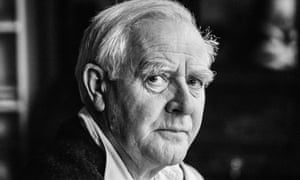
John le Carré wins $100,000 prize for ‘contribution to democracy’ | Books | The Guardian

Alison Flood and Sian CainFri 10 Jan 2020 00.45 EST

Source: John le Carré wins $100,000 prize for ‘contribution to democracy’ | Books | The Guardian

John le Carré has been named the latest recipient of the $100,000 (£76,000) Olof Palme prize, an award given for an “outstanding achievement” in the spirit of the assassinated Swedish prime minister.

Won in the past by names including whistleblower Daniel Ellsberg, who exposed the US government’s secret intelligence about the Vietnam war in 1971, the Olof Palme prize is intended to reward “an outstanding achievement in any of the areas of anti-racism, human rights, international understanding, peace and common security”.

Announcing Le Carré’s win early on Friday morning, the prize organisers praised the 88-year-old author, whose real name is David Cornwell, “for his engaging and humanistic opinion-making in literary form regarding the freedom of the individual and the fundamental issues of mankind.

“Attracting worldwide attention, he is constantly urging us to discuss the cynical power games of the major powers, the greed of global corporations, the irresponsible play of corrupt politicians with our health and welfare, the growing spread of international crime, the tension in the Middle East and the alarming rise of fascism and xenophobia in Europe and the US,” the organisers said, calling his career “an extraordinary contribution to the necessary fight for freedom, democracy and social justice”.

Le Carré said he would donate the winnings to the international humanitarian NGO Médecins Sans Frontières.

Le Carré, the acclaimed author of some of the last century’s most enduring works, from Tinker, Tailor, Soldier, Spy to The Spy Who Came in from the Cold, has been consistently outspoken about abuses of power in his fiction, his targets including governments, big pharma and arms dealing. Agent Running in the Field, his most recent book – which he has hinted will be his last – depicts collusion between Donald Trump’s US and the British security services with the aim of undermining the European Union.

The author has long steered clear of honours. In 2011, when he was nominated for the Man Booker International prize, he asked for his name to be withdrawn, saying that while he was “enormously flattered”, he did not compete for literary prizes.

Few authors have won the Olof Palme prize, named for the Social Democrat who led his country for 11 years and was mysteriously gunned down in a Stockholm street in 1986 after leaving the cinema. Playwright and political dissident Václav Havel won in 1989, soon before becoming president of Czechoslovakia, Danish novelist Carsten Jensen won in 2009 and the Italian journalist and author of Gomorrah Roberto Saviano won in 2011.

Le Carré will receive his award at a ceremony in Stockholm on 30 January.

Leave a comment

Filed under 2020, author, author tribute, awards