Monthly Archives: January 2019

Poetry sales soar as political millennials search for clarity | Books | The Guardian

Record £12m sales last year were driven by younger readers, with experts saying hunger for nuance amid conflict and disaster were fuelling the boom

Source: Poetry sales soar as political millennials search for clarity | Books | The Guardian

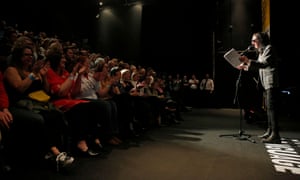
A passion for politics, particularly among teenagers and young millennials, is fuelling a dramatic growth in the popularity of poetry, with sales of poetry books hitting an all-time high in 2018.

Statistics from UK book sales monitor Nielsen BookScan show that sales grew by just over 12% last year, for the second year in a row. In total, 1.3m volumes of poetry were sold in 2018, adding up to £12.3m in sales, a rise of £1.3m on 2017. Two-thirds of buyers were younger than 34 and 41% were aged 13 to 22, with teenage girls and young women identified as the biggest consumers last year.

Rupi Kaur, a 26-year-old Canadian poet with 3.4 million followers on Instagram, leads the bestsellers list and was responsible for almost £1m of sales. “You tell me to quiet down / cause my opinions make me less beautiful,” she writes in Milk and Honey, the No 1 bestselling collection of 2018, “but I was not made with a fire in my belly / so I could be put out.”

Works by Leonard Cohen, John Cooper Clarke, Seamus Heaney, Carol Ann Duffy and Homer also sold well.

Andre Breedt, for Nielsen, said that sales were booming because in times of political upheaval and uncertainty, people turn to poems to make sense of the world: “Poetry is resonating with people who are looking for understanding. It is a really good way to explore complex, difficult emotions and uncertainty.”

He added that the form’s brevity also meant it could be easily consumed on phones and shared on social media.

In the immediate aftermath of the Manchester bombing, Tony Walsh’s reading of his poem, This Is the Place, at Manchester town hall was shared thousands of times online and became instantly famous worldwide. Ben Okri’s poem Grenfell Tower, June, 2017, written in the aftermath of the fire, followed a similar trajectory.

“At these moments of national crisis, the words that spread and the words that were heard were not the words of politicians, they were the words of poets,” said Susannah Herbert, director of the Forward Arts Foundation, which runs the Forward prizes for poetry and National Poetry Day. “Almost everything a politician says is incredibly forgettable. There is a hunger out there for more nuanced and memorable forms of language.”

People wanted to cut through the verbiage of Brexit to see the bigger picture in 2018, she said: “Language gets stale in politics. Words begin to lose their meaning. Poetry occupies a different space to the humdrum. It is a way of renewing what words actually mean. It offers you a different way of looking at the world.”

A comparable boom in the popularity of poetry was seen during the miners’ strike in the 1980s and during the rise of Chartism in the 19th century, according to Katy Shaw, professor of contemporary writings at Northumbria University.

“To me, it’s no coincidence that poetry as a form is being used to critically discuss events like Grenfell, the Manchester bombing and Brexit as well,” she said. “It’s being repurposed as this really dynamic and vital form that can capture, in a very condensed way, the turbulent nature of contemporary society – and give us the space to struggle with our desire to understand and negotiate a lot of what is going on at the moment.”

Like the miners and Chartists did before them, people are reading and sharing poetry not to passively reflect on what’s going on in society, but as a way of engaging, said Shaw. “Poetry as a form can capture the immediate responses of people to divisive and controversial current events. It questions who has the authority to put their narrative forward, when it is written by people who don’t otherwise hold this power,” she said. “Writing poetry and sharing it in this context is a radical event, an act of resistance to encourage other people to come round to your perspective.”

Social media and technology have made poetry much easier to access and pass along, magnifying its impact, Shaw said: “In the miners’ strike, we had poetry being written on the side of instruction manuals and printed on typewriters, distributed by hand or sent through the post. Similarly, we have evidence of a lot of Chartist poetry being publicly read out and shared between different groups of workers.

“But poetry has a strong oral tradition – it wasn’t always written down, people would learn it and recite it. The one great advantage we have now is the speed at which we can share new work.”

Leave a comment

Filed under 2019, news, poetry

Celebrity Killed The Radio Star | You and Me, Dupree

Source: Celebrity Killed The Radio Star | You and Me, Dupree

Unknown.jpeg

One of the most moving, most significant, most powerful books I’ve read over the last few years is mainly made up of illustrations. It’s the remarkable ALL THE ANSWERS, a “graphic memoir” by Michael Kupperman, and I strongly urge you to give it a spin.

The author is not new to me: I published Michael Kupperman’s first book, SNAKE ’N’ BACON’S CARTOON CABARET, nearly twenty years ago. We had noticed his work in such publications as the Oxford American, and every time we saw another cheerily demented comic strip we wound up wiping tears of laughter from our faces. Mike has a straight-laced, almost retro drawing style that you can tell a mile away (by now, others are obviously trying to imitate it). But the cultural melange roiling around in his brain is unique, charming and dangerous. He loves old Hollywood, old media (heavy-breathing magazine ads from the Thirties and Forties are a huge inspiration), mass marketing to innocents, deliberately absurd juxtapositions — you can’t possibly get ahead of him before you turn the page.

Either you love this stuff to death or you want to throw it across the room. Some people at the publisher where I worked were far from smitten, but to their credit they said, we don’t get it, but we get that you get it. I got the green light and set out to find the guy who signed his work “P. Revess” by calling those magazines and asking, where do you send the checks? Turned out they headed right here, to New York City, to a guy named “Michael Kupperman.” When I called him to ask about his interest in possibly doing a book, I detected a hint of suspicion, the do-you-have-Prince-Albert-in-a-can type. But I proved my bona fides and we made a deal. No agent, no nuthin.

The book sold modestly but steadily (it’s still in print after all this time, which is an achievement on its own), but more important, it introduced Mike to a growing and influential audience. Art directors loved his funky visual style: I started to see his spot illustrations in unexpected places like the New Yorker. One week he did the cover and interior color illos for the lead story in an issue of Fortune. He was all over the place outside the comics field for a while.

He was also getting noticed in the world of comedy. Andy Richter, Conan O’Brien’s original sidekick, was such an early fan that he gave us a quote for our book cover. Conan himself called Mike “probably one of the greatest comedy brains on the planet.” Robert Smigel, who is also probably one of the greatest comedy brains on the planet, heartily agreed and adapted some wild stuff for his TV FUNHOUSE, and Michael Kupperman was officially hip. There’s since been more tv, more illustration, more comics, and in 2013 Mike won the Eisner Award, comics’ highest honor, for a fevered, off-the-scale-hilarious story about the 1969 moon landing in his book TALES DESIGNED TO THRIZZLE.

I’ve been following Mike’s career as best I could in the years since we worked together. I’m proud of him. But nothing prepared me for this latest dazzler. It comes from someplace deep inside the artist, an excruciatingly personal corner where he hasn’t allowed us before. As the flap copy calmly states, “This is his first serious book.”

Nearly every creative person I’ve ever encountered, myself certainly included, loves it when s/he is credited by name. A couple times I casually asked Mike why he signed a pseudonym instead and never got a straight answer. Maybe this book provides a clue. I didn’t know it, but there was a time when “Kupperman” was one of the most famous surnames in America. It belonged to an unwitting pioneer of celebrity culture, a child star whose popularity was launched and exploited by the mass medium of radio. This was Michael’s father, Joel Kupperman. He was a Quiz Kid — probably the best known Quiz Kid of them all.

Joel was a “child prodigy” when that term was new. He scored better than 200 on the Stanford-Binet test when he was only six years old. His specialty was doing complex mathematical calculations in his head; he was also a maven at trivia and remembered nearly everything he read. He was a perfect fit for QUIZ KIDS, a radio program created by broadcasting executive Louis G. Cowan (the author calls him “almost certainly the smartest person in this book”) in which children answered questions sent in by listeners. Joel’s first appearance was in 1942; he was five.

Today Joel is a grandfather. He spent fifty years teaching and writing books about philosophy. He has been a good man, neither an abuser nor philanderer, but to his son lamentably distant. Now, before Joel succumbs to the dementia that has just been diagnosed, the young Kupperman wants to open a subject which his father has compartmentalized and never discussed: the traumatic years on QUIZ KIDS which basically stole his childhood, tormented him as he grew out of single-digit cuteness and the show migrated to television, and caused him to recoil from the whole experience.

The complexities which intertwine to form this saga include the state of mass media in the mid-twentieth century, Joel’s stern and smothering stage mother, the role of anti-Semitism on QUIZ KIDS, the high price of fame, and most searingly, the poignant real-life relationship between a wounded father and his son, who is by now raising his own young boy. These strands dart and weave and intersect in magical ways: ALL THE ANSWERS turns on a dime from humor to heartbreak.

It looks simple, but looks are deceiving. The pages are trimmed to 6-by-9, just like a book full of words. It’s drawn in black-and-white (like the book we did together). The illustrative style is Kupperman-clean, with slightly more ornate chapter-heading ”splash pages,” and show off how the artist can conjure familiar people from real life with just a few economical lines (a secret cache of scrapbooks assiduously kept by Joel’s mother provides all the contemporary source material needed). The first-person narration is active, impassioned, haunting and honest, a world away from the hyperventilating wisenheimer of gonzo Kupperman comics. The text in ALL THE ANSWERS is so clear that it serves to emphasize the rich subtext. Ideas, emotions, relationships, issues, injustices, yearnings — they all pop off the pages in deeply human ways. It appears to be hand-lettered, though I bet there’s a computer involved by now, but this isn’t a comic book. It’s exactly what it claims to be: a graphic memoir. The closest cousin I can think of is Alison Bechdel’s FUN HOME, but this feels even more basic and vital, and you can’t stop comparing the World War II years — QUIZ KIDS’s golden age — with our culture today. As you read, Michael Kupperman’s very personal world expands to encompass your own.

Artists are supposed to startle and surprise us. Boy, did this book deliver. I didn’t know Michael Kupperman had it in him. I’ll be thinking about this for a long time, especially while reading this talented man’s next outrageous bit of goofiness, which I hope comes along very soon. (He’s got an agent now.) It’ll be even more fun now that I know the guy a little better.

Leave a comment

Filed under 2019, author

After Twenty Years by O. Henry — LitReading – Classic Short Stories

Twenty years after heading west to find his fortunes a man returns to meet a long lost friend. 5 to 15 minutes

Source: After Twenty Years by O. Henry — LitReading – Classic Short Stories

THE COP MOVED ALONG THE STREET, LOOKING strong and important. This was the way he always moved. He was not thinking of how he looked. There were few people on the street to see him. It was only about ten at night, but it was cold. And there was a wind with a little rain in it.

He stopped at doors as he walked along, trying each door to be sure that it was closed for the night. Now and then he turned and looked up and down the street. He was a fine-looking cop, watchful, guarding the peace.

People in this part of the city went home early. Now and then you might see the lights of a shop or of a small restaurant. But most of the doors belonged to business places that had been closed hours ago.Then the cop suddenly slowed his walk. Near the door of a darkened shop a man was standing. As the cop walked toward him, the man spoke quickly.

“It’s all right, officer,” he said. “I’m waiting for a friend. Twenty years ago we agreed to meet here tonight. It sounds strange to you, doesn’t it? I’ll explain if you want to be sure that everything’s all right. About twenty years ago there was a restaurant where this shop stands. ‘Big Joe’ Brady’s restaurant.”

“It was here until five years ago,” said the cop.

The man near the door had a colorless square face with bright eyes, and a little white mark near his right eye. He had a large jewel in his necktie.

“Twenty years ago tonight,” said the man, “I had dinner here with Jimmy Wells. He was my best friend and the best fellow in the world. He and I grew up together here in New York, like two brothers. I was eighteen and Jimmy was twenty. The next morning I was to start for the West. I was going to find a job and make a great success. You couldn’t have pulled Jimmy out of New York. He thought it was the only place on earth.

“We agreed that night that we would meet here again in twenty years. We thought that in twenty years we would know what kind of men we were, and what future waited for us.”

“It sounds interesting,” said the cop. “A long time between meet- ings, it seems to me. Have you heard from your friend since you went West?”

“Yes, for a time we did write to each other,” said the man. “But after a year or two, we stopped. The West is big. I moved around every- where, and I moved quickly. But I know that Jimmy will meet me here if he can. He was as true as any man in the world. He’ll never forget. I came a thousand miles to stand here tonight. But I’ll be glad about that, if my old friend comes too.”

The waiting man took out a fine watch, covered with small jewels.

“Three minutes before ten,” he said. “It was ten that night when we said goodbye here at the restaurant door.”

“You were successful in the West, weren’t you?” asked the cop.

“I surely was! I hope Jimmy has done half as well. He was a slow mover. I’ve had to fight for my success. In New York a man doesn’t change much. In the West you learn how to fight for what you get.”

The cop took a step or two.

“I’ll go on my way,” he said. “I hope your friend comes all right. If he isn’t here at ten, are you going to leave?”

“I am not!” said the other. “I’ll wait half an hour, at least. If Jimmy is alive on earth, he’ll be here by that time. Good night, officer.”

“Good night,” said the cop, and walked away, trying doors as he went.

There was now a cold rain falling and the wind was stronger. The few people walking along that street were hurrying, trying to keep warm. And at the door of the shop stood the man who had come a thousand miles to meet a friend. Such a meeting could not be certain. But he waited.

About twenty minutes he waited, and then a tall man in a long coat came hurrying across the street. He went directly to the waiting man.

“Is that you, Bob?” he asked, doubtfully.

“Is that you, Jimmy Wells?” cried the man at the door.

The new man took the other man’s hands in his. “It’s Bob! It sure-

ly is. I was certain I would find you here if you were still alive. Twenty years is a long time. The old restaurant is gone, Bob. I wish it were here, so that we could have another dinner in it. Has the West been good to you?”

“It gave me everything I asked for. You’ve changed, Jimmy. I never thought you were so tall.”

“Oh, I grew a little after I was twenty.”

“Are you doing well in New York, Jimmy?”

“Well enough. I work for the city. Come on, Bob, We’ll go to a

place I know, and have a good long talk about old times.”

The two men started along the street, arm in arm. The man from the West was beginning to tell the story of his life. The other, with his coat up to his ears, listened with interest.

At the corner stood a shop bright with electric lights. When they

came near, each turned to look at the other’s face.

The man from the West stopped suddenly and pulled his arm away. “You’re not Jimmy Wells,” he said. “Twenty years is a long time,

but not long enough to change the shape of a man’s nose.”

“It sometimes changes a good man into a bad one,” said the tall man. “You’ve been under arrest for ten minutes, Bob. Chicago cops thought you might be coming to New York. They told us to watch for you. Are you coming with me quietly? That’s wise. But first here is something I was asked to give you. You may read it here at the window.

It’s from a cop named Wells.”

The man from the West opened the little piece of paper. His hand

began to shake a little as he read.

“Bob: I was at the place on time. I saw the face of the man want- ed by Chicago cops. I didn’t want to arrest you myself. So I went and got another cop and sent him to do the job.

JIMMY.”

Leave a comment

Filed under 2019, author, short story

Announcing The Charles Frazier Cold… | Hub City Writers Project

Charles Frazier, Hub City Press Team Up for Brand New Book Series

Source: Announcing The Charles Frazier Cold… | Hub City Writers Project

SPARTANBURG, S.C.—National Book Award Winner Charles Frazier and Hub City Press are teaming up on a new series of books spotlighting extraordinary writers from the American South. Beginning in spring 2019, the Cold Mountain Fund Series will publish literary fiction in hardback.

Frazier, best-selling author of “Cold Mountain,” “Thirteen Moons,” “Nightwoods,” and “Varina,” will provide financial support through the Frazier family’s Cold Mountain Fund at the Community Foundation of Western North Carolina. Frazier also will assist in book promotion and make occasional appearances with the Cold Mountain Fund Series authors.

“I have long considered Hub City Press to be one of the very finest independent publishers in the country and am excited to help foster their already excellent offerings of literary fiction,” Frazier said.

Hub City Press, now in its 24th year, is the South’s premier independent literary press. Funded by the National Endowment for the Arts, Hub City is focused on finding and publishing new and extraordinary voices from the South. Among its recent successes are an NPR Book of the Year, a Kirkus Book of the Year, a book longlisted for the Center for Fiction First Novel Prize, and coverage in The Los Angeles Times and The New York Times.

“I couldn’t be more thrilled at this new partnership,” said Meg Reid, director of Hub City Press. “Charles Frazier has long been one of the South’s greatest writers, as well as one of Hub City’s most ardent supporters. This series will be vital in helping us continue our mission to find and champion the finest fiction the South has to offer.”

The first three books in the series will be “The Magnetic Girl” by Jessica Handler of Atlanta, GA (April 2019), “Watershed” by Mark Barr of Little Rock, AR (October 2019), and “The Prettiest Star” by Carter Sickels of Lexington, KY (April 2020).

“Finding an audience has never been easy for writers of literary fiction,” Frazier said, “so in working with Hub City, my hope is to help amplify distinctive Southern voices and connect them with curious readers.”

Cold Mountain funds primarily will be targeted for more substantial book advances and for book marketing.

Hub City Press titles are distributed by Publishers Group West. Among its published authors are Leesa Cross-Smith, Ron Rash, Michel Stone, Julia Franks, Ashley Jones and others. Hub City annually sponsors the $10,000 C. Michael Curtis Short Story Book Prize (judged this year by Lauren Groff), the biennial New Southern Voices Poetry Prize and the biennial South Carolina Novel Prize.

Leave a comment

Filed under 2019, announcement, author

How language shapes how we see our world

Leave a comment

Filed under 2019, language

Haiku (and cartoon) to you Thursday: “New Year”

Another year lapses /
Burdened with what might have beens: /
Tomorrow whispers.

Calvin and Hobbs: New Year's resolutions

Leave a comment

Filed under 2019, Haiku to You Thursday, poetry by author

Writing tip Wednesday: “Flush with success”

A simple writing tip to start the New Year. /
I will say it once, so gather round here. /
Whatever you may do about beginnings and ends /
When sitting on the throne do not hours spend. /
Your poem you will not complete before other deeds are done. /
And your legs and your feet will be the slumbering ones. /
Your audience, too, may have abandoned you. /
They may find what you have done not the best you can doo-doo.

Simple tip to start out the New Year. Do not write a completed poem while sitting on the commode. Before you’re finished, your legs — if not your audience — will be numb and asleep.

Leave a comment

Filed under 2019, Writing Tip Wednesday, writing tips

cARtOONSdAY: “eXIT rIGHT”

How you end a scene or chapter is as important as how you begin one.

Staged exit

Staged exit right.

Left in a flight.

Rung drama from the night

Exited before day bright.

We cried, “No more!”

Our eyes cast to the floor

We showed him the door.

He cried, “You bore.”

He left with a sting

Like a long hard fling

When the door it swings

Into the ding-a-king.

Staged exit


Leave a comment

Filed under 2019, CarToonsday, poetry by author