Monthly Archives: January 2017

Sad chart: Book reading

reading-facts

Leave a comment

January 13, 2017 · 11:29 pm

Photo finish Friday: “Azalea”

Fall colors; winter rain.

Fall colors; winter rain.

Leave a comment

Filed under 2017, photo by David E. Booker, Photo Finish Friday

Haiku to you Thursday: “Cheap soles”

Troubling questions /

crunched under trampling footsteps. /

Cheap soles speaking lies.

Leave a comment

Filed under 2017, Haiku to You Thursday, poetry by author

Writing tip Wednesday: Agent to consider

New Literary Agent Alert: Maximilian Ximenez of L. Perkins Agency

max_agent-72dpi_5x6_4c-copy

About Maximilian: Maximilian Ximenez grew up within the New York publishing industry. Prior to joining the L. Perkins Agency, he worked at Blizzard Entertainment, creators of the popular Warcraft, StarCraft, and Diablo video game franchises. He is a strong believer in publishing and narrative as a central pillar of franchise and transmedia development.

He is seeking: Maximilian is actively pursuing clients for both fiction and nonfiction works. In fiction, he is acquiring science fiction, fantasy, horror, and thrillers, particularly cyberpunk and neo-noir as well as books with a uniquely deconstructive bent. For nonfiction, Maximilian is seeking popular science, true crime, and books pertaining to arts and trends in developing fields and cultures.

How to submit: For submissions, please send an email to maximilian [at] lperkinsagency.com with your bio, a brief synopsis, and the first five pages of your book or novel in the body.

Leave a comment

Filed under 2017, writing tip, Writing Tip Wednesday

Monday (morning) writing joke: “Subject addressed”

There once was a quirky writer from Nice /
Who wore clothes only made from fleece. /
He visited friends around France /
In his polyester-type pants. /
Their plastic tongues wagged without cease.

Leave a comment

Filed under 2017, Monday morning writing joke, poetry by author

Diagramming Sentences

A Picture Of Language: The Fading Art Of Diagramming Sentences

Source: http://www.npr.org/sections/ed/2014/08/22/341898975/a-picture-of-language-the-fading-art-of-diagramming-sentences?utm_source=facebook.com&utm_medium=social&utm_campaign=npr&utm_term=nprnews&utm_content=20170101

by Juana Summers
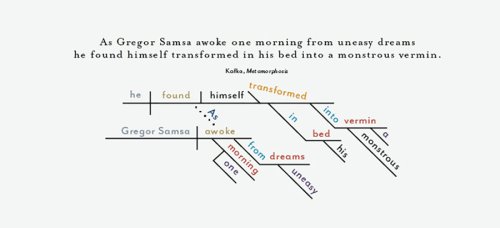
The design firm Pop Chart Lab has taken the first lines of famous novels and diagrammed those sentences. This one shows the opening of Franz Kafka's "Metamorphosis."

The design firm Pop Chart Lab has taken the first lines of famous novels and diagrammed those sentences. This one shows the opening of Franz Kafka’s “Metamorphosis.”

When you think about a sentence, you usually think about words — not lines. But sentence diagramming brings geometry into grammar.

If you weren’t taught to diagram a sentence, this might sound a little zany. But the practice has a long — and controversial — history in U.S. schools.

And while it was once commonplace, many people today don’t even know what it is.
So let’s start with the basics.

“It’s a fairly simple idea,” says Kitty Burns Florey, the author of Sister Bernadette’s Barking Dog: The Quirky History and Lost Art of Diagramming Sentences. “I like to call it a picture of language. It really does draw a picture of what language looks like.”

I asked her to show me, and for an example she used the first sentence she recalls diagramming: “The dog barked.”

“By drawing a line and writing ‘dog’ on the left side of the line and ‘barked’ on the right side of the line and separating them with a little vertical line, we could see that ‘dog’ was the subject of the sentence and ‘barked’ was the predicate or the verb,” she explains. “When you diagram a sentence, those things are always in that relation to each other. It always makes the same kind of picture. And supposedly, it makes it easier for kids who are learning to write, learning to use correct English.”

An Education ‘Phenomenon’

Burns Florey and other experts trace the origin of diagramming sentences back to 1877 and two professors at Brooklyn Polytechnic Institute. In their book, Higher Lessons in English, Alonzo Reed and Brainerd Kellogg made the case that students would learn better how to structure sentences if they could see them drawn as graphic structures.

After Reed and Kellogg published their book, the practice of diagramming sentences had something of a Golden Age in American schools.

“It was a purely American phenomenon,” Burns Florey says. “It was invented in Brooklyn, it swept across this country like crazy and became really popular for 50 or 60 years and then began to die away.”

By the 1960s, new research dumped criticism on the practice.

“Diagramming sentences … teaches nothing beyond the ability to diagram,” declared the 1960 Encyclopedia of Educational Research.

In 1985, the National Council of Teachers of English declared that “repetitive grammar drills and exercises” — like diagramming sentences — are “a deterrent to the improvement of students’ speaking and writing.”

Nevertheless, diagramming sentences is still taught — you can find it in textbooks and see it in lesson plans. My question is, why?

Burns Florey says it might still be a good tool for some students. “When you’re learning to write well, it helps to understand what the sentence is doing and why it’s doing it and how you can improve it.”

But does it deserve a place in English class today? (The Common Core doesn’t mention it.)

“There are two kinds of people in this world — the ones who loved diagramming, and the ones who hated it,” Burns Florey says.

She’s in the first camp. But she understands why, for some students, it never clicks.

“It’s like a middle man. You’ve got a sentence that you’re trying to write, so you have to learn to structure that, but also you have to learn to put it on these lines and angles and master that, on top of everything else.”

So many students ended up frustrated, viewing the technique “as an intrusion or as an absolutely confusing, crazy thing that they couldn’t understand.”

2 Comments

Filed under 2017, sentences

Storytelling

John Berger (RIP) and Susan Sontag Take Us Inside the Art of Storytelling (1983)

Source: http://www.openculture.com/2017/01/john-berger-rip-and-susan-sontag-take-us-inside-the-art-of-storytelling-1983.html

“Somebody dies,” says John Berger. “It’s not just a question of tact that one then says, well, perhaps it is possible to tell that story,” but “it’s because, after that death, one can read that life. The life becomes readable.” His interlocutor, a certain Susan Sontag, interjects: “A person who dies at 37 is not the same as a person who dies at 77.” True, he replies, “but it can be somebody who dies at 90. The life becomes readable to the storyteller, to the writer. Then she or he can begin to write.” Berger, the consummate storyteller as well as thinker about stories, left behind these and millions of other memorable words, spoken and written, when he yesterday passed away at age 90 himself.

This conversation aired 35 years ago as “To Tell a Story,” an hourlong episode of Channel 4’s Voices, “a forum of debate about the key issues in the world of the arts and the life of the mind.” Though Berger and Sontag surely agreed in life on more than they disagreed (“not since [D.H.] Lawrence has there been a writer who offers such attentiveness to the sensual world with responsiveness to the imperatives of conscience,” the latter once said of the former), they here enter into a kind of debate about storytelling itself: why we do it, how we do it, when we can do it. Berger, for his part, characterizes all fiction as “a fight against the absurd,” against “that endless, terrifying space in which we live.”

Sontag, in the words of Lily Dessau at Berger’s publisher Verso, “considers the storyteller as inventor, in control of the material, out of which the ‘people come.’ Berger conversely takes the form of the story as the result of the language coming out of the people — but he does characterize their differing views as arriving at the same place — the scene of the text.” While both of them wrote fiction as well as essays, “Berger considers the story and essay in one breath, both as a form of struggle to model the unsayable,” while “for Sontag the two are entirely separate, although the struggle persists in both.”

Or, as Berger puts it in highlighting another aspect of the difference in their perspectives, “You say you want to be carried away by the story. I want the story to stop things being carried away into oblivion, into indifference.” The many tributes already paid to him, especially by influential creators formed in part by the influence of his work, indicate that Berger’s legacy hardly finds itself now on the brink of an indifferent oblivion. Now that his long life has reached the end of its final chapter, well, perhaps we can begin to read, and to tell, his story.

Leave a comment

Filed under 2017, storytelling

Photo finish Friday: “Arrival”

First snow

First snow

First snow came to visit today. /
Did you come from far away? /
Drifting softly from gray clouds, /
Landing where the cold allowed. /
You came to rest upon my glider. /
Was that your plan, your desire? /
How long do you think you will stay? /
Can I touch you, use you like clay? /
Mold a snowball or a snowman, /
I’m not sure yet what is my plan. /
Will more snow be coming soon? /
Falling by the light of the moon. /
Drifting down and all around, /
Landing without making a sound. /
Yes, first snow came today, /
But I know you will not stay. /
The sun too soon will replace the moon /
And sweep you away like a big, yellow broom.

Leave a comment

Filed under 2017, photo by David E. Booker, Photo Finish Friday, poetry by author

Haiku to you Thursday: “Remains”

Between what is said /

and what is done /

is that which remains.

Leave a comment

Filed under 2017, Haiku to You Thursday, poetry by author

Writing tip Wednesday: “New agent to consider”

New Literary Agent Alert: Shana Kelly of Einstein Literary

Source: http://www.writersdigest.com/editor-blogs/guide-to-literary-agents/new-literary-agent-alert-shana-kelly-einstien-literary

Shana Kelly

Shana Kelly

About Shana: Shana started her publishing career in the literary department of the William Morris Agency, where she worked for ten years. She began in foreign rights in the New York office and later worked out of the London office for two years. Shana was the signing agent for many successful authors, including New York Times bestseller Curtis Sittenfeld, author of PREP and ELIGIBLE. For the past eight years, Shana has worked as a freelance editor and publishing consultant.

She is seeking: Shana is looking for novels with great writing and surprising plots; her favorite books fall between commercial and literary. She has a soft spot for well written thrillers and psychological suspense.

How to submit: Please submit a query letter and the first ten double-spaced pages of your manuscript in the body of the e-mail (no attachments) to submissions@einsteinliterary.com Please put Shana’s name in the subject line of your e-mail.

Leave a comment

Filed under 2017, writing tip, Writing Tip Wednesday