
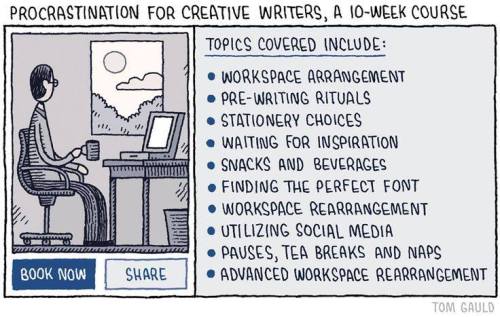
Online or maybe at a retreat near you. We’ll see. The author hasn’t quite decided.
Online or maybe at a retreat near you. We’ll see. The author hasn’t quite decided.
Filed under 2017, CarToonsday
First-year students at the Purdue School of Veterinary Medicine were attending their first anatomy class with a real dead cow. They all gathered around the surgery table with the bovine body covered with a white sheet.
The professor started the class by telling them, “In Veterinary medicine it is necessary to have two important qualities as a doctor. The first is that you not be disgusted by anything involving an animal’s body.” For an example, the professor pulled back the sheet, stuck his finger in the butt of the cow, withdrew it, and stuck his finger in his mouth. “Go ahead and do the same thing,” he told his students.
The students freaked out, hesitated for several minutes, but eventually took turns sticking a finger in the butt of the dead cow and, sucked on it …. followed by assorted gagging, retching and spitting, etc.
When everyone had finished wiping their faces, the Professor looked at them and said, “The second most important quality is observation. I stuck in my middle finger and sucked on my index finger. Now learn to pay attention. Life is tough but it’s even tougher if you’re stupid.”
***
[Editor’s note: while not directly a writing joke, observation is also important to a writer.]
Filed under 2017, Monday morning writing joke
Literary detective Heather Wolfe reveals how her passion for manuscripts helped unravel mystery of who the bard really was
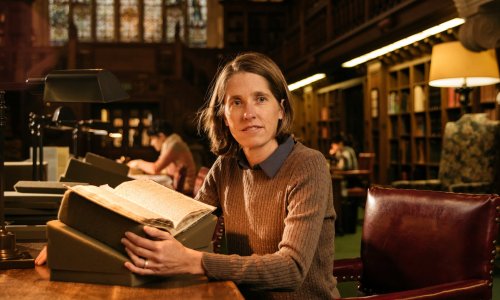
By Robert McCrum
Deep in the Folger Library, in Washington DC, Heather Wolfe says that studying Shakespeare makes an ideal preparation for the onset of Trump’s America. You can see her point: Shakespeare would have revelled in the mad excesses, the sinister vanities and the pervasive stench of cronyism and corruption surrounding the president-elect as America makes the painful transition from Barack Obama.
Dr Wolfe is a willowy, bright-eyed manuscript scholar, a paleographer specialising in Elizabethan England who in certain moods of candour might put you in mind of Portia or perhaps Cordelia. She’s also a Shakespeare detective who, last year, made the career-defining discovery that is going to transform our understanding of Shakespeare’s biography. In the simplest terms, Wolfe delivered the coup de grace to the wild-eyed army of conspiracy theorists, including Vanessa Redgrave and Derek Jacobi, who contest the authenticity, even the existence, of the playwright known to contemporaries as Master Will Shakespeare.
Wolfe is an accidental sleuth. Her scholar’s passion is as much for old manuscripts as for the obscurities surrounding our national poet. Project Dustbunny, for example, one of her initiatives at the Folger Shakespeare Library, has made some extraordinary discoveries based on microscopic fragments of hair and skin accumulated in the crevices and gutters of 17th-century books.
DNA forensics aside, Wolfe’s role as a curator at the Folger is to bring her expertise to bear on the tantalising mass of documents that survives from the late 16th century. And yet, despite a heap of legal, commercial and matrimonial evidence, Shakespeare the man continues to slip through scholars’ fingers. Four centuries after his death, apart from a handful of crabbed signatures, there is not one manuscript, letter or diary we can definitively attribute to the poet, sponsoring the pervasive air of mystery that surrounds his genius. Indeed, the most intimate surviving Shakespeare document remains that notorious will, in which he bequeathed his wife his “second best bed”.
Before Wolfe arrived on the scene, all that scholars could be certain about was that a man named Shaxpere, Shaxberd or Shakespear was born in Stratford in 1564, and that he was an actor whose name is printed in the collected edition of his work published in 1623. We also know that he married Anne Hathaway, and died in 1616, according to legend, on his birthday, St George’s Day. The so-called “Stratfordian” case for Shakespeare rested on these, and a few other facts, but basically, that was it.
Into this vacuum, a bizarre fraternity, including Mark Twain, Charlie Chaplin and Sigmund Freud, have projected a “Shakespeare” written by a more obviously accomplished writer: Edward de Vere (the 17th earl of Oxford), Sir Francis Bacon and the playwright Christopher Marlowe, to name the leading contenders in a field that includes Sir Walter Raleigh, and even Elizabeth, the Virgin Queen herself.
In the absence of reliable data, a mountain of speculation has morphed into the weirdest fantasy, notably the 2011 film, Anonymous. Wolfe has no time for this. Speaking exclusively for the first time to the Observer, she says: “Without the evidence for other contenders, it’s hard for me to engage with this line of inquiry.”
Wolfe’s appetite for manuscript corroboration has led her into many dusty corners of the Elizabethan archives. It was this research instinct that first led her to reopen the file on the coat of arms granted to Shakespeare’s father, the small-town glover, in 1596.
John Shakespeare, from Stratford-upon-Avon, was ambitious to rise in the world. He was certainly not the first Englishman keen to put his origins as a provincial tradesman behind him. Among his contemporaries in Stratford, he was a figure of fun for his social climbing. English class snobbery has a long pedigree. His son, who would continue the quest for official recognition after his father’s death, also attracted metropolitan disdain as “an upstart crow beautified with our feathers”. In 1601, after his father’s death, Shakespeare the upstart returned to the college of arms to renew the family application for a coat of arms. He had made a small fortune in the theatre, and was buying property in and around Stratford. Now he set out to consolidate his reputation as a “Gentleman”. Under the rules that governed life at the court of Elizabeth I, only the Queen’s heralds could grant this wish.
A much-reproduced sketch for a coat of arms crystallised Shakespeare’s hopes for legitimacy in the antique jargon of heraldry: “Gould, on a Bend Sables, a Speare of the first steeled argent. And for his Crest, a falcon, his winges displayed Argent, supporting a Speare Gould …” The needy applicant also attached a motto: Non Sanz Droit (“Not Without Right”). All this, and much more, is buried in the archives of the college of arms in London.
Wolfe’s fascination with Shakespeare’s quest for a family crest grew out of her immersion in the manners and customs of late Elizabethan England, in particular the College of Heralds. These court officials were required to administer the complex rituals governing the lives of the knights, barons and earls surrounding Queen Elizabeth.
An adjunct to the court, the College of Heralds was not exempt from its own secret feuds. In 1602, the internecine rivalry between Sir William Dethick, the Garter King of Arms, and another herald, Ralph Brooke, burst into the open when Brooke released a list of 23 “mean persons” whose applications for crests (he claimed) had been wrongfully preferred by Dethick. When “Shakespeare the Player” found himself on this list, his campaign for social advancement seemed in jeopardy. A bitter row broke out at court between two factions. Shakespeare himself became an object of ridicule. Another rival, Ben Jonson, in his satire Every Man out of his Humour, poked fun at him as a rustic buffoon who pays £30 for a ridiculous coat of arms with the humiliating motto “Not Without Mustard”.
It’s at this point in the story that Wolfe discovered “the smoking gun”. In the Brooke-Dethick feud, it becomes clear that “Shakespeare, Gent. from Stratford” and “Shakespeare the Player” are the same man. In other words, “the man from Stratford” is indeed the playwright. Crucially, in the long-running “authorship” debate, this has been a fiercely contested point. But Wolfe’s research nails any lingering ambiguity in which the Shakespeare deniers can take refuge.
Wolfe is circumspect about making extravagant claims. Speaking carefully, she says that her manuscript discoveries fill in gaps, illuminating Shakespeare’s character. “They point to someone actively involved in defining and defending his legacy in 1602, shortly after his father’s death.”
For Wolfe, it’s Shakespeare the man who breaks cover here. “He’s defending his legacy not only as a playwright but, most importantly to him, as a gentleman.” The derogatory references to arms belonging to “Shakespeare ye player”, she says, show that “he’s playing the same game as everyone else in the period, purchasing land in Stratford to support his case to ‘ancient’ gentility, rather than through his astonishing professional success”.
James Shapiro, bestselling author of 1599, who is persuaded by Wolfe’s discoveries, compares her to “a Sherlock Holmes of the archives”. Shapiro says that Wolfe “has had the intellectual independence to see what others have overlooked, the skills to make sense of what she has stumbled upon and the modesty not to trumpet the larger implications of those finds. But make no mistake: they are enormously consequential.”
For Shapiro, Wolfe’s work suggests future breakthroughs. “I doubt that these are the last archival treasures she will unearth. Her recent finds sharpen our sense of Shakespeare’s dogged pursuit of upward mobility. And it is one more nail in the coffin of those who can’t bring themselves to acknowledge that the glover’s son from Stratford was also the successful man of the theatre who left us so many extraordinary plays.”
Wolfe says she looks forward to “poking about” in the archives, and is convinced that Shakespeare’s identity no longer needs re-confirmation. “There is such a wealth of evidence out there that he’s the playwright.” She adds: “I’m sure there’s more untapped material waiting to be uncovered. Additional finds will certainly help us understand his life – as much as we can understand anyone’s life from 400 years ago.”
Filed under 2017, author tribute, author write up
What should you read when your president-elect is an unrepentant xenophobe who wants to ban Muslims from America? Well, lots of things, of course, but here’s a more pointed suggestion: read m…
Source: 10 Contemporary Novels By and About Muslims You Should Read | Literary Hub

What should you read when your president-elect (now president) is an unrepentant xenophobe who wants to ban Muslims from America? Well, lots of things, of course, but here’s a more pointed suggestion: read more books by and about Muslims, particularly books written in the last ten years. It’s a small way to understand and empathize with a group of your fellow Americans who desperately need the understanding and empathy of their countrymen and women. (Consider giving them as holiday gifts to relatives who voted for Trump.) It is also important, whenever we can, to amplify the voices of the oppressed. (Consider buying them and donating them to schools.) Oh, and another thing? These books are just good. They are good books, and you will enjoy them, all politics aside.

Some rice just can’t make it and had to be let go.
Filed under 2017, photo by David E. Booker, Photo Finish Friday
I am the lost wind /
and an old oak leaf captured /
in a spider’s kiss.

A spider’s kiss

At least the commas and periods were in their right places.
Filed under 2017, cartoon by author, CarToonsday
 An unranked, incomplete, utterly biased list of the greatest works of literature ever published. How many have you read?
Source: 80 Best Books of All Time – The Greatest Books Ever Written
Some of the books on the list:
What We Talk About When We Talk About Love, by Raymond Carver
Collected Stories of John Cheever
Deliverance, by James Dickey
The Grapes of Wrath, by John Steinbeck
Blood Meridian, by Cormac McCarthy
The Brothers Karamazov, by Fyodor Dostoevsky
The Known World, by Edward P. Jones
The Good War, by Studs Terkel
American Pastoral, by Philip Roth
One of the few not about Roth. It’s about that guy you idolized in high school. And gloves. And you.
A Good Man Is Hard to Find and Other Stories, by Flannery O’Connor
“She would of been a good woman… if it had been somebody there to shoot her every minute of her life.” Wouldn’t we all.
The Things They Carried, by Tim O’Brien.
No one else has written so beautifully about human remains hanging from tree branches.
A Sport and a Pastime, by James Salter
Remember your college buddy’s girlfriend, the one you were in love with? Because of her.
The Call of the Wild, by Jack London
A book about dogs is equally a book about men.
Time’s Arrow, by Martin Amis
You’ve never seen the Holocaust from this angle and with this much ferocity. Backwards.
A Sense of Where You Are, by John McPhee
It’s about how two men can be made better just by sharing each other’s company.
Hell’s Angels, by Hunter S. Thompson
Because it’s his first book, and because he got his ass kicked for it, and because in the book and the beating were the seeds of all that came after, including the bullet in the head.
Invisible Man, by Ralph Ellison
Born in an epic fist-fight or forgotten in the sewers, no character is as clearly heard as the man who is never really seen by the world around him.
Dubliners, by James Joyce
Plain and simple: “The Dead”
Rabbit, Run, by John Updike
Because it’s one of the few not about Updike. It’s about that guy you idolized in high school. And kitchen gadgets. And you.
The Postman Always Rings Twice, by James M. Cain
Teaches men about women. Also, there’s not a single postman in the book.
Dog Soldiers, by Robert Stone
Begins in Saigon, ends in Death Valley. Somewhere in between you realize that profit is second only to survival.
Winter’s Bone, by Daniel Woodrell
The best book by a modern-day Twain, high on meth, drousy with whiskey.
Legends of the Fall, by Jim Harrison
Because of revenge. Because Harrison is as masculine and raw and unrelenting as they come.
Under the Volcano, by Malcolm Lowry
A terrifying riderless horse, mescaline, and this line: “Somebody threw a dead dog after him down the ravine.”
The Naked and the Dead, by Norman Mailer
His first book turned out to be his best book. The skulls of young men at war.
The Professional, by W.C. Heinz
It’s about fighting, but it’s also about watching and listening, and it’s about patience, and honing, and craft, and sparseness, and beauty, and crushing, awful defeat.
For Whom the Bell Tolls, by Ernest Hemingway
A lesson in manhood: Even when you’re damned, you press on.
Dispatches, by Michael Herr
“Vietnam Vietnam Vietnam, we’ve all been there.” You’ll never forget that line. You won’t forget what precedes it, either.
Tropic of Cancer, by Henry Miller.
Dirty, grotesque. Beautiful.
Revolutionary Road, by Richard Yates
The thousands of little compromises we make every day that eventually add up to the loss of ourselves.
As I Lay Dying, by William Faulkner
Because the man’s cold brilliance enabled him to make the line “My mother is a fish,” into a chapter in itself.
The Killer Angels, by Michael Shaara
Because the Battle of Gettysburg took place in that blue-gray area between black and white.
Slaughterhouse-Five, by Kurt Vonnegut
A mad hatter of an antiwar novel that understands how a smile, shaped like a sickle, can cut deeply. So it goes.
All the King’s Men, by Robert Penn Warren
Crooked judges, concealed paternity, deception, betrayal, and lots of whiskey.
One Flew Over the Cuckoo’s Nest, by Ken Kesey
Because sometimes you have to go crazy to stay sane.
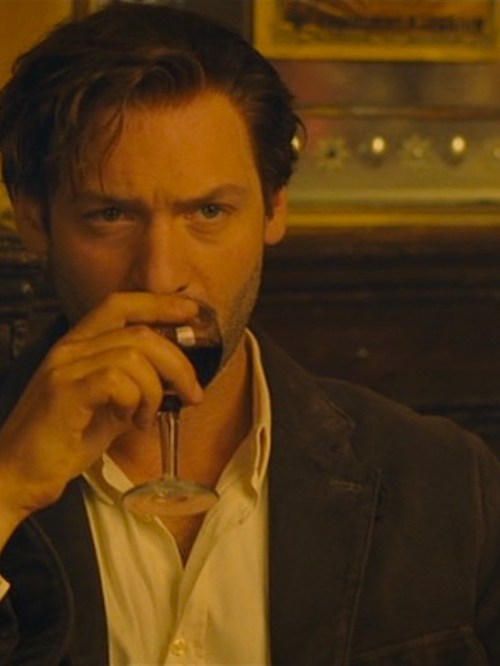
Source: 6 Famous Authors With Shocking Beliefs | Inverse
When we fall in love with a novel, we sometimes believe we come to know its author just by reading the book. From reading the Harry Potter novels one can easily conclude that its author — J.K. Rowling — is intolerant of oppression, politically progressive, a strong believer in diversity, and most certainly, British. All of these things about Rowling are overwhelmingly true, though if we found out she hated children, we’d probably be totally scandalized. (She doesn’t, thankfully).
Similarly, if you read Robert A. Heinlein’s Stranger in a Strange Land you might erroneously assume the author was a free-love hippie, when in fact, Heinlein’s libertarian and conservative views couldn’t be further from the tone of that particular novel. With Robert Heinlein and Stranger in a Strange Land, it’s almost as if the novel’s free-love protagonist offers a mirror image to the novelist — it’s Dr. Jekyll to a Mr. Hyde, say — something that is true of other writers on this list. Here are six super-famous writers with beliefs that are either inversions of their literary reputations, or just straight-up fascinating.
Philip K. Dick Thought He Was a Robot and, Also, the Spirit of Elijah

Okay, so this one isn’t too shocking. In addition to believing he was contacted by intelligences from beyond, the prolific and visionary sci-fi writer Philip K. Dick also toyed with the idea that he may, in fact, have been a robot. While the events of many of his novels (notably Do Androids Dream of Electric Sheep?) certainly check with this passing fancy of Dick’s, he also flirted with the idea that he was possessed by the spirit of the biblical prophet Elijah. So, next time you’re at a Seder, ask if you can leave something out for Philip K. Dick and see if anyone gets it.
Sir Arthur Conan Doyle Believed in Fairies

In Conan Doyle’s short story “The Adventure of the Sussex Vampire” the protagonist — the great Sherlock Holmes — says, “This Agency stands flat-footed upon the ground and there it must remain. The world is big enough for us. No ghost need apply.” Throughout the 56 short stories and four novels chronicling the adventures of Sherlock Holmes, never once does the stoic detective flirt with a belief in the supernatural or paranormal. And yet, late in his life, the creator of the uber-rational Sherlock Holmes, Sir Arthur Conan Doyle himself, asserted frequently that he had seen fairies and other supernatural creatures. Perhaps when Conan Doyle attempted to kill off Sherlock Holmes, he was attempting to destroy his rational side to have more fun with fairy thoughts. Either that, or fairies are totally real.
Anne Rice Found God

The author of Interview With the Vampire briefly became extremely pious, and even authored Christian texts (including her novel Christ the Lord: Out of Egypt). While the steamy and grotesque nature of her vampire books seems to be in stark opposition to traditional Christianity, as of 2010, Anne Rice maintains that she is still “committed to Christ.” But to be clear, Rice did officially leave the Catholic Church because she felt that being a “Christian,” was “quarrelsome” and “hostile.” It’s unclear if there are any parallels between her feelings about quarrelsome religious folks and the frequently quarrelsome vampire, Lestat.
James Joyce Thought Radio Controlled the Weather

In Sylvia Beach’s excellent memoir, Shakespeare and Company, the publisher and proprietor of the famous Parisian bookstore recounts her fascinating dealings with the late author of Ulysses, James Joyce. One interesting tidbit was Joyce’s growing impatience with the rise of radios in culture. Specifically, Joyce thought there was obviously some kind of correlation between the surge of radios use and rainstorms in France. Climate change deniers, take that! Or actually, don’t. Let James Joyce have it.
Hemingway Wanted to Work for the KGB?
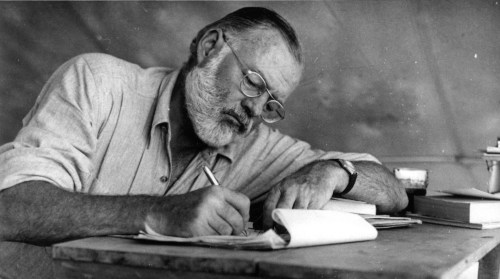
While this one is disputed, there is some indication that Ernest Hemingway was recruited by the KGB in 1941 and that he was a secret agent named “Argo.” The only problem is that apparently Hemingway was really bad at being a double agent — assuming he really wanted to be one — as he never really supplied the KGB with any good intelligence. While we tend to think of Hemingway as an American man of his time (as he’s portrayed in Midnight in Paris), his real-life political leanings were certainly all over the place. While it might be surprising that Hemingway had communist beliefs in the ‘40s, it’s not totally implausible.
Stephen King Hates Adverbs

Stephen King may be the undisputed master of horror, but there’s only one thing truly fears: adverbs. King maintains that adverbs were created with “the timid writer in mind.” He may be an extremely creative guy, but I don’t want to even think about how many grotesque and sickening adverbs I’ve overzealously employed to get my points across throughout the years.

Morning in the neighborhood.
Filed under 2017, photo by David E. Booker, Photo Finish Friday


 Booker's Blog