Monthly Archives: December 2016

Eight Mystery Writers You Should Be Reading Now | Jaden Terrell

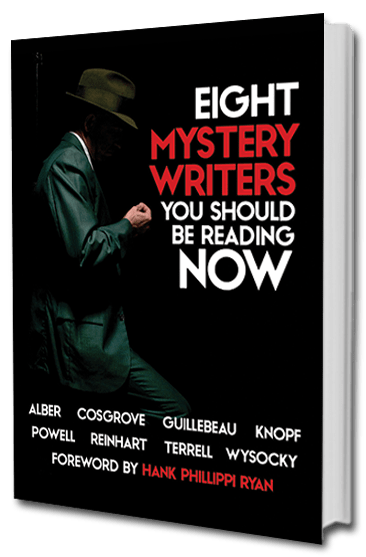
Eight Mystery Writers You Should Be Reading Now – if you don’t know who these mystery writers are, you should.

Source: Eight Mystery Writers You Should Be Reading Now | Jaden Terrell

If you don’t know who these mystery writers are, you’re missing out.

Now you can get it free when you subscribe to my email list.

My part in this book began on Halloween weekend at Killer Nashville 2015, when Michael Guillebeau asked me to be a part of a project he was working on—a sampler of eight mystery writers he admired, each of whom would contribute a short story, an interview, and a sample chapter from one of their novels.

To say I was honored would be an understatement. I’d read Michael’s work, and the guy has some serious writing chops. I mean, the guy can WRITE. Haven’t read him yet? Hie thee to his website and check out his novels right now. Seriously, I’ll wait.

Of course I said yes. And boy, am I glad I did. The other writers Michael lined up are all topnotch, and all a delight to work with. To top it off, bestselling author (and fabulous-in-every-way) Hank Phillippi Ryan came on board to write the introduction. If you don’t already know their work, I hope you’ll find enough in these pages to make you want to learn more.

The book isn’t a five-course meal. It’s more like the appetizer sampler you’d get at a good restaurant. Eight very different flavors. The hope is that you’ll find at least a few you love.

You can get a PDF or mobi copy of it for free by subscribing to my newsletter. The signup form is in the upper right corner of this page.

Since it would be hard to top Michael’s descriptions of the contributors, I’ll let him introduce us:

Lisa Alber – Mystery with a smattering of psychological suspense and tons of atmosphere. Beautifully written, complex stories set in the Irish countryside. Reminiscent of Erin Hart, Julia Spencer-Fleming, and Susan Hill. Rosebud Award and Pushcart Prize Nominee.

Kathleen Cosgrove – Florida weird with a middle-aged woman returning home. Kick-ass funny.

Michael Guillebeau – Broken war hero has to navigate the oddballs and save the girl to get back to the bar he’s been hiding in. Reminiscent of Elmore Leonard and Carl Hiaasen. Silver Falchion Finalist, and Library Journal Mystery Debut of the Month.

Chris Knopf – Hardboiled in the Hamptons. Ex-boxer Sam Acquillo is a noir descendent of Travis McGee and Spencer, and one of my favorite characters. Nero award winner. Chris was featured on my Crimereaders.com blog here.

Jessie Bishop Powell – Cozy noir mysteries that embrace the genre’s extremes. In The Marriage at the Rue Morgue, police suspect an orangutan of murder. Primatologists Noel Rue and Lance Lakeland have to save the ape and still find time to get married. Sounds light, but Powell’s stuff is as intense as it is funny.

Larissa Reinhart – If you like Janet Evanovich’s Stephanie Plum, you need to read Reinhart’s Cherry Tucker. A damaged artist with twice the depth, twice the funny of Plum and set in small-town Georgia. I dare you to put this down. Daphne du Maurier Finalist

Jaden Terrell – A “hardboiled hero with a soft-boiled heart,” Nashville PI Jared McKean has enough emotional issues to carry a book all by himself, and then Terrell throws him into big issues like human trafficking. Shamus Award Finalist.

Lisa Wysocky – Multiple awards for Lisa’s books about a horse trainer with a smart horse who helps her solve crimes. One of the most realistic and loving use of animals in mystery. Winner of American Horse Publication Awards, and the National Indie Excellence Awards.

“It’s easy to find a book. It’s hard to find the book, that new author, who sets your life on fire. That’s why we put this collection together.” – Michael Guillebeau, author of Josh Whoever, Silver Falchion finalist and Library Journal Mystery Debut of the Month

3 Comments

Filed under 2016, mystery

Ann Patchett’s Guide for Bookstore Lovers – The New York Times

The pilgrims have been coming to Nashville for as long as the Grand Ole Opry has been on the radio. They come for Fan Fair and Taylor Swift concerts or just to walk down Lower Broad in cowboy boots. Parents visit their children in college. Conventioneers deplane by the thousands. Nashville is a hip city now, with a food scene, an art scene and two poorly performing professional sports teams.

With all the reasons to travel to Nashville, one might be surprised to learn that some people come just to see a small independent bookstore. It’s true. The Book Faithful journey to Music City because they still like their novels printed on paper. They come because they’ve heard about the shop dogs, or because someone told them years ago that bookstores were moving onto the endangered species list and they wanted to see one that was thriving in its natural habitat: in a strip mall, behind Fox’s Donut Den, beside Sherwin-Williams Paint Store. Some come in hopes of seeing a favorite author read, or catching a glimpse of the author who co-owns the store.

That would be me.

Karen Hayes and I opened Parnassus Books in November 2011. This summer, when Pickles and Ice Cream Maternity went out of business, we took down the adjoining wall and doubled our space. Business is good, which, by bookstore standards, means we spring for employee health insurance and pay the rent.

Karen and I are vocal supporters of the Shop Local movement, while at the same time benefiting from the Destination Bookstore travelers. It seems as if every time I’m in the back room signing special orders or meeting with staffers to pick a book for our First Editions Club, Bill, the tall Englishman who works the front, comes to tell me a book club has just arrived from Omaha or Bangor or Sweden. I go out and pose for group pictures, recommend books, give an impromptu tour. I always ask the same question, “What made you think I’d be here?” because seriously, I’m gone a lot. They always give me the same answer: I’m not why they came. They came to see the store.

With its high wooden shelves and rolling ladders and dangling stars, Parnassus is — if I may say so myself — worth a visit, a reminder that a strip mall need not be judged by its parking lot. But there are many bookstores that could stand as the centerpiece of a vacation. Here are some categories to consider when searching for one.

Children’s Books

Before we opened Parnassus, I made a fact-finding tour of American bookstores. The best advice I got was this: If you want customers, you have to raise them yourself. That means a strong children’s section. If e-books have taken a bite out of the adult market, they’ve done very little damage to children’s books, maybe because even the most tech-savvy parents understand that reading “Goodnight Moon” off your phone doesn’t create the same occasion for bonding.

There are some knockout stores that sell nothing but children’s books, including the Curious George Store in Cambridge, Mass., Wild Rumpus in Minneapolis, Books of Wonder in New York, and Tree House Books in Ashland, Ore., as well as loads of general interest stores that do a particularly great job with their children’s section, like Women & Children First in Chicago and Greenlight Bookstore in Brooklyn.

For many of us, children’s books are the foundation of bookselling, the cornerstone, the rock on which this church is built.

Before going, be sure to check the bookstores’ events calendars for visiting authors. If I may make a sweeping generalization, children’s book authors — from those who write board books suitable for teething to those who write young adult fiction full of vampires and angst — are the nicest people on the planet. Not only will they talk to your child or young adult, they will relate to them, they will draw pictures for them, they will create an indelible link between reading and joy.

The Destination Stores

I’m not sure why you’d be going to Greenwood, Miss., except for a mad desire to see TurnRow Book Company. It’s one of the most beautiful bookstores I know, and the sheer unlikelihood of its presence makes a traveler feel she’s stumbled into an oasis in the Mississippi Delta. Thanks to the Viking Range plant, the town also has a few top-notch restaurants and a very pretty inn, but the bookstore is the reason to go.

And since you’re in Greenwood, you’ve got to go to Oxford, a town defined by its writers. You can visit Faulkner’s home as well as the bookstore, or make that bookstores. Richard Howorth, the former mayor of Oxford, has three locations on the downtown square: the original Square Books; Square Books, Jr., the children’s store; and Off Square, which sells discount books and provides space for author events. Despite the enormity of Ole Miss, these three stores are the backbone of Oxford.

When was the last time you strolled around downtown Los Angeles near Skid Row? Never? I’m from Los Angeles and it took the Last Bookstore to get me there. The store’s tagline, “What are you waiting for? We won’t be here forever,” has a suitably apocalyptic ring to it, but the place is so monumental that it’s hard to imagine it going anywhere: 22,000 square feet on three floors with new and used books, vinyl records and gallery space. The whole thing appears to have been made out of books, books that are folded and fanned and stacked into towering sculptures. The clientele is as eclectic and fascinating as the reading selection. It did my heart good to see so many tattooed kids with black nail polish and nose rings sprawled out in chairs reading books.

As long as you’re going to places you never thought you’d go, head to Plainville, Mass., to see An Unlikely Story Bookstore & Café, which I hope will soon replace Disney World as the place all parents feel duty-bound to take their children. Jeff Kinney took part of the proceeds from his juggernaut series “Diary of a Wimpy Kid” and built his hometown a four-story bookstore — the ultimate fulfillment of literary civic duty. The building contains a dazzling bookshop, event space and cafe, and the top floor will soon be a Wimpy Kid museum, complete with movie props and the model for the Wimpy Kid Macy’s Thanksgiving Day parade balloon. (How do you know that your character is reaching the heights of Snoopy? You get your own parade balloon.)

The Tiny Stores

I’m a sucker for a little bookstore. In the right hands, the limited space can set off an explosion of personality and innovation. It’s like going to a French bistro with five tables and five things on the menu: You discover they’re exactly the right five things. New York City, land of skyrocketing rents and ubiquitous nail salons, has some of the best tiny bookstores in the world, including the Corner Bookstore, 192 Books and my favorite, Three Lives & Company. Sometimes what’s lost in square footage is made up for by a brilliant staff, or maybe it’s just that the people who work in tiny stores really do know exactly where every book is located. And they’ve read them. Little bookstores give off that same warm, snug feeling one gets from reading a novel in a comfy chair. Go look at the light in Newtonville Books outside Boston, or drive down the cape to Provincetown Bookshop, that essential last stop before hitting the beach. The novelist Louise Erdrich owns the tiny Birchbark Books in Minneapolis, a store that uses a chunk of its limited space to display an elaborately carved confessional box. You’ll wish every bookstore had one.

The Venerables

In Washington you see the Vietnam Memorial, the new National Museum of African American History & Culture and Politics & Prose Bookstore. It’s where the Obamas shop, and it’s where the movers and shakers of our nation’s capital come to see what’s really going on. It also happens to be where I eat lunch, as they have the best bookstore cafe I know.

Doesn’t everyone who visits Harvard go across the street to the Harvard Book Store, a shop as esteemed as the university? When you’re finished there (it will take all day), walk down Plympton Street to Grolier Poetry Book Shop. In Cambridge a store that sells nothing but poetry seems indispensable.

But if you’re interested in Grolier’s aesthetic opposite, go to the fabulous Books & Books. It’s everything I love about Miami without any of the things I don’t love about Miami, a store where books are elevated to new heights of gorgeousness. Just walking in the door of either the Coral Gables or South Beach location makes me feel like an automatic hipster, a book hipster. I always leave with armloads of art books and travel books, things I never knew I needed but I do need desperately.

And then, of course, there’s Powell’s: an entire block, a dizzying, self-proclaimed City of Books. The fact that Portland, Ore., celebrates being defined by its independent bookstore is really all you need to know about Portland.
The Personals

I went on my first book tour in 1992 when I was 28, and I have been going on book tours ever since. I have made it a point to go to bookstores in every town I’ve ever driven through. I go both as a writer and a reader, for business and for pleasure, and I have been in love with too many to make a comprehensive list here. Still, I have to call out some of my favorites, like Boswell Book Company in Milwaukee, lit by the internal fire of one Daniel Goldin, a stupendously great bookseller. And since you’re in Milwaukee, you won’t be that far from McLean & Eakin Booksellers in Petoskey, Mich., a personal favorite that proves Northern Michigan has a lot more to offer than cherries and apples. Malaprop’s was the heart and soul of Asheville, N.C., when Asheville was a sleepy little hippie town, and it’s still its heart and soul now that the city is cool and overcrowded, a position Malaprop’s maintained by being unabashedly true to itself.

No bookstore ever made a strip mall look better than Book Passage in Corte Madera, Calif. Every author you could hope to see comes to read at Book Passage.

And then there’s Explore Booksellers in Aspen, Colo., a town that’s gotten so expensive that the bookstore would have to sell Chanel bags alongside Michael Chabon novels in order to make the rent, so a group of people got together and bought it so that the town could have a bookstore

All these bookstores will welcome you, as will those I failed to mention. They’re delicate little ecosystems based on a passion for books and a belief in community. They’re here for you, but they need your attention and support to thrive.

Of course we’d love to see you at Parnassus. The shop dogs are lazy. They pile up in the office and sleep beneath the desks, but if you ask, we’ll wake them up and send them out on the floor. When you’ve gotten your recommendations from our brilliant staff, and listened to story time in the children’s section, and seen a couple of authors (and country music stars) shopping themselves, we’ll give you advice on where to go to dinner and hear music. Or maybe you just want to sit in a quiet chair and read your new book. Go ahead, that’s what we’re here for.

Ann Patchett’s most recent novel is “Commonwealth.”

Leave a comment

Filed under 2016, bookstore

Haiku to you Thursday: “Nip”

The nip of winter /

a small feral animal /

happy to see you.

Leave a comment

Filed under 2016, Haiku to You Thursday, poetry by author

‘It’s All One Case’ is a revealing look at detective master Ross Macdonald – The Washington Post

The sprawling book includes previously unpublished interviews and hundreds of photos.

Source: ‘It’s All One Case’ is a revealing look at detective master Ross Macdonald – The Washington Post

“It’s All One Case” is a book that any devotee of American detective fiction would kill for. For fans of Ross Macdonald, the finest American detective novelist of the 1950s and ’60s, it’s an absolute essential.

First off, this huge album contains the transcript of 47 hours of talk between Kenneth Millar — Macdonald’s real name — and Rolling Stone reporter Paul Nelson. The conversations, which took place in 1976, were intended for an article that never got written. Soon after the interviews were over, Millar began to exhibit symptoms of Alzheimer’s disease and would never write another book. He died in 1983. Nelson’s life would gradually just fall apart. He died in 2006.

Largely because of Kevin Avery’s devotion and hard work this major work of mystery scholarship has finally appeared in print.

Yet there’s still another reason to covet this book — its pictures, hundreds of them. Virtually every page shows off Jeff Wong’s awe-inspiring collection of material relating to Millar.

Here one can see every Ross Macdonald novel in every hardcover and paperback edition and seemingly all the periodicals — from Ellery Queen’s Mystery Magazine to Cosmopolitan and Gallery — in which Millar published a story or article; reproductions of the writer’s handwritten letters, spiral notebooks and typed manuscripts; pages from Knopf galleys; and even VHS tapes and DVDs of the movies and TV series based on private eye Lew Archer.

In addition, “It’s All One Case” includes dozens of photographs of Millar, as a boy in Canada, at his longtime home in Santa Barbara, and with his wife, the comparably gifted mystery writer Margaret Millar (whose works Soho Press has recently reissued in several omnibus volumes).

Nearly all Lew Archer’s cases — “The Zebra-Striped Hearse ,” “The Chill ” and a half dozen others — deal, more or less, with the sins of an earlier generation wreaking havoc in the present. In the interviews here, Millar admits that he consciously worked and reworked variations on this theme because of its personal relevance: His father walked out on his mother when he wasn’t quite 4, and little Ken grew up being shunted among various relatives, so much so that he had lived in 50 different houses or apartments by the time he was 16.

At an early age, Millar decided to become a writer. He tells Nelson that important influences included Poe and Twain but that F. Scott Fitzgerald’s “The Great Gatsby” was, for him, “the central novel of the century.” He reveres Dashiell Hammett’s “The Maltese Falcon” and deeply admires the early work of James M. Cain: “Nothing has ever been done in its field better than ‘Double Indemnity.’ ” Among favorite contemporary writers, Millar names Nabokov, “who doesn’t really make mistakes.” He regards Dostoevsky “as probably the greatest of all fiction writers.”

To write his detective novels, Millar says he spends months scribbling plot details in notebooks and that he deliberately uses symbolic imagery as a structural element. His books are, consequently, both complicated and precisely engineered: “I don’t aim at simplicity.” He also stresses that it’s “the stories of the other people” — Archer’s clients rather than the detective himself — “that really interest me more. Archer is just a means of getting to them and showing them as they are.” Indeed, some of his books, he would argue, “are tragedy or at least aim at it.”

Nonetheless, Millar explains, “I don’t start out with a character. I start out with an idea, which is generally a moral situation. . . . The characters are just notations which together form the book. They do represent energies of course, various kinds of imaginative energy going in different directions, and all that has to be orchestrated and unified. That’s what really is so difficult: to get it all in a proper balance so that each of these energies represented by the twenty or so characters in a book gets its proper place, its proper presentation, and its final place in the structure.” He emphasizes that structure is “the one thing I can do better than my competition, so I spend a lot of time on it.”

Clearly Millar, who earned a Ph.D in English from the University of Michigan, isn’t your average pulp mystery hack. Instead his books honor the hard-boiled tradition, even as they complicate and slightly soften it. These days, however, I suspect that Millar’s novels —despite being reprinted in the Library of America — have fallen into literary limbo, remembered but not much read. Yet his mysteries still pack a wallop, as I discovered when, after many years, I again picked up my copy of “The Galton Case.” From the start, Archer’s voice exhibits the laconic factuality and low-keyed wit we associate with Hammett and Raymond Chandler:

“The law offices of Wellesley and Sable were over a savings bank on the main street of Santa Teresa. Their private elevator lifted you from a bare little lobby into an atmosphere of elegant simplicity. It created the impression that after years of struggle you were rising effortlessly to your natural level, one of the chosen.”

As Millar talks about his life and work in “It’s All One Case,” he does repeat some of the same points again and again. Nonetheless, he absolutely refuses to discuss his daughter Linda, who accidentally killed a young boy when driving drunk at the age of 16 and later died at 31. While Millar admits that his fiction is replete with troubled adolescents, he contends that any personal or autobiographical material has been sublimated, shaped and refracted. He is an artist, after all, and that’s what artists do.

Michael Dirda reviews books on Thursdays in Style.

Leave a comment

Filed under 2016, author tribute

17 Science Fiction Books That Forever Changed The Genre | Lifehacker Australia

Source: 17 Science Fiction Books That Forever Changed The Genre | Lifehacker Australia

Speculative fiction is the literature of change and discovery. But every now and then, a book comes along that changes the rules of science fiction for everybody. Certain great books inspire scores of authors to create something new. Here are 21 of the most influential science fiction and fantasy books.

These are books which clearly inspired a generation of authors, and made a huge splash either in publishing success or critical acclaim. Or both. And these are in no particular order.

#1 The Hitchhiker’s Guide to the Galaxy by Douglas Adams (1979)

The first (maybe only) science-fiction-comedy-multimedia phenomenon, Hitchhiker’s was a radio drama before it was a book, and the book sold 250,000 copies in its first three months.The Guardian named it one of the 1000 novels everyone must read, and a BBC poll ranked it fourth, out of 200, in their Big Read poll.

Ted Gioia comments on Adams’ hilarious book about the trials and tribulations of Arthur Dent, the survivor of a destroyed Earth, across the universe:

“No book better epitomizes the post-heroic tone of sci-fi than Douglas Adams’ The Hitchhiker’s Guide to the Galaxy. As the name indicates, a certain louche bohemianism permeates its pages. This is star-hopping on the cheap, pursued by those aiming not to conquer the universe, but merely sample its richeson fewer than thirty Altairian dollars per day. You can trace the lineage of many later science fictions books, with their hip and irreverent tone, back to this influential and much beloved predecessor.”

#2 20,000 Leagues Under the Sea by Jules Verne (1870)

Verne’s whole career is full of works that have inspired generations of authors — but this tale of the underwater adventure of Captain Nemo and the Nautilus has also had a profound effect on science, and inspired real scientific advancement.

In the introduction to William Butcher’s book Verne’s Journey to the Centre of the Self Ray Bradbury wrote that, “We are all, in one way, children of Jules Verne. His name never stops. At aerospace or NASA gatherings, Verne is the verb that moves us to space.”

Verne translator and scholar F.P. Walter added:

“For many, then, this book has been a source of fascination, surely one of the most influential novels ever written, an inspiration for such scientists and discoverers as engineer Simon Lake, oceanographer William Beebe, polar traveller Sir Ernest Shackleton. Likewise Dr. Robert D. Ballard, finder of the sunken Titanic, confesses that this was his favourite book as a teenager, and Cousteau himself, most renowned of marine explorers, called it his shipboard bible.”

#3 Dhalgren by Samuel R. Delaney (1975)

Sam Anderson prefaced his interview with Samuel R. Delany with this praise for Dhalgren’s impact:

“In the 35 years since its publication, Dhalgren has been adored and reviled with roughly equal vigour. It has been cited as the downfall of science fiction (Philip K. Dick once called it “the worst trash I’ve ever read”), turned into a rock opera, dropped by its publisher, and reissued by others. These days, it seems to have settled into the groove of a cult classic. In a foreword in the current edition, William Gibson describes the book as “a literary singularity” and Jonathan Lethem called it “the secret masterpiece, the city-book-labyrinth that has swallowed astonished readers alive.”

Dhalgren has remained popular through the years, being reprinted 7 times since 1975. It was also dropped by Bantam, the original publisher, because of its willingness to tackle LGBT themes despite the fact that the Bantam version sold over a million copies and went through 19 printings.

#4 War of the Worlds by H.G. Wells (1898)

In his book about The War of the Worlds, a seminal look at an invasion of Earth by Martians, author Brian Holmsten states:

“Since 1898 the War of the Worlds has been translated into countless languages, adapted by comic books, radio, film, stage, and even computer games, and has inspired a wide range of alien invasion tales in every medium. Few ideas have captured the imagination of so many people all over the world in the last century so well.

“It is a tribute to H.G. Wells that his story of alien conquest was not only the first of its kind, but remains one of the best.”

The 1927 American reprint, it can be argued, was one of the touching-off points for the Golden Age of science fiction. It inspired John W. Campbell to write and commission invasion stories — which also prompted authors like Arthur C. Clarke, Clifford Simak, Robert A. Heinlein and John Wyndham to do the same.

#5 Foundation by Isaac Asimov (1951)

Foundation is a sweeping tale of pyschohistory and the battle for the intellectual soul of a civilisation. and According to the BBC:

“The Foundation series helped to launch the careers of three notable science fiction authors of the succeeding generation. Janet Asimov sanctioned these novels, which were published in the late 1990s: Foundation’s Fear by Gregory Benford, Foundation and Chaos by Greg Bear, and Foundation’s Triumph by David Brin.” And without a doubt it launched the imaginations of countless other writers.”

It is also worth mentioning that the Foundation series won the 1966 Hugo for best all-time series. An award that has not been given out since.

And this book’s influence goes beyond science fiction: Artificial intelligence pioneer Marvin Minsky classified Asimov “among the finest of modern philosophers,” and Nobel-prize-winning economist Paul Krugman describesFoundation as his version of Atlas Shrugged, “I didn’t grow up wanting to be a square-jawed individualist or join a heroic quest; I grew up wanting to be Hari Seldon, using my understanding of the mathematics of human behaviour to save civilisation.”

#6 Stranger in a Strange Land by Robert Heinlein (1961)

The first science-fiction work to enter the New York Times Book Review’s bestseller list, Stranger sold 100,000 copies in hardcover and over five million in paperback. This book’s influence can’t be overstated. Arthur D. Hlavaty refers to Heinlein as a prototypical science-fiction author, saying:

“One of the ways human beings organise the world is by prototypes. We define a set as a typical example and a bunch of other things that are like it. For instance, when I was growing up, the prototype Writer was Shakespeare, the Artist was Rembrandt, and the Composer was Beethoven. In that way, Robert A. Heinlein has often been taken as the prototype Science Fiction Writer, and as changes and new paradigms shake the field, he still sometimes represents the science fiction of the past.”

Writer Ted Gioia looks at Stranger in a Strange Land’s main character as a prototype for other similar characters in SF, saying: “Smith is more than a character. He is prototype of an alternative personality structure. The question of whether we can remake the human personality from the ground up.”

#7 Dangerous Visions, edited by Harlan Ellison (1967)

This series helped launch the careers of almost every major author of the New Wave. The first volume included Samuel R. Delany, Philip K. Dick, and J.G. Ballard. In his introduction to the 2002 reissue of Ellison’s anthology, contributor Michael Moorcock wrote of Ellison’s collections:

“He changed our world forever. And ironically, it is usually the mark of a world so fundamentally altered — be it by Stokely Carmichael or Martin Luther King Jr. or Lyndon Johnson, or Kate Millet — that nobody remembers what it was like before things got better. That’s the real measure of Ellison’s success.”

“Gonna Roll the Bones” by Fritz Leiber won a Hugo Award and a Nebula Award for Best novelette. “Riders of the Purple Wage” a novella by Philip José Farmer tied for the Hugo Award. Samuel R. Delany got the Nebula for Best Short Story for “Aye, and Gomorrah…” Ellison was given a commendation at the 26th World SF Convention for editing “the most significant and controversial SF book” published in 1967.

#8 Childhood’s End by Arthur C. Clarke (1953)

Arthur C. Clarke himself had reservations about this novel, yet it sold out its first printing, 200,000 copies, in just two months after publication. Author Jo Walton writes about the first book to feature benevolent aliens who try to help the human race evolve:

“Science fiction is a very broad genre, with lots of room for lots of kinds of stories, stories that go all over the place and do all kinds of things. One of the reasons for that is that early on there got to be a lot of wiggle room.

“Childhood’s End was one of those things that expanded the genre early and helped make it more open-ended and open to possibility.

“Clarke was an engineer and he was a solidly scientific writer, but he wasn’t a Campbellian writer. He brought his different experiences to his work, and the field is better for it.”

Childhood’s End was nominated for a retro Hugo award in 2004.

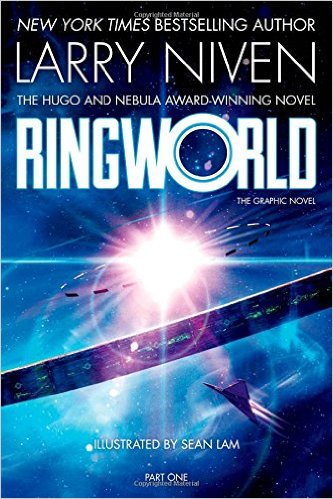
#9 Ringworld by Larry Niven (1970)

Sam Jordison of the Guardian had this to say about Ringworld, the masterpiece that is centered around around a theoretical ring-shaped space-habitat:

“Larry Niven’s 1970 Hugo award winner, Ringworld, is arguably one of the most influential science fiction novels of the past 50 years. As well as having had a huge impact on nearly all subsequent space operas (Iain M Banks’ Culture series and Alastair Reynolds’ House of Suns are just two), the book has helped generate a multi-billion-dollar industry.”

To add to this Jonathan Cowie, who wrote Essetial SF: A Concise Guide, called Ringworld “a landmark novel of planetary engineering (for want of a better term) that ranks alongside the late Bob Shaw’s Orbitsville.”

Niven later added four sequels and four prequels which tie into numerous other books set in Known Space; the fictional setting of about a dozen science fiction novels and several collections of short stories.

The other books are listed and discussed at: http://www.lifehacker.com.au/2016/09/17-science-fiction-books-that-forever-changed-the-genre/

Leave a comment

Filed under 2016, book list

Haiku to you Thursday: “Pain”

Pain is a song /

whose melody is as true /

as its words are inadequate.

[Editor’s note: a modified haiku structure, varying a little from the 5 syllable, 7 syllable, 5 syllable structure. Still, I believe it carries the spirit of a haiku.]

Leave a comment

Filed under 2016, Haiku to You Thursday, poetry by author