Monthly Archives: December 2016

The 27 Best Books on Writing

Writing is hard, and defining yourself as a writer can be even harder. Here’s our exhaustive list of the best books on writing when the blank page beckons.

Source: The 27 Best Books on Writing

Writing is, as a general rule, hard. Defining yourself as a writer can be even harder. Sure, there are other difficult practices like law and medicine out there, but a person becomes a lawyer or a doctor when he or she passes a series of exams and graduates from a certain school. Writing doesn’t always work that way. There aren’t tests to study for and facts to memorize. Where are we supposed to learn how to write?

From grammar rules to publishing advice to personal narratives, these books on writing reveal in intimate detail the ins and outs of what it means to call yourself a writer. Sometimes harsh, sometimes funny, but always honest, they can be thought of as a kind of syllabus for writing. Whether you’re an aspiring artist working on your first drafts or a seasoned veteran in the publishing world, these are some of the best books on writing with insight and wisdom that can support you at all stages of your writing process.

Books listed include:

The Forest for the Trees (Revised and Updated)
An Editor’s Advice to Writers

by Betsy Lerner
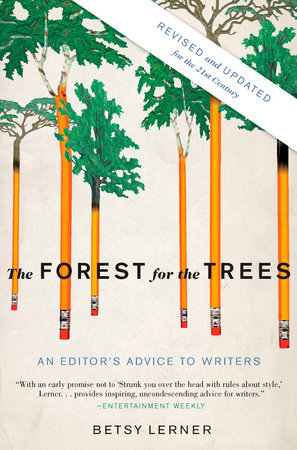
For both established and prospective authors alike, the publishing house can seem like a jungle. Luckily, Betsy Lerner is here to lead a safari, citing her vast collection of experiences as an editor as her field guide. The Forest for the Trees motivates writers by helping them get over their fear of the unknown. It’s less about taming the wilderness and more about facing the demons of self-doubt and sloth that live in every person’s own mind.

***

The Elements of Style Illustrated

by Strunk, White, Kalman
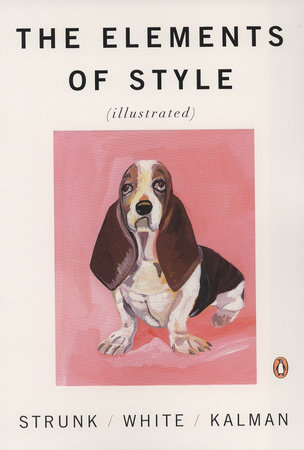
William Strunk and E.B. White’s The Elements of Style is so widely known that we’re sure you already have a copy, but of course we had to mention it. The only style guide to ever appear on a bestseller list, this book should be your go-to if your writing is in need of an infusion of clarity. Plus, this particular edition is illustrated by Maira Kalman, adding a visual element of style to the classic.

***

Story Engineering

by Larry Brooks

Larry Books turns a technical eye to the writing process in Story Engineering. If you don’t properly plan out your story prior to setting pen to paper, he argues, your storytelling won’t be as effective as you’d like it to be. To remedy this, he takes readers through six core elements of storytelling: concept, character, theme, story structure, scene construction, and voice.

***

Naked, Drunk, and Writing
Shed Your Inhibitions and Craft a Compelling Memoir or Personal Essay

by Adair Lara

Adair Lara’s Naked, Drunk, and Writing is a must-read for any memoirist or personal essayist. With experience as a teacher, editor, and, of course, writer, Lara’s know-how will help readers through problems like how to face your family after they’ve read your work and how to find an agent who will fight for you. The perfect mix of tough love, comic relief, and passion, Lara’s book is invaluable for anyone who needs a little help telling their story.

***

How to Write a Damn Good Novel

by James N. Frey

James N. Frey’s overarching guide will be of use to both the novice and the seasoned, published writer. He provides advice for how to overcome writer’s block and fear of the blank page, how to turn a critical eye to your own writing, and more. Frey’s book is one to keep within arm’s reach while writing, to grab during those moments when you need to take a step back from your work and get back to basics.

***

On Moral Fiction

by John Gardner

Morality and art have a complicated relationship, but John Gardner faces it fearlessly in this book-length essay. By Gardner’s way of thinking, all real art is moral, but morality doesn’t necessarily have to do with codes of conduct and submission to a Higher Power; it is the ability of art to point to some human value. The harsh lines he draws to distinguish “art” from “not art,” may frustrate some, but even in that case, this book’s ideas stick in the reader’s head.

***

On Writing

by Stephen King

If you’ve ever read a book by renowned American horror novelist Stephen King, you’ve probably wondered just how he comes up with his ideas. For the answer, look no further than On Writing, King’s memoir where he describes his writing process, including anecdotes about how he started some of his most iconic stories. In addition to recounting his personal experiences, he dedicates a whole chapter to grammar and offers his advice on form. It’s a great read for anyone in need of inspiration, and how better to make you pay attention than Mr. King?

***

The Writer’s Journey

by Christopher Vogler

Movie lovers will appreciate this book from Christopher Vogler. He exemplifies his writing tips with movies, a practice that makes this instructional especially helpful for screenwriters. Having received praise from writers and directors such as Darren Aronofsky (Black Swan) and Bruce Joel Rubin (Ghost), The Writer’s Journey can boast its status as an essential to anyone looking to write the next Oscar nominated film. It’s also an excellent field guide for a novelist stuck in a plot maze and desperate to get out.

***

A Poetry Handbook

by Mary Oliver

Imagine if you could get help with the very basics of writing poetry from a Pulitzer Prize-winning poet? Fact is, you can via Mary Oliver’s book A Poetry Handbook. The handbook is written in a way that makes it a perfect resource for both teens and adults as they start on their poetry journey – and is a useful refresher for veteran poets as well.

***

For the full list, with brief descriptions and links to buy them, go to http://www.signature-reads.com/2016/10/the-27-best-books-on-writing/?ref=PRH6E5971A08F&aid=randohouseinc31159-20&linkid=PRH6E5971A08F

Leave a comment

Filed under 2016, advice

Photo finish Friday: “Bone up”

A bone to pick.

A bone to pick.

Some people said their hearts weren’t in this Christmas season. Other said they could not stomach all the commercialism. Maybe what they really meant was they didn’t have the backbone necessary to deal with bickering relatives and pushy strangers. Maybe what they actually needed was a vertebrae or two or three under their Christmas trees.

Leave a comment

Filed under 2016, photo by David E. Booker, Photo Finish Friday

Haiku to you Thursday: “Winter kindness”

Winter’s kindness /

begets Spring’s regret and leaves /

darkness for my love.

Leave a comment

Filed under 2016, Haiku to You Thursday, poetry by author

Watch a Book Being Made the Old-Fashioned Way | Atlas Obscura

Slowly, and by hand.

Source: Watch a Book Being Made the Old-Fashioned Way | Atlas Obscura

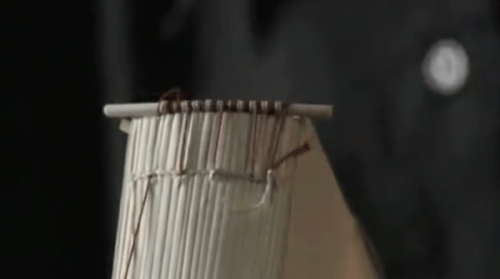
Books were once made by hand, one by one, with patience and perfection. In this video, you can watch each step of the process—from the setting of the type, to the application of ink, to the impression onto paper, to the folding, cutting, hammering, sewing, binding, clamping, and trimming. And all of this is still after metal type was invented, replacing painstakingly handwritten script.

Bookmaking, though it now enjoys newer and faster forms technology, is still an art. And though these days, books are much easier to make and acquire, we still think that they are objects of great value. Perhaps we’re biased, since we just finished making our own book, Atlas Obscura: An Explorer’s Guide to the World’s Hidden Wonders. And though we may not have sewn the binding ourselves, it sometimes feels as though we might have.

Let us never forget that books are treasures.

Leave a comment

Filed under 2016, books

Isaac Asimov: How to Never Run Out of Ideas Again – Personal Growth – Medium

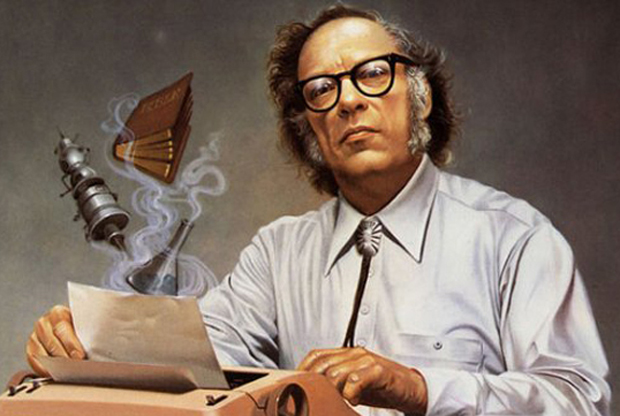
If there’s one word to describe Isaac Asimov, it’s “prolific”.

Source: Isaac Asimov: How to Never Run Out of Ideas Again – Personal Growth – Medium

by Charles Chu

If there’s one word to describe Isaac Asimov, it’s “prolific.”
To match the number of novels, letters, essays and other scribblings Asimov produced in his lifetime, you would have to write a full-length novel every two weeks for 25 years.

Why was Asimov able to have so many good ideas when the rest of us seem to only have 1 or 2 in a lifetime? To find out, I looked into Asimov’s autobiography, It’s Been a Good Life.

Asimov wasn’t born writing 8 hours a day 7 days a week. He tore up pages, he got frustrated and he failed over and over and over again. In his autobiography, Asimov shares the tactics and strategies he developed to never run out of ideas again.

Let’s steal everything we can.
________________________________________
1. Never Stop Learning
Asimov wasn’t just a science fiction writer. He had a PhD in chemistry from Columbia. He wrote on physics. He wrote on ancient history. Hell, he even wrote a book on the Bible.

Why was he able to write so widely in an age of myopic specialization?
Unlike modern day “professionals”, Asimov’s learning didn’t end with a degree—

“I couldn’t possibly write the variety of books I manage to do out of the knowledge I had gained in school alone. I had to keep a program of self-education in process. My library of reference books grew and I found I had to sweat over them in my constant fear that I might misunderstand a point that to someone knowledgeable in the subject would be a ludicrously simple one.”

To have good ideas, we need to consume good ideas too. The diploma isn’t the end. If anything, it’s the beginning.

Growing up, Asimov read everything —
“All this incredibly miscellaneous reading, the result of lack of guidance, left its indelible mark. My interest was aroused in twenty different directions and all those interests remained. I have written books on mythology, on the Bible, on Shakespeare, on history, on science, and so on.”
Read widely. Follow your curiosity. Never stop investing in yourself.
________________________________________
2. Don’t Fight the Stuck
It’s refreshing to know that, like myself, Asimov often got stuck —
Frequently, when I am at work on a science-fiction novel, I find myself heartily sick of it and unable to write another word.

Getting stuck is normal. It’s what happens next, our reaction, that separates the professional from the amateur.

Asimov didn’t let getting stuck stop him. Over the years, he developed a strategy…

I don’t stare at blank sheets of paper. I don’t spend days and nights cudgeling a head that is empty of ideas. Instead, I simply leave the novel and go on to any of the dozen other projects that are on tap. I write an editorial, or an essay, or a short story, or work on one of my nonfiction books. By the time I’ve grown tired of these things, my mind has been able to do its proper work and fill up again. I return to my novel and find myself able to write easily once more.

When writing this article, I got so frustrated that I dropped it and worked on other projects for 2 weeks. Now that I’ve created space, everything feels much, much easier.

The brain works in mysterious ways. By stepping aside, finding other projects and actively ignoring something, our subconscious creates space for ideas to grow.
________________________________________
3. Beware the Resistance
All creatives — be they entrepreneurs, writers or artists — know the fear of giving shape to ideas. Once we bring something into the world, it’s forever naked to rejection and criticism by millions of angry eyes.

Sometimes, after publishing an article, I am so afraid that I will actively avoid all comments and email correspondence…

This fear is the creative’s greatest enemy. In the The War of Art, Steven Pressfield gives the fear a name.

He calls it Resistance.

Asimov knows the Resistance too —
The ordinary writer is bound to be assailed by insecurities as he writes. Is the sentence he has just created a sensible one? Is it expressed as well as it might be? Would it sound better if it were written differently? The ordinary writer is therefore always revising, always chopping and changing, always trying on different ways of expressing himself, and, for all I know, never being entirely satisfied.

Self-doubt is the mind-killer.

I am a relentless editor. I’ve probably tweaked and re-tweaked this article a dozen times. It still looks like shit. But I must stop now, or I’ll never publish at all.

The fear of rejection makes us into “perfectionists”. But that perfectionism is just a shell. We draw into it when times are hard. It gives us safety… The safety of a lie.

The truth is, all of us have ideas. Little seeds of creativity waft in through the windowsills of the mind. The difference between Asimov and the rest of us is that we reject our ideas before giving them a chance.

After all, never having ideas means never having to fail.
________________________________________
4. Lower Your Standards
Asimov was fully against the pursuit of perfectionism. Trying to get everything right the first time, he says, is a big mistake.

Instead, get the basics down first —
Think of yourself as an artist making a sketch to get the composition clear in his mind, the blocks of color, the balance, and the rest. With that done, you can worry about the fine points.

Don’t try to paint the Mona Lisa on round one. Lower your standards. Make a test product, a temporary sketch or a rough draft.

At the same time, Asimov stresses self-assurance —
[A writer] can’t sit around doubting the quality of his writing. Rather, he has to love his own writing. I do.

Believe in your creations. This doesn’t mean you have to make the best in the world on every try. True confidence is about pushing boundaries, failing miserably, and having the strength to stand back up again.

We fail. We struggle. And that is why we succeed.
________________________________________
5. Make MORE Stuff
Interestingly, Asimov also recommends making MORE things as a cure for perfectionism —

By the time a particular book is published, the [writer] hasn’t much time to worry about how it will be received or how it will sell. By then he has already sold several others and is working on still others and it is these that concern him. This intensifies the peace and calm of his life.

If you have a new product coming out every few weeks, you simply don’t have time to dwell on failure.

This is why I try to write multiple articles a week instead of focusing on one “perfect” piece. It hurts less when something flops. Diversity is insurance of the mind.
________________________________________
6. The Secret Sauce
A struggling writer friend of Asimov’s once asked him, “Where do you get your ideas?”

Asimov replied, “By thinking and thinking and thinking till I’m ready to kill myself. […] Did you ever think it was easy to get a good idea?”
Many of his nights were spent alone with his mind —

I couldn’t sleep last night so I lay awake thinking of an article to write and I’d think and think and cry at the sad parts. I had a wonderful night.
Nobody ever said having ideas was going to be easy.
If it were, it wouldn’t be worth doing.
________________________________________

Leave a comment

Filed under 2016, Writing Tip Wednesday, writing tips

cARtOONSdAY: “cASE lOGIC 21: dUST uP”

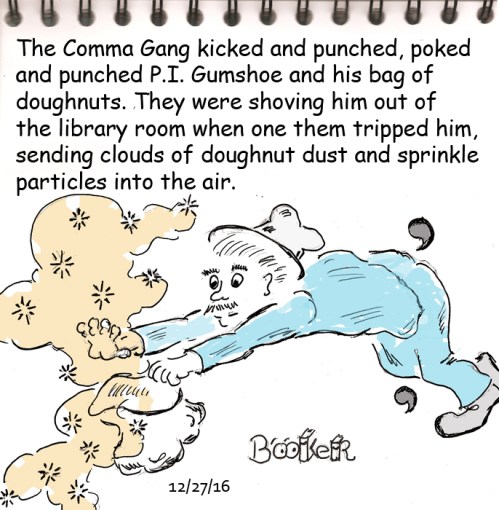
"Oh NO!" the head comma said, realizing this was a turning point.

“Oh NO!” the head comma said, realizing this was a turning point.

Leave a comment

Filed under 2016, cartoon by author, CarToonsday

Sadly, ‘Puppy’ Isn’t Merriam-Webster’s Word Of The Year | The Huffington Post

Source: Sadly, ‘Puppy’ Isn’t Merriam-Webster’s Word Of The Year | The Huffington Post

“Surreal” is Merriam-Webster’s (yes, the dictionary) word of the year.

“Surreal” won out over “puppy,” “flummadiddle,” and “fascism,” which were all trending earlier this month.

The announcement comes after Oxford Dictionaries’ choice of “post-truth” and Dictionary.com’s choice of “xenophobia” for their respective Word of the Year picks.

Merriam-Webster defines surreal as “marked by the intense irrational reality of a dream,” with its synonyms being unbelievable and fantastic.

dictionary publisher established their choice due to the high volume of lookups “surreal” received in 2016.

The word spiked after the Brussels terror attacks in March, the coup attempt in Turkey, the terrorist attack in Nice, and the U.S. election in November, according to the site.

Merriam-Webster editor at large Peter Sokolowski noted in a press release how unusual it was that the word had been so frequently searched.

“Historically, surreal has been one of the words most searched after tragedy, most notably in the days following 9/11, but it was associated with a wide variety of stories this year,” he said.

“Surreal” was an even more surprising winner for Word of the Year when you consider that both “puppy,” “flummadiddle,” and “fascism” were all trending this month. “Fascism” was leading the pack for a while, but in an effort to, you know, not have “fascism” be the Word of the Year, the folks at Merriam-Webster sent out a call to arms to ask people to search literally anything else.

But don’t worry: this election was not rigged. Merriam-Webster assured us all weeks ago that they’d select a winner appropriately.

“Our Word of the Year cannot be rigged. We encourage people to look up new words at all times, particularly if those words are strange 19th-century Americanisms or words for adorable doll-like creatures, but our Word of the Year is based on year-over-year increase in lookups,” they said on their site. “We look for a word which got a high number of lookups and increased dramatically in popularity when compared to previous years.”

Leave a comment

Filed under 2016, words

Dashiell Hammett: a hero for our time – San Francisco Chronicle

Source: Dashiell Hammett: a hero for our time – San Francisco Chronicle

Every Christmas season, my family indulges in the same movie-watching rituals as we trim the tree and string necklaces of twinkling lights around the living room. These movies serve as a comforting backdrop to our yuletide routines. Some of our favorite seasonal films are relative obscurities like “The Family Man” (2000), starring Nicolas Cage, Téa Leoni and Don Cheadle. But we also search out classics, including movies that seemingly have nothing to do with the holiday season. Inevitably, we end up watching at least one of the old “Thin Man” features, that durable Dashiell Hammett detective series starring the most adorable and effervescent married couple in cinematic history, Nick and Nora Charles (William Powell and Myrna Loy).
Why does “The Thin Man” series beckon us this time of year? Maybe it’s the lovely, icy clatter of a holiday martini shaker, that merry clinking sound Nora used to call Nick home to their New York hotel suite when he was relaxing far away in Central Park with their toddler. “Nicky,” the bibulous detective tells Junior, “something tells me that something important is happening somewhere and I think we should be there.”

Or maybe it’s the witty banter and teasing sexuality between Nick and Nora that every sophisticated relationship should aspire to. Nick (trying to divert his wife from an uncomfortably racy subject): “Did I ever tell you that you’re the most fascinating woman on this side of the Rockies?” Nora (signaling she’s no prude): “Wait till you see me on the other side.”
Or it could be the San Francisco aura that drifts through the “Thin Man” films, especially my favorite, “After the Thin Man” (1936), which is set in the city and features locations like the Coit Tower lawn, doubling as the grounds of the Charleses’ Telegraph Hill mansion. Foggy nights in San Francisco are still suffused with a Hammett-like mystery. And there is no better place to conjure the spirit of the founder of the hard-boiled mystery genre than John’s Grill on Ellis Street, where Hammett hero Sam Spade grabbed a quick meal of chops, baked potato and sliced tomato in “The Maltese Falcon.” Hammett himself pounded out his pulp masterpieces on his Underwood typewriter in his apartment nearby, at 891 Post St., after his TB-wracked lungs made it impossible for him to continue his career as a Pinkerton Agency gumshoe.

There is no better way to celebrate the holidays in San Francisco than taking a break from the tyranny of shopping at the legendary downtown grill, presided over by John Konstin, the city’s most charming Greek (besides Art Agnos). A recent lunch hour there was populated by the usual mix of jailhouse lawyers, newshounds, colorful barflies, and SFPD detectives with legendary names – including Lt. Dave Falzon and retired homicide inspector John Cleary Jr. In other words, old San Francisco at its best.

And there is no better lunch companion for such an occasion than fedora-wearing, dapper Eddie Muller — the “Czar of Noir” whose classic cinema festival at the Castro Theatre each January brings together a wildly diverse pageant of filmgoers, from schlumpy and frighteningly obsessive cineastes to elegantly dressed lounge-room lizards and femme fatales who have stepped right out of their own torrid dream. Muller is also a growing presence on the Turner Classic Movies channel, as the film noir host for the brilliantly curated network.

Muller has a familial affinity for the world of Hammett. His late father was the boxing reporter for the San Francisco Examiner for a half-century, a respected fixture in a demimonde filled with the palookas, promoters, and gangsters — the same types Nick and Nora liked to pal around with. And we both share an affection for the prototypical, if opposite, Hammett screen heroines, Loy and Mary Astor.

Astor was the sad-eyed, seductive screen siren who costarred with Bogart in “The Maltese Falcon” (and with my father, Lyle, in such lesser 1930s offerings as “Return of the Terror,” “Red Hot Tires” and “Trapped by Television,” a B-movie thriller that foresaw the scary aspects of the coming medium). Astor was a sexually liberated woman of her day; her erotic self-confidence surges through her performance as the masterfully manipulative Brigid O’Shaughnessy in the Hammett classic.

In 1936, Astor found herself on the pyre in the hottest Hollywood sex scandal of its day, when her estranged husband exposed her “Purple Diary” to the press — a lusty account of her sexual exploits, including the grades she assigned to her lovers’ performances. Playwright George S. Kaufman scored the highest, with Astor extolling his prowess. “Fits me perfectly,” she wrote. “Many exquisite moments … twenty — count them, diary, twenty … I don’t see how he does it … he’s perfect.”

Astor — whose Purple Diary is the subject of two recent books, including a sensually illustrated chronicle by the artist Edward Sorel — got Muller and me talking about Hammett and his view of women. “In some ways, the male-female dynamic is the most interesting thing about Hammett’s work,” said Muller, between sips from his Manhattan. “There’s an emotional complexity and tension that separates it from other detective fiction.” In his own life, Hammett cut himself off from his father and brother at a young age, but remained close to his mother and sister. His own formidable drinking and sparring partner, the writer Lillian Hellman, was the inspiration for Nora Charles.

“He was a tall, slim, well-dressed ladies’ man, who carried with him a sense of damage that women found attractive,” continued Muller. “His drinking, his illness. He made binge drinking heroic because he was so frail. Women would marvel at him — it’s 4 a.m. and he’s still going.”

Hammett had another kind of fortitude as well. A lifelong man of the Left, he was dragged before a federal tribunal during the Cold War and asked to reveal the names of those who had contributed to a bail fund he had overseen for jailed Communist Party leaders. He refused. Ratting on friends was not the kind of thing that the creator of Sam Spade would do. He was sentenced to six months in federal prison for contempt of court, and when he was released in December 1951, his health was more ruined than ever. In 1953, he was summoned again by the witch-hunters, this time by Sen. Joe McCarthy and his sidekick, the reptilian Roy Cohn — one of Donald Trump’s mentors. Again Hammett refused to cooperate. He was blacklisted by Hollywood and went broke. But he was unbroken.

As Trump adviser Newt Gingrich floats the idea of reviving the notorious House Un-American Activities Committee, it’s a good time for us to recall Hammett’s heroism. “People should read his testimony and look at the pictures of him as he underwent the inquisition; it’s so inspiring,” said Muller. “He was just so cool and unshakable. His attitude was like, ‘Do your worst, you can’t even make me angry.’ He was one of his own heroes come to life.”

San Francisco Chronicle columnist David Talbot appears Sundays, Tuesdays and Thursdays. Email: dtalbot@sfchronicle.com

Leave a comment

Filed under 2016, author tribute

Most annoying word?

Poughkeepsie, NY, A poll by Marist College found that the most annoying word or phrase used in casual conversation in America is “whatever.” The poll indicates the word irritates 38 percent of Americans.

The pollsters offered up five options for most annoying word of phrase: “whatever,” “no offense, but,” “you know, right,” I can’t even,” and “huge.”

In second place? “No offense, but” with 20 percent. Third place went to two phrases that tied: “you know, right,” and “I can’t even.” In each case, 14 percent of Americans found the phrase irksome. In last place, with 8 percent, was the word “huge.”

Last year “whatever” took first place with 43 percent. Also, age maters. Americans under 30 years old found “I can’t even” to be the most annoying word or phrase for whatever reason.

Leave a comment

Filed under 2016, words

Photo finish Friday: “It’s Christmas when…”

You know it’s Christmas when…

  1. You find a half-empty cup of eggnog in your refrigerator and you mix it with milk and chocolate syrup for your breakfast drink.
  2. You get to eat slightly lumpy chipped beef on toasted bagel, because, well, you’re home for the holidays and you just do.
  3. Your artificial Christmas tree sheds needles like real one.
  4. You set up your outdoor inflatable Christmas decorations and two of them die. One right out of storage from last Christmas, and the other shortly after it has been set up and inflated for this year.
  5. In order to entice your significant other into at least being more tolerant of your outdoor inflatables, you replace one of the ones that dies with something she likes but you have no fondness for – an inflatable pink flamingo. Even though it’s carrying a gift and wearing a red stocking cap, it still is not a favorite.
  6. Nothing says Christmas quite like an inflatable pink flamingo in a red cap.

    Nothing says Christmas quite like an inflatable pink flamingo in a red cap.

  7. Two Christmas packages arrive and they rattle – but they shouldn’t.
  8. You find a Christmas card from several years back from a friend and mentor whom you had lost touch with and learned recently died earlier this year.
  9. You pay a repair to fix a major appliance, and the problem he finds is an easy fix you should have seen if you had been a little more on the ball.
  10. You receive a present you wanted, but it turns out not to be all that interesting, but you also receive a present that you didn’t want and it turns out to be the most interesting thing you received. In kids, this is known as “The-cardboard-box-is-more-fun-to-play-with-than-the-toy-inside phenomenon.” It happens with adults, too. We just don’t generally call it that, or own up to it.
  11. To boldly go where no Christmas tree has gone … recently. For the first time in five years you get to put up your Star Trek Christmas tree. And because you have so many, you decide to limit the decorations to those from The Original Series, because it is the original and you are that old.
  12. "Beam me somewhere Mr. Scott. Any ol' place in Earth or space. You pick the century and I'll pick the spot."

    “Beam me somewhere Mr. Scott. Any ol’ place in Earth or space. You pick the century and I’ll pick the spot.”

  13. A young lady shows up at your doorstep, gently tapping on your door, a bag of homemade Michelle Obama’s shortbread cookies in her hand. She gives them to you and says, “Merry Christmas.” Then she scurries away.
  14. You’re driving around with you kids looking at Christmas lights and see Santa crossing the street and walking into a dive bar on the edge of your neighborhood. Not sure how to explain that one.
  15. Merry Christmas and Happy New Year. Happy Holidays, whichever ones you celebrate. Including Festivus for the Rest of Us

    Merry Christmas and Happy New Year. Happy Holidays, whichever ones you celebrate. Including Festivus for the Rest of Us,

Leave a comment

Filed under 2016, photo by David E. Booker, Photo Finish Friday