Monthly Archives: October 2016

Haiku to you Thursday: “Wings”

Fall dips into day. /

Wings open unto the sky: /

migration returns.

Leave a comment

Filed under 2016, Haiku to You Thursday, poetry by author

Writing tip Wednesday: “Get it write”

biggest-lie

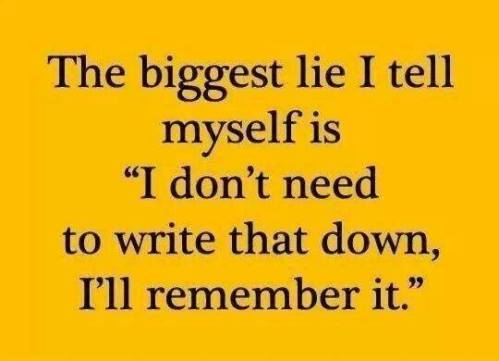
One of the easiest things to do is also one of the hardest, and that is to write down that piece of dialogue, turn of phrase, descriptive passage, ear catching name for a character, or any other part of writing.

Granted, it can be hard to write something down when you are driving or in the middle of shopping for food for that big holiday meal, or even in the dark watching a movie. I’m sure you can fill in the line, I had a great idea, but I couldn’t write it down because….

The only thing I can say is I have kicked myself too many times over things I have forgotten when I told myself I would remember them until I could write them.

Sometimes, it helps me to remember the first letter of each word in a phrase I am trying to remember until I can write it down. But I always, or at least almost always, have a pen and paper with me, even a scrap piece of paper. And though I still fail, I try to write it down as soon as I can after the idea has come to me.

It’s not always easy, but nobody said writing should be. Sometimes it is. Often it isn’t, so don’t make it harder on yourself by not having pen and paper or some other way of recording that bit of inspiration when it comes your way. Even if I don’t end up using it, I have acknowledged it, and I have found that acknowledging inspiration helps bring forth more inspiration, while ignoring it or being lazy about it only causes it to go elsewhere, to someone else who will appreciate it.

–David E. Booker

Leave a comment

Filed under 2016, writing tip, Writing Tip Wednesday

cARtOONSdAY: “cASE lOGIC 19: tURN aROUND”

This might be called a turning point in the story.

This might be called a turning point in the story.

Leave a comment

Filed under 2016, cartoon by author, CarToonsday

Monday morning writing joke: “Dueling puns, part 2”

Two writers who didn’t like each other met in a bar, as such writers often do. Each claimed it was his favorite bar and each claimed he had found it first. After several months of glowering at each other and bad mouthing each other, they agree to settle the matter with a duel of puns.

Since the short writer won the first round, he was given the first pun of the second round. A set of cards was placed on the table between them, face down. On each card was a subject. The short rider flipped the card over and the subject was bodily functions. The bartender, a waiter, and a waitress would be the judges, scoring each round.

Props were allowed, and for each turn, each writer could make one phone call.

After thinking a moment, he drew an outhouse and asked, “What do you call this when it sits outside a sewage treatment plant?”

The tall, thin writer thought and thought and thought. His time was almost up when he blurted out: “Outsourcing.”

The short writer nodded. The tall writer then took a comb out of his pocket and ran it through his hair several times, continuing to do so when he asked in his best burr accent, “What does a Scotsman call a young woman constantly combing her hair?”

The short writer felt sweat running down the small of his back, and just as the bartender started to ring a small bell, blurted out, “A combly lass.”

Round two was declared a tie, but the short writer was ahead 1 win, no losses, 1 tie.

Leave a comment

Filed under 2016, joke by author, Monday morning writing joke

Short stories on the train

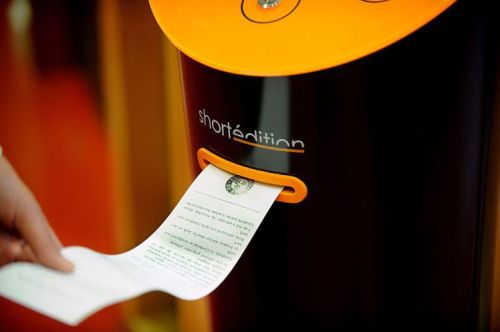
French train stations now have vending machines that dispense short stories to entertain you while you wait

http://metro.co.uk/2016/10/03/french-train-stations-now-have-vending-machines-that-dispense-short-stories-to-entertain-you-while-you-wait-6167708/

By Lisa Bowman for Metro.co.uk

There’s nothing worse than having to wait for your train when you’ve forgotten your book, all the free papers have gone, or you just don’t feel like falling down the rabbit hole of the Internet via your smartphone.

A woman chooses a short story at a short-story distribution terminal in the Mistral district of Grenoble, on October 12, 2015. The city of Grenoble is testing the invention of a local start-up and recently installed the terminal, which delivers free reading material to people waiting in public spaces.  AFP PHOTO / JEAN-PERRE CLATOT        (Photo credit should read JEAN-PIERRE CLATOT/AFP/Getty Images)

A woman chooses a short story at a short-story distribution terminal in the Mistral district of Grenoble, on October 12, 2015. The city of Grenoble is testing the invention of a local start-up and recently installed the terminal, which delivers free reading material to people waiting in public spaces. AFP PHOTO / JEAN-PERRE CLATOT (Photo credit should read JEAN-PIERRE CLATOT/AFP/Getty Images)

Which is why France’s idea to install free short story vending machines is genius.
The idea was trialled a year ago in the country’s Grenoble train station, where it went down so well that they decided to roll it out across more stations.

You simply choose your wait-time – one, three or five minutes – and the machine will dispense a story accordingly. All for free.

The stories are all printed on paper, and topics range from children’s stories to lyrical poetry.

The authors of the stories are all anonymous, and over 5,000 have submitted stories.
The machines have been installed at 24 train stations all over France, with plans to introduce them at a further 11 by the end of the year.

The idea was dreamt up by publishing house Short Edition, which specialises in short stories.

‘Our ambition is to see distributors pop up everywhere to encourage reading – and writing – and to promote our artists,’ Short Edition director Christophe Sibieude told Télérama. ‘The paper medium is a breath of fresh air, it’s more unexpected that a smartphone screen.’

Considering that we’re coming into ‘leaves on the line’ season, it might be a good idea to start installing these at commuter hubs in the UK…

Leave a comment

Filed under 2016, short story

Photo finish Friday: “Enlightenment”

Friday night on the town, awaiting the start of Mark Twain Tonight at The Tennessee Theatre.

Friday night on the town, awaiting the start of Mark Twain Tonight at The Tennessee Theatre.

Leave a comment

Filed under 2016, photo by David E. Booker, Photo Finish Friday

Haiku to you Thursday: “Truth”

The wind and the truth, /

Whirl on fall’s brittle edge: /

Leaves and love are brown.

Leave a comment

Filed under 2016, Haiku to You Thursday, poetry by author

Writing tip Wednesday: “Evolving into a writing schedule”

Struggling to write? Take some tips from Charles Darwin

charles-darwin-100pdi_7x9

Darwin’s magnum opus, On the Origin of Species, is a masterclass in how to structure research and craft your arguments

By Rosalind White

After his voyage on HMS Beagle, Charles Darwin relocated to the English countryside near Orpington in 1842. There, he would spend the next 17 years working on his magnum opus, On the Origin of Species.

He adopted a surprisingly relaxed routine. A schedule was kept by his son, Francis Darwin, summarising a typical day in his father’s life.

  • 7am: Rose and took a short walk, followed by breakfast.
  • 8am: Worked in his study; he considered this his best working time.
  • 9.30am: Went to drawing room and read his letters, followed by reading aloud of family letters.
  • 10.30am: Returned to study for more research.
  • Noon: Walk, starting with visit to greenhouse, then down his gravel path known as the “sandwalk”, sometimes accompanied by his dog.
  • 12.45pm: Lunch with whole family, which was his main meal of the day.
  • 3pm: Rested in his bedroom on the sofa and smoked a cigarette, listened to a novel or other light literature read by Emma Darwin, his wife.
  • 4pm: Walked around the sandwalk again.
  • 4.30pm: Worked in study, clearing up matters of the day.
  • 6pm: Rested again in bedroom with Emma reading aloud.
  • 7.30pm: Light high tea while the family dined. In late years he never stayed in the dining room with the men, but retired to the drawing-room with the ladies.
  • 10pm: Left the drawing room and usually in bed by 10.30, but slept badly.

Make an emotional connection

Darwin’s strategy was one of crafted self-possession. He prioritised domestic comfort, time with his family and rambles in the country, rather than intellectual endurance. As a method for writing, it fostered a deep emotional connection with his research – and this intimacy resonates in the lucid flow and appreciative tone of his arguments:

“It is interesting to contemplate an entangled bank, clothed with many plants of many kinds,” he writes. “With birds singing on the bushes, with various insects flitting about, and with worms crawling through the damp earth, and to reflect that these elaborately constructed forms, so different from each other, and dependent on each other in so complex a manner, have all been produced by laws acting around us.”

Darwin resisted an automatic, or breakneck approach. The pleasure he took in both his writing and his research is tied up with his ability to take a moment, breathe and witness the world in a wider dimension. This consciousness of place is a method that can be applied to both natural history and to writing. If your writing is made up of frantic action, with no breathing space, you will spawn a confusing muddle of disparate ideas.

In a letter written to HW Bates in 1861 he provides an outline for effective working. Lamenting the sting of labouring “very hard and slowly at every sentence”, he admits that he sometimes finds style “a great difficulty”.

Find your imaginary person

His advice to fellow floundering writers is: “I find it a very good plan, when I cannot get a difficult discussion to please me, to fancy that someone comes into the room and asks me what I am doing, then try at once and explain to the imaginary person what it is all about.”

He also suggests that a writer should power through their piece briskly to construct a kind of skeleton argument. Equally, however, he is cautious to prepare for counter-arguments without appearing too dogmatic. On the Origin of Species has been described as “one long provocation in the guise of being none”.

US writer Adam Gopnik, who wrote a book on Darwin, notes that the habit of “sympathetic summary” is essential to his rhetorical power.

“All of what remain today as the chief objections to his theory are introduced by Darwin himself, fairly and accurately, and in a spirit of almost panicked anxiety — and then rejected not by bullying insistence but by specific example, drawn from the reservoir of his minute experience of life… [On the Origin of Species] is not only a statement of a thesis; it is a book of answers to questions that no one had yet asked.”

The survival of his thesis was won partly because of intellectual empathy, rather than an ugly fight to the death played out in the public arena. Darwin teaches us that – in an effort to make sure that your work does not go the way of the dodo – it’s essential to adjust your methodology and anticipate arguments in order to survive.

But in the spirit of this philosophy, it is important to remember that such advice is worthless if you lack the tenacity to actually write the thing in the first place. So write. But be patient. After all, Darwin himself took more than two decades to finish his book.

Leave a comment

Filed under 2016, writing tip, Writing Tip Wednesday

cARtOONSdAY: “hAIR oF tHE dOG”

Another tall tail ... ah, I mean tale bites the dust. Howl about that?

Another tall tail … ah, I mean tale bites the dust. Howl about that?

Leave a comment

Filed under 2016, CarToonsday

Monday morning writing joke: “Dueling puns, part 1”

Two writers who didn’t like each other met in a bar, as such writers often do. Each claimed it was his favorite bar and each claimed he had found it first.

After several months of glowering at each other and bad mouthing each other, they agree to settle the matter with a duel of puns. A set of cards was placed on the table between them, face down. On each card was a subject. Each writer in turn would flip over the top card and then each writer would have to come up with a pun that the other writer would have to guess. There would be several rounds, possibly over several nights. The bartender, a waiter, and a waitress would be the judges, scoring each round.

Props were allowed, and for each turn, each writer could make one phone call.
The tall, thin writer won the coin toss, so he decided to turn over the first card. The card read, “animal.”

The shorter, plump writer thought about it for a moment and called a friend. In a few minutes, a duck started appearing at the windows of the bar. First looking in one window, then the next, then another.

The tall writer made a few guesses, none of them right. Finally he gave up.
“Peeking duck,” the short writer said.

The bartender and wait staff nodded, thinking it was a pretty good pun.

The tall writer felt sweat running down the back of his shirt. He wasn’t sure what to do, then he had an idea and called a friend at a costume shop.

In a little while, a Panda walked into the bar, dressed in baggy clothes. Every now and then, the pants on the Panda would fall and the bear would have to bend over to pull them up, causing people to laugh, giggle, even turn red-faced every now and then.

I know what this is, the short writer said: “Panda moonin’ ’em. Pandemonium.”

Round one to the short writer.

Leave a comment

Filed under 2016, joke by author, Monday morning writing joke