
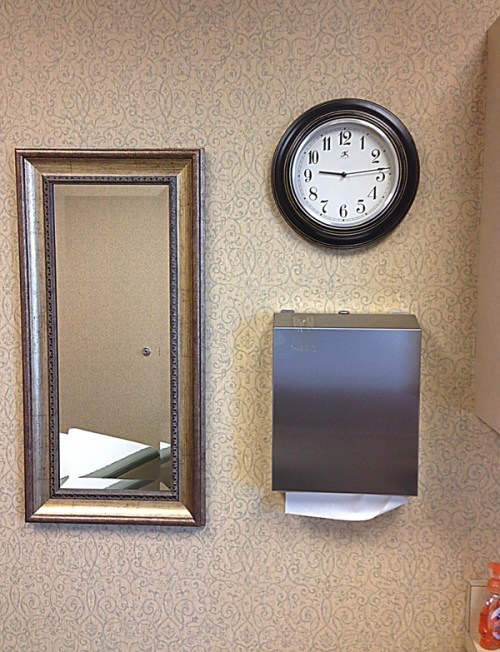
The time is now. The place, your doctor’s examination room. The reason: your doctor is somewhere else, somewhere in … The Twilight Zone.
The time is now. The place, your doctor’s examination room. The reason: your doctor is somewhere else, somewhere in … The Twilight Zone.
Filed under 2016, photo by David E. Booker, Photo Finish Friday
Silence tastes empty. /
Without your whisper, my ear /
hears only stale words.
Filed under 2016, Haiku to You Thursday, poetry by author
Neil Gaiman: Why our future depends on libraries, reading and daydreaming
A lecture explaining why using our imaginations, and providing for others to use theirs, is an obligation for all citizens
By Neil Gaiman
Source: https://www.theguardian.com/books/2013/oct/15/neil-gaiman-future-libraries-reading-daydreaming
See also: Can reading make you happier?
 It’s important for people to tell you what side they are on and why, and whether they might be biased. A declaration of members’ interests, of a sort. So, I am going to be talking to you about reading. I’m going to tell you that libraries are important. I’m going to suggest that reading fiction, that reading for pleasure, is one of the most important things one can do. I’m going to make an impassioned plea for people to understand what libraries and librarians are, and to preserve both of these things.
And I am biased, obviously and enormously: I’m an author, often an author of fiction. I write for children and for adults. For about 30 years I have been earning my living though my words, mostly by making things up and writing them down. It is obviously in my interest for people to read, for them to read fiction, for libraries and librarians to exist and help foster a love of reading and places in which reading can occur.
So I’m biased as a writer. But I am much, much more biased as a reader. And I am even more biased as a British citizen.
And I’m here giving this talk tonight, under the auspices of the Reading Agency: a charity whose mission is to give everyone an equal chance in life by helping people become confident and enthusiastic readers. Which supports literacy programs, and libraries and individuals and nakedly and wantonly encourages the act of reading. Because, they tell us, everything changes when we read.
And it’s that change, and that act of reading that I’m here to talk about tonight. I want to talk about what reading does. What it’s good for.
I was once in New York, and I listened to a talk about the building of private prisons – a huge growth industry in America. The prison industry needs to plan its future growth – how many cells are they going to need? How many prisoners are there going to be, 15 years from now? And they found they could predict it very easily, using a pretty simple algorithm, based on asking what percentage of 10 and 11-year-olds couldn’t read. And certainly couldn’t read for pleasure.
It’s not one to one: you can’t say that a literate society has no criminality. But there are very real correlations.
And I think some of those correlations, the simplest, come from something very simple. Literate people read fiction.
Fiction has two uses. Firstly, it’s a gateway drug to reading. The drive to know what happens next, to want to turn the page, the need to keep going, even if it’s hard, because someone’s in trouble and you have to know how it’s all going to end … that’s a very real drive. And it forces you to learn new words, to think new thoughts, to keep going. To discover that reading per se is pleasurable. Once you learn that, you’re on the road to reading everything. And reading is key. There were noises made briefly, a few years ago, about the idea that we were living in a post-literate world, in which the ability to make sense out of written words was somehow redundant, but those days are gone: words are more important than they ever were: we navigate the world with words, and as the world slips onto the web, we need to follow, to communicate and to comprehend what we are reading. People who cannot understand each other cannot exchange ideas, cannot communicate, and translation programs only go so far.
The simplest way to make sure that we raise literate children is to teach them to read, and to show them that reading is a pleasurable activity. And that means, at its simplest, finding books that they enjoy, giving them access to those books, and letting them read them.
I don’t think there is such a thing as a bad book for children. Every now and again it becomes fashionable among some adults to point at a subset of children’s books, a genre, perhaps, or an author, and to declare them bad books, books that children should be stopped from reading. I’ve seen it happen over and over; Enid Blyton was declared a bad author, so was RL Stine, so were dozens of others. Comics have been decried as fostering illiteracy.
It’s tosh. It’s snobbery and it’s foolishness. There are no bad authors for children, that children like and want to read and seek out, because every child is different. They can find the stories they need to, and they bring themselves to stories. A hackneyed, worn-out idea isn’t hackneyed and worn out to them. This is the first time the child has encountered it. Do not discourage children from reading because you feel they are reading the wrong thing. Fiction you do not like is a route to other books you may prefer. And not everyone has the same taste as you.
Well-meaning adults can easily destroy a child’s love of reading: stop them reading what they enjoy, or give them worthy-but-dull books that you like, the 21st-century equivalents of Victorian “improving” literature. You’ll wind up with a generation convinced that reading is uncool and worse, unpleasant.
We need our children to get onto the reading ladder: anything that they enjoy reading will move them up, rung by rung, into literacy. (Also, do not do what this author did when his 11-year-old daughter was into RL Stine, which is to go and get a copy of Stephen King’s Carrie, saying if you liked those you’ll love this! Holly read nothing but safe stories of settlers on prairies for the rest of her teenage years, and still glares at me when Stephen King’s name is mentioned.)
And the second thing fiction does is to build empathy. When you watch TV or see a film, you are looking at things happening to other people. Prose fiction is something you build up from 26 letters and a handful of punctuation marks, and you, and you alone, using your imagination, create a world and people it and look out through other eyes. You get to feel things, visit places and worlds you would never otherwise know. You learn that everyone else out there is a me, as well. You’re being someone else, and when you return to your own world, you’re going to be slightly changed.
Empathy is a tool for building people into groups, for allowing us to function as more than self-obsessed individuals.
You’re also finding out something as you read vitally important for making your way in the world. And it’s this:
The world doesn’t have to be like this. Things can be different.
I was in China in 2007, at the first party-approved science fiction and fantasy convention in Chinese history. And at one point I took a top official aside and asked him Why? SF had been disapproved of for a long time. What had changed?
It’s simple, he told me. The Chinese were brilliant at making things if other people brought them the plans. But they did not innovate and they did not invent. They did not imagine. So they sent a delegation to the US, to Apple, to Microsoft, to Google, and they asked the people there who were inventing the future about themselves. And they found that all of them had read science fiction when they were boys or girls.
Fiction can show you a different world. It can take you somewhere you’ve never been. Once you’ve visited other worlds, like those who ate fairy fruit, you can never be entirely content with the world that you grew up in. Discontent is a good thing: discontented people can modify and improve their worlds, leave them better, leave them different.
And while we’re on the subject, I’d like to say a few words about escapism. I hear the term bandied about as if it’s a bad thing. As if “escapist” fiction is a cheap opiate used by the muddled and the foolish and the deluded, and the only fiction that is worthy, for adults or for children, is mimetic fiction, mirroring the worst of the world the reader finds herself in.
If you were trapped in an impossible situation, in an unpleasant place, with people who meant you ill, and someone offered you a temporary escape, why wouldn’t you take it? And escapist fiction is just that: fiction that opens a door, shows the sunlight outside, gives you a place to go where you are in control, are with people you want to be with(and books are real places, make no mistake about that); and more importantly, during your escape, books can also give you knowledge about the world and your predicament, give you weapons, give you armour: real things you can take back into your prison. Skills and knowledge and tools you can use to escape for real.
As JRR Tolkien reminded us, the only people who inveigh against escape are jailers.
Another way to destroy a child’s love of reading, of course, is to make sure there are no books of any kind around. And to give them nowhere to read those books. I was lucky. I had an excellent local library growing up. I had the kind of parents who could be persuaded to drop me off in the library on their way to work in summer holidays, and the kind of librarians who did not mind a small, unaccompanied boy heading back into the children’s library every morning and working his way through the card catalogue, looking for books with ghosts or magic or rockets in them, looking for vampires or detectives or witches or wonders. And when I had finished reading the children’s’ library I began on the adult books.
They were good librarians. They liked books and they liked the books being read. They taught me how to order books from other libraries on inter-library loans. They had no snobbery about anything I read. They just seemed to like that there was this wide-eyed little boy who loved to read, and would talk to me about the books I was reading, they would find me other books in a series, they would help. They treated me as another reader – nothing less or more – which meant they treated me with respect. I was not used to being treated with respect as an eight-year-old.
But libraries are about freedom. Freedom to read, freedom of ideas, freedom of communication. They are about education (which is not a process that finishes the day we leave school or university), about entertainment, about making safe spaces, and about access to information.
I worry that here in the 21st century people misunderstand what libraries are and the purpose of them. If you perceive a library as a shelf of books, it may seem antiquated or outdated in a world in which most, but not all, books in print exist digitally. But that is to miss the point fundamentally.
I think it has to do with nature of information. Information has value, and the right information has enormous value. For all of human history, we have lived in a time of information scarcity, and having the needed information was always important, and always worth something: when to plant crops, where to find things, maps and histories and stories – they were always good for a meal and company. Information was a valuable thing, and those who had it or could obtain it could charge for that service.
In the last few years, we’ve moved from an information-scarce economy to one driven by an information glut. According to Eric Schmidt of Google, every two days now the human race creates as much information as we did from the dawn of civilisation until 2003. That’s about five exobytes of data a day, for those of you keeping score. The challenge becomes, not finding that scarce plant growing in the desert, but finding a specific plant growing in a jungle. We are going to need help navigating that information to find the thing we actually need.
Libraries are places that people go to for information. Books are only the tip of the information iceberg: they are there, and libraries can provide you freely and legally with books. More children are borrowing books from libraries than ever before – books of all kinds: paper and digital and audio. But libraries are also, for example, places that people, who may not have computers, who may not have internet connections, can go online without paying anything: hugely important when the way you find out about jobs, apply for jobs or apply for benefits is increasingly migrating exclusively online. Librarians can help these people navigate that world.
I do not believe that all books will or should migrate onto screens: as Douglas Adams once pointed out to me, more than 20 years before the Kindle turned up, a physical book is like a shark. Sharks are old: there were sharks in the ocean before the dinosaurs. And the reason there are still sharks around is that sharks are better at being sharks than anything else is. Physical books are tough, hard to destroy, bath-resistant, solar-operated, feel good in your hand: they are good at being books, and there will always be a place for them. They belong in libraries, just as libraries have already become places you can go to get access to ebooks, and audiobooks and DVDs and web content.
A library is a place that is a repository of information and gives every citizen equal access to it. That includes health information. And mental health information. It’s a community space. It’s a place of safety, a haven from the world. It’s a place with librarians in it. What the libraries of the future will be like is something we should be imagining now.
Literacy is more important than ever it was, in this world of text and email, a world of written information. We need to read and write, we need global citizens who can read comfortably, comprehend what they are reading, understand nuance, and make themselves understood.
Libraries really are the gates to the future. So it is unfortunate that, round the world, we observe local authorities seizing the opportunity to close libraries as an easy way to save money, without realising that they are stealing from the future to pay for today. They are closing the gates that should be open.
According to a recent study by the Organisation for Economic Cooperation and Development, England is the “only country where the oldest age group has higher proficiency in both literacy and numeracy than the youngest group, after other factors, such as gender, socio-economic backgrounds and type of occupations are taken into account”.
Or to put it another way, our children and our grandchildren are less literate and less numerate than we are. They are less able to navigate the world, to understand it to solve problems. They can be more easily lied to and misled, will be less able to change the world in which they find themselves, be less employable. All of these things. And as a country, England will fall behind other developed nations because it will lack a skilled workforce.
Books are the way that we communicate with the dead. The way that we learn lessons from those who are no longer with us, that humanity has built on itself, progressed, made knowledge incremental rather than something that has to be relearned, over and over. There are tales that are older than most countries, tales that have long outlasted the cultures and the buildings in which they were first told.
I think we have responsibilities to the future. Responsibilities and obligations to children, to the adults those children will become, to the world they will find themselves inhabiting. All of us – as readers, as writers, as citizens – have obligations. I thought I’d try and spell out some of these obligations here.
I believe we have an obligation to read for pleasure, in private and in public places. If we read for pleasure, if others see us reading, then we learn, we exercise our imaginations. We show others that reading is a good thing.
We have an obligation to support libraries. To use libraries, to encourage others to use libraries, to protest the closure of libraries. If you do not value libraries then you do not value information or culture or wisdom. You are silencing the voices of the past and you are damaging the future.
We have an obligation to read aloud to our children. To read them things they enjoy. To read to them stories we are already tired of. To do the voices, to make it interesting, and not to stop reading to them just because they learn to read to themselves. Use reading-aloud time as bonding time, as time when no phones are being checked, when the distractions of the world are put aside.
We have an obligation to use the language. To push ourselves: to find out what words mean and how to deploy them, to communicate clearly, to say what we mean. We must not to attempt to freeze language, or to pretend it is a dead thing that must be revered, but we should use it as a living thing, that flows, that borrows words, that allows meanings and pronunciations to change with time.
We writers – and especially writers for children, but all writers – have an obligation to our readers: it’s the obligation to write true things, especially important when we are creating tales of people who do not exist in places that never were – to understand that truth is not in what happens but what it tells us about who we are. Fiction is the lie that tells the truth, after all. We have an obligation not to bore our readers, but to make them need to turn the pages. One of the best cures for a reluctant reader, after all, is a tale they cannot stop themselves from reading. And while we must tell our readers true things and give them weapons and give them armour and pass on whatever wisdom we have gleaned from our short stay on this green world, we have an obligation not to preach, not to lecture, not to force predigested morals and messages down our readers’ throats like adult birds feeding their babies pre-masticated maggots; and we have an obligation never, ever, under any circumstances, to write anything for children that we would not want to read ourselves.
We have an obligation to understand and to acknowledge that as writers for children we are doing important work, because if we mess it up and write dull books that turn children away from reading and from books, we ‘ve lessened our own future and diminished theirs.
We all – adults and children, writers and readers – have an obligation to daydream. We have an obligation to imagine. It is easy to pretend that nobody can change anything, that we are in a world in which society is huge and the individual is less than nothing: an atom in a wall, a grain of rice in a rice field. But the truth is, individuals change their world over and over, individuals make the future, and they do it by imagining that things can be different.
Look around you: I mean it. Pause, for a moment and look around the room that you are in. I’m going to point out something so obvious that it tends to be forgotten. It’s this: that everything you can see, including the walls, was, at some point, imagined. Someone decided it was easier to sit on a chair than on the ground and imagined the chair. Someone had to imagine a way that I could talk to you in London right now without us all getting rained on.This room and the things in it, and all the other things in this building, this city, exist because, over and over and over, people imagined things.
We have an obligation to make things beautiful. Not to leave the world uglier than we found it, not to empty the oceans, not to leave our problems for the next generation. We have an obligation to clean up after ourselves, and not leave our children with a world we’ve shortsightedly messed up, shortchanged, and crippled.
We have an obligation to tell our politicians what we want, to vote against politicians of whatever party who do not understand the value of reading in creating worthwhile citizens, who do not want to act to preserve and protect knowledge and encourage literacy. This is not a matter of party politics. This is a matter of common humanity.
Albert Einstein was asked once how we could make our children intelligent. His reply was both simple and wise. “If you want your children to be intelligent,” he said, “read them fairy tales. If you want them to be more intelligent, read them more fairy tales.” He understood the value of reading, and of imagining. I hope we can give our children a world in which they will read, and be read to, and imagine, and understand.
• This is an edited version of Neil Gaiman’s lecture for the Reading Agency, delivered on Monday October 14 at the Barbican in London. The Reading Agency’s annual lecture series was initiated in 2012 as a platform for leading writers and thinkers to share original, challenging ideas about reading and libraries.
Source: https://www.theguardian.com/books/2013/oct/15/neil-gaiman-future-libraries-reading-daydreaming
See also: Can reading make you happier?
Filed under 2016, writing tip, Writing Tip Wednesday
After an Artist’s Anonymous meeting, three writers were sitting around talking about the upcoming Fourth of July.
“The fireworks have already started at my house,” the first writer said, “The dog died, my wife left me, and the car wouldn’t start and that’s why I was late getting here.”
The second writer shook his head, “Change that car to a truck and you could write a country song about it.”
“No,” the third writer said, “change the car to a dragon and you could have a fantasy story about a dragon who kills a man’s dog and kidnaps his princess wife.”
“Nah,” said the first writer. “I think I’ll leave as it is. The dog’s was my wife’s and the car was in her name. And right about now she’s probably finding out the guy she left me for wasn’t such a bargain, either.”
“Why do you say that?” the other two writers asked.
“Because he was my agent.”
Filed under 2016, joke by author, Monday morning writing joke
Library Cat is Being Taken Away from the Place He Calls Home After 6 Years
Source: http://www.lovemeow.com/save-library-cat-browser-1889260522.html
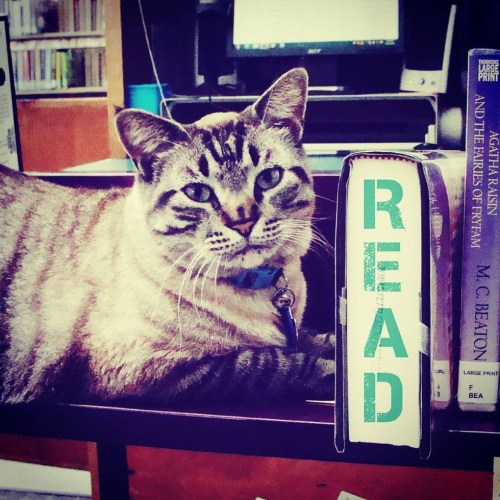
Browser being evicted from only home he’s known.
A cat that has been a loyal worker and family to a library for six years is being taken away from the place he calls home.
Browser has been living at the Friends of the White Settlement Public Library (White Settlement, TX) for six years. He’s done great to contribute to fixing the library’s rodent problem and is loved by everyone there. However, things took a different turn, when suddenly he was asked to move out of the place he calls home.
This friendly feline has been a fixture at the library and people from all ages adore him and his purrsonality.
“I don’t have any animals. But this cat is so gentle and so lovable and he brings so much comfort to so many people, it seems like a shame to take him away,” Lillian Blackburn, president of the library, told Star Telegram.
It all happened after a city employee complained to the city council that they weren’t allowed to bring their puppy to work, but also pointed out the fact that Browser was allowed to stay at the library.
Despite “an outpouring of support for the cat”, the White Settlement City Council voted to evict the cat.
Ironically, it was the city council that voted to allow the library to have a cat to help them with pest control.
Mayor Ron White, a nonvoting council moderator, also wants Browser to stay.
“That cat doesn’t have anything to do with whether somebody can have their puppy at City Hall. That cat doesn’t hurt anybody,” he said to Star-Telegram.
Browser is a wonderful cat and always so helpful around the library.
Not only does he keep the rodents at bay, he helps his humans with their work too.
Browser, the supercat, protecting the library from rodents.
What a hero!
He helps kids and adults pick good reads and brings a big smile to everyone that walks in.
Mayor White hopes they could reconsider its decision at the next council meeting on July 12, two days before Browser has to move out.
“Browser is still at the library for now,” White Settlement Public Library told Love Meow.
If you’d like to show your support in favor of keeping Browser the cat at the library, you can contact White Settlement council members at this link.

A young Ambrose Bierce
For example, here is a definition for the words Populist and Pray. The Old definition is Bierce’s. The New definition is, in many cases, an update. Sometimes little change is needed. Sometimes more. From time to time, just as it was originally published, we will come back to The Devil’s Dictionary, for a look at it then and how it applies today. Click on Devil’s Dictionary in the tags below to bring up the other entries.
OLD DEFINITION
POPULIST, n. A fossil patriot of the early agricultural period, found in the old red soapstone underlying Kansas; characterized by an uncommon spread of ear, which some naturalists contend gave him the power of flight, though Professors Morse and
Whitney, pursuing independent lines of thought, have ingeniously pointed out that had he possessed it he would have gone elsewhere. In the picturesque speech of his period, some fragments of which have come down to us, he was known as “The Matter with Kansas.”
PRAY, n. To ask that the laws of the universe be annulled in behalf of a single petitioner confessedly unworthy.
NEW DEFINITION
POPULIST, n. A fossil patriot of the post-industrial period, found in the faulty towers, broken university, and failed airline (to name a few endeavors) of ignorance plus arrogance added to money; characterized by an uncommon spread of hair, which some naturalists contend could be a species in its own right, if only they had time to closely exam it. In the picturesque speech of his period, some fragments of which have come down to us, he was known as “The Huuge Mouth from Manhattan.”
PRAY, n. 1) What the other candidates claimed they did after God told them to run for the highest office in the land, which they all failed at famously. 2) To ask that the laws of the universe be annulled in behalf of a certain party petitioning, though confessedly unworthy, that their Populist decides to either drop dead or drop out. 3) What you do when here the populist of this party speak. 4) What politicians do in lieu of doing any real work to solve a problem, such as after a mass shooting when politicians say, “Our prayers and our hearts go out to the victims of this tragedy,” begging the question: is it the tragedy of the event or the tragedy of your inaction for which you are praying?
Filed under 2016, Devil's Dictionary
By Ceridwen Dovey

No outlet, except maybe to happiness.
But the session was a gift, and I found myself unexpectedly enjoying the initial questionnaire about my reading habits that the bibliotherapist, Ella Berthoud, sent me. Nobody had ever asked me these questions before, even though reading fiction is and always has been essential to my life. I love to gorge on books over long breaks—I’ll pack more books than clothes, I told Berthoud. I confided my dirty little secret, which is that I don’t like buying or owning books, and always prefer to get them from the library (which, as I am a writer, does not bring me very good book-sales karma). In response to the question “What is preoccupying you at the moment?,” I was surprised by what I wanted to confess: I am worried about having no spiritual resources to shore myself up against the inevitable future grief of losing somebody I love, I wrote. I’m not religious, and I don’t particularly want to be, but I’d like to read more about other people’s reflections on coming to some sort of early, weird form of faith in a “higher being” as an emotional survival tactic. Simply answering the questions made me feel better, lighter.
We had some satisfying back-and-forths over e-mail, with Berthoud digging deeper, asking about my family’s history and my fear of grief, and when she sent the final reading prescription it was filled with gems, none of which I’d previously read. Among the recommendations was “The Guide,” by R. K. Narayan. Berthoud wrote that it was “a lovely story about a man who starts his working life as a tourist guide at a train station in Malgudi, India, but then goes through many other occupations before finding his unexpected destiny as a spiritual guide.” She had picked it because she hoped it might leave me feeling “strangely enlightened.” Another was “The Gospel According to Jesus Christ,” by José Saramago: “Saramago doesn’t reveal his own spiritual stance here but portrays a vivid and compelling version of the story we know so well.” “Henderson the Rain King,” by Saul Bellow, and “Siddhartha,” by Hermann Hesse, were among other prescribed works of fiction, and she included some nonfiction, too, such as “The Case for God,” by Karen Armstrong, and “Sum,” by the neuroscientist David Eagleman, a “short and wonderful book about possible afterlives.”
I worked my way through the books on the list over the next couple of years, at my own pace—interspersed with my own “discoveries”—and while I am fortunate enough to have my ability to withstand terrible grief untested, thus far, some of the insights I gleaned from these books helped me through something entirely different, when, over several months, I endured acute physical pain. The insights themselves are still nebulous, as learning gained through reading fiction often is—but therein lies its power. In a secular age, I suspect that reading fiction is one of the few remaining paths to transcendence, that elusive state in which the distance between the self and the universe shrinks. Reading fiction makes me lose all sense of self, but at the same time makes me feel most uniquely myself. As Woolf, the most fervent of readers, wrote, a book “splits us into two parts as we read,” for “the state of reading consists in the complete elimination of the ego,” while promising “perpetual union” with another mind.
Bibliotherapy is a very broad term for the ancient practice of encouraging reading for therapeutic effect. The first use of the term is usually dated to a jaunty 1916 article in The Atlantic Monthly, “A Literary Clinic.” In it, the author describes stumbling upon a “bibliopathic institute” run by an acquaintance, Bagster, in the basement of his church, from where he dispenses reading recommendations with healing value. “Bibliotherapy is…a new science,” Bagster explains. “A book may be a stimulant or a sedative or an irritant or a soporific. The point is that it must do something to you, and you ought to know what it is. A book may be of the nature of a soothing syrup or it may be of the nature of a mustard plaster.” To a middle-aged client with “opinions partially ossified,” Bagster gives the following prescription: “You must read more novels. Not pleasant stories that make you forget yourself. They must be searching, drastic, stinging, relentless novels.” (George Bernard Shaw is at the top of the list.) Bagster is finally called away to deal with a patient who has “taken an overdose of war literature,” leaving the author to think about the books that “put new life into us and then set the life pulse strong but slow.”
Today, bibliotherapy takes many different forms, from literature courses run for prison inmates to reading circles for elderly people suffering from dementia. Sometimes it can simply mean one-on-one or group sessions for “lapsed” readers who want to find their way back to an enjoyment of books. Berthoud and her longtime friend and fellow bibliotherapist Susan Elderkin mostly practice “affective” bibliotherapy, advocating the restorative power of reading fiction. The two met at Cambridge University as undergraduates, more than twenty years ago, and bonded immediately over the shared contents of their bookshelves, in particular Italo Calvino’s novel “If on a Winter’s Night a Traveller,” which is itself about the nature of reading. As their friendship developed, they began prescribing novels to cure each other’s ailments, such as a broken heart or career uncertainty. “When Suse was having a crisis about her profession—she wanted to be a writer, but was wondering if she could cope with the inevitable rejection—I gave her Don Marquis’s ‘Archy and Mehitabel’ poems,” Berthoud told me. “If Archy the cockroach could be so dedicated to his art as to jump on the typewriter keys in order to write his free-verse poems every night in the New York offices of the Evening Sun, then surely she should be prepared to suffer for her art, too.” Years later, Elderkin gave Berthoud,who wanted to figure out how to balance being a painter and a mother, Patrick Gale’s novel “Notes from an Exhibition,” about a successful but troubled female artist.
They kept recommending novels to each other, and to friends and family, for many years, and, in 2007, when the philosopher Alain de Botton, a fellow Cambridge classmate, was thinking about starting the School of Life, they pitched to him the idea of running a bibliotherapy clinic. “As far as we knew, nobody was doing it in that form at the time,” Berthoud said. “Bibliotherapy, if it existed at all, tended to be based within a more medical context, with an emphasis on self-help books. But we were dedicated to fiction as the ultimate cure because it gives readers a transformational experience.”
Berthoud and Elderkin trace the method of bibliotherapy all the way back to the Ancient Greeks, “who inscribed above the entrance to a library in Thebes that this was a ‘healing place for the soul.’ “ The practice came into its own at the end of the nineteenth century, when Sigmund Freud began using literature during psychoanalysis sessions. After the First World War, traumatized soldiers returning home from the front were often prescribed a course of reading. “Librarians in the States were given training on how to give books to WWI vets, and there’s a nice story about Jane Austen’s novels being used for bibliotherapeutic purposes at the same time in the U.K.,” Elderkin says. Later in the century, bibliotherapy was used in varying ways in hospitals and libraries, and has more recently been taken up by psychologists, social and aged-care workers, and doctors as a viable mode of therapy.
There is now a network of bibliotherapists selected and trained by Berthoud and Elderkin, and affiliated with the School of Life, working around the world, from New York to Melbourne. The most common ailments people tend to bring to them are the life-juncture transitions, Berthoud says: being stuck in a rut in your career, feeling depressed in your relationship, or suffering bereavement. The bibliotherapists see a lot of retirees, too, who know that they have twenty years of reading ahead of them but perhaps have only previously read crime thrillers, and want to find something new to sustain them. Many seek help adjusting to becoming a parent. “I had a client in New York, a man who was having his first child, and was worried about being responsible for another tiny being,” Berthoud says. “I recommended ‘Room Temperature,’ by Nicholson Baker, which is about a man feeding his baby a bottle and having these meditative thoughts about being a father. And of course ‘To Kill a Mockingbird,’ because Atticus Finch is the ideal father in literature.”
Berthoud and Elderkin are also the authors of “The Novel Cure: An A-Z of Literary Remedies,” which is written in the style of a medical dictionary and matches ailments (“failure, feeling like a”) with suggested reading cures (“The History of Mr. Polly,” by H. G. Wells). First released in the U.K. in 2013, it is now being published in eighteen countries, and, in an interesting twist, the contract allows for a local editor and reading specialist to adapt up to twenty-five per cent of the ailments and reading recommendations to fit each particular country’s readership and include more native writers. The new, adapted ailments are culturally revealing. In the Dutch edition, one of the adapted ailments is “having too high an opinion of your own child”; in the Indian edition, “public urination” and “cricket, obsession with” are included; the Italians introduced “impotence,” “fear of motorways,” and “desire to embalm”; and the Germans added “hating the world” and “hating parties.” Berthoud and Elderkin are now working on a children’s-literature version, “A Spoonful of Stories,” due out in 2016.
For all avid readers who have been self-medicating with great books their entire lives, it comes as no surprise that reading books can be good for your mental health and your relationships with others, but exactly why and how is now becoming clearer, thanks to new research on reading’s effects on the brain. Since the discovery, in the mid-nineties, of “mirror neurons”—neurons that fire in our brains both when we perform an action ourselves and when we see an action performed by someone else—the neuroscience of empathy has become clearer. A 2011 study published in the Annual Review of Psychology, based on analysis of fMRI brain scans of participants, showed that, when people read about an experience, they display stimulation within the same neurological regions as when they go through that experience themselves. We draw on the same brain networks when we’re reading stories and when we’re trying to guess at another person’s feelings.
Other studies published in 2006 and 2009 showed something similar—that people who read a lot of fiction tend to be better at empathizing with others (even after the researchers had accounted for the potential bias that people with greater empathetic tendencies may prefer to read novels). And, in 2013, an influential study published in Science found that reading literary fiction (rather than popular fiction or literary nonfiction) improved participants’ results on tests that measured social perception and empathy, which are crucial to “theory of mind”: the ability to guess with accuracy what another human being might be thinking or feeling, a skill humans only start to develop around the age of four.
Keith Oatley, a novelist and emeritus professor of cognitive psychology at the University of Toronto, has for many years run a research group interested in the psychology of fiction. “We have started to show how identification with fictional characters occurs, how literary art can improve social abilities, how it can move us emotionally, and can prompt changes of selfhood,” he wrote in his 2011 book, “Such Stuff as Dreams: The Psychology of Fiction.” “Fiction is a kind of simulation, one that runs not on computers but on minds: a simulation of selves in their interactions with others in the social world…based in experience, and involving being able to think of possible futures.” This idea echoes a long-held belief among both writers and readers that books are the best kinds of friends; they give us a chance to rehearse for interactions with others in the world, without doing any lasting damage. In his 1905 essay “On Reading,” Marcel Proust puts it nicely: “With books there is no forced sociability. If we pass the evening with those friends—books—it’s because we really want to. When we leave them, we do so with regret and, when we have left them, there are none of those thoughts that spoil friendship: ‘What did they think of us?’—‘Did we make a mistake and say something tactless?’—‘Did they like us?’—nor is there the anxiety of being forgotten because of displacement by someone else.”
George Eliot, who is rumored to have overcome her grief at losing her life partner through a program of guided reading with a young man who went on to become her husband, believed that “art is the nearest thing to life; it is a mode of amplifying experience and extending our contact with our fellow-men beyond the bounds of our personal lot.” But not everybody agrees with this characterization of fiction reading as having the ability to make us behave better in real life. In her 2007 book, “Empathy and the Novel,” Suzanne Keen takes issue with this “empathy-altruism hypothesis,” and is skeptical about whether empathetic connections made while reading fiction really translate into altruistic, prosocial behavior in the world. She also points out how hard it is to really prove such a hypothesis. “Books can’t make change by themselves—and not everyone feels certain that they ought to,” Keen writes. “As any bookworm knows, readers can also seem antisocial and indolent. Novel reading is not a team sport.” Instead, she urges, we should enjoy what fiction does give us, which is a release from the moral obligation to feel something for invented characters—as you would for a real, live human being in pain or suffering—which paradoxically means readers sometimes “respond with greater empathy to an unreal situation and characters because of the protective fictionality.” And she wholeheartedly supports the personal health benefits of an immersive experience like reading, which “allows a refreshing escape from ordinary, everyday pressures.”
So even if you don’t agree that reading fiction makes us treat others better, it is a way of treating ourselves better. Reading has been shown to put our brains into a pleasurable trance-like state, similar to meditation, and it brings the same health benefits of deep relaxation and inner calm. Regular readers sleep better, have lower stress levels, higher self-esteem, and lower rates of depression than non-readers. “Fiction and poetry are doses, medicines,” the author Jeanette Winterson has written. “What they heal is the rupture reality makes on the imagination.”
One of Berthoud’s clients described to me how the group and individual sessions she has had with Berthoud have helped her cope with the fallout from a series of calamities, including losing her husband, the end of a five-year engagement, and a heart attack. “I felt my life was without purpose,” she says. “I felt a failure as a woman.” Among the books Berthoud initially prescribed was John Irving’s novel “The Hotel New Hampshire.” “He was a favorite writer of my husband, [whom] I had felt unable to attempt for sentimental reasons.” She was “astounded and very moved” to see it on the list, and though she had avoided reading her husband’s books up until then, she found reading it to be “a very rewarding emotional experience, both in the literature itself and ridding myself of demons.” She also greatly appreciated Berthoud guiding her to Tom Robbins’s novel “Jitterbug Perfume,” which was “a real learning curve for me about prejudice and experimentation.”
One of the ailments listed in “The Novel Cure” is “overwhelmed by the number of books in the world,” and it’s one I suffer from frequently. Elderkin says this is one of the most common woes of modern readers, and that it remains a major motivation for her and Berthoud’s work as bibliotherapists. “We feel that though more books are being published than ever before, people are in fact selecting from a smaller and smaller pool. Look at the reading lists of most book clubs, and you’ll see all the same books, the ones that have been shouted about in the press. If you actually calculate how many books you read in a year—and how many that means you’re likely to read before you die—you’ll start to realize that you need to be highly selective in order to make the most of your reading time.” And the best way to do that? See a bibliotherapist, as soon as you can, and take them up on their invitation, to borrow some lines from Shakespeare’s “Titus Andronicus”: “Come, and take choice of all my library/And so beguile thy sorrow…”
Ceridwen Dovey is the author of the novel “Blood Kin” and the short-story collection “Only the Animals.”

U.S. Flags waving.
Filed under 2016, photo by David E. Booker, Photo Finish Friday


 Booker's Blog