Monthly Archives: July 2016

Haiku to you Thursday: “Passing seasons”

Winter, quietly. /

Summer, intensely. /

Fall and Spring, without regrets.

Leave a comment

Filed under 2016, poetry by author

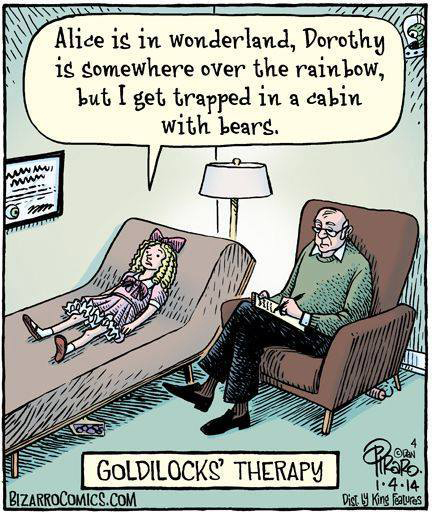
cARtOONSdAY: “tHERAPY”

What are little girls made of: Freud or Jung?

What are little girls made of: Freud or Jung?

Leave a comment

Filed under 2016, CarToonsday

Monday morning writing joke: “Agreeable”

A subject, a verb, and a direct object enter a bar and sit on the stools.

“What’ll ya have?” the bartender asks.

“I’ll have whatever he’s having,” the noun said pointing to the direct object.

“Same for me,” the verb said, “but make mine to go.”

The bartender then looked directly at the direct object.

The direct object rolled his eyes back and fluttered his lips. “All day,” he said, “all day and now we finally have a noun-verb agreement and I have no clue what I want.”

The subject looked at the verb. “I told you he was a third wheel.”

“Let’s go,” the verb said.

“Agreed,” said the subject and they left.

Leave a comment

Filed under 2016, Monday morning writing joke

X-rays reveal 1,300-year-old writings inside later bookbindings

The words of the 8th-century Saint Bede are among those that have been found by detecting iron, copper and zinc – constituents of medieval ink

By Dalya Alberge

Source: https://www.theguardian.com/books/2016/jun/04/x-rays-reveal-medieval-manuscripts

Ancient book reveraled 100dpi_6x4_4c

Medieval manuscripts that have been hidden from view for centuries could reveal their secrets for the first time, thanks to new technology.

Dutch scientists and other academics are using an x-ray technique to read fragments of manuscripts that have been reused as bookbindings and which cannot be deciphered with the naked eye. After the middle ages manuscripts were recycled, with pages pasted inside bindings to strengthen them. Those fragments may be the unique remains of certain works.

Dr Erik Kwakkel, a medieval book historian at Leiden University, told the Observer: “It’s really like a treasure trove. It’s extremely exciting.”
Professor Joris Dik, of the Delft University of Technology, described the potential for finding new material with clues to the past as “massive”. The technology does not just make hidden texts visible, but legible.

Access to such “hidden libraries” has been made possible by macro x-ray fluorescence spectrometry (MA-XRF), which allows pages to be read without removing the bookbinding.

Bindings made between the 15th and 18th centuries often contain hidden manuscript fragments that can be much older. Bookbinders used to cut up and recycle handwritten books from the middle ages, which had become old-fashioned following the invention of printing. These fragments, described by Kwakkel as “stowaways from a distant past”, are within as many as one in five early modern age printed books.

Kwakkel added: “Much of what we’re finding is 15th or 14th century, but it would be really nice to have Carolingian material, so from the ninth century or even older. It would be great to find a fragment of a very old copy of a Bible, the most important text in the middle ages. Every library has thousands of these bindings, especially the larger collections. If you go to the British Library or the Bodleian [in Oxford], they will have thousands of these bindings. So you can see how that adds up to a huge potential.”

Experiments have found a fragment from a 12th-century manuscript that includes excerpts from the work of Bede, the 8th-century monk and scholar. The researchers were even able to disassemble multiple pages that had been pasted on to one another, making the text legible. In one case, they could read each of three medieval pages that had been glued together. Elsewhere, they found two fragments stuck together underneath the cover of a 16th-century binding.

Dik’s team originally developed the technology, in collaboration with others, to “visualise” hidden layers in Old Master paintings. In 2011, for example, they discovered a previously unknown self-portrait by Rembrandt beneath another work. Although faint and unfinished, it dispelled doubts about the surface picture’s attribution to the 17th-century Dutch master, to the excitement of art historians.

Now the technology has proved to be “equally efficient in the visualisation of hidden medieval inks,” he said. “A thin beam of x-rays is used to scan the object, charting the presence and abundance of various elements below the surface. That is how iron, copper and zinc, the main element constituents of medieval inks, could be viewed, even when covered by a layer of paper or parchment.”

The problem, though, is that the current methodology is painfully slow, with scans sometimes taking more than 24 hours. Faster techniques are being explored. Dik said: “Right now, we’ve shown that it works.”

The research has been subsidised by the Young Academy, a branch of the Royal Netherlands Academy of Arts and Sciences.

Last year it emerged that techniques had been developed to decipher ancient papyrus scrolls that were burned black and buried in ash when Mount Vesuvius erupted 2,000 years ago. Vito Mocella, a scientist in Naples, found that they could read some of the scrolls without unravelling them by peering inside with x-rays.

Referring to Mocella’s technology, Dik said: “It’s different. The papyrus texts are hidden inside papyrus. We’re looking at stuff that is covered by something that is much thicker. Parchment and papyrus are quite different. Parchment is a much thicker, denser material.”

Leave a comment

Filed under 2016, books

Photo finish Friday: “Chicken”

A special delicacy, if you can stomach it.

A special delicacy, if you can stomach it.

Chicken

by David E. Booker

Boneless Skinless Children’s Thighs.
Picked up a pack and to my surprise
The taste just hit me right between the eyes:
chicken.

Didn’t matter how I had them made:
Sautéed, fried, or in a marinade.
One small taste did all to persuade:
chicken.

I even tried eleven herbs and spices.
Mixed in rice, lettuce, and tomato slices.
It did not matter what culinary devices:
chicken.

I consulted a cannibal from a foreign land.
Who said such boneless thighs would not stand.
Children were not on his diet plan:
chicken.

Boneless Skinless Children’s Thighs.
I saw the ad right before my own eyes.
I handed the neighbors’ kids over with no good-byes:
chicken.

Leave a comment

Filed under 2016, Photo Finish Friday, poetry by author

Haiku to you Thursday: “Tastes”

Without your whisper /

my ear hears only stale words. /

Summer tastes empty.

[Editor’s note: This is a variation on the Haiku posted last Thursday, entitled “Silence.”]

Leave a comment

Filed under 2016, Haiku to You Thursday, poetry by author

cARtOONSdAY: “cASE lOGIC 12: “rUNNY eGGS”

Nobody had thrown any eggs yet, but Gumshoe was certain that was about happen. Was this what it had come to: runny eggs and run on sentences?

Nobody had thrown any eggs yet, but Gumshoe was certain that was about happen. Was this what it had come to: runny eggs and run on sentences?

Leave a comment

Filed under 2016, cartoon by author, CarToonsday

Monday morning writing joke: “Greetings”

An older writer a bit down on his writing luck, takes a job as a greeter at Walmart to make ends meet. He tells himself that it is only for a little while, until freelance work picks back up, but even he is surprised when it only lasted one day.

The next day he walks into his favorite little dive and orders a tea. One of his writing friends is there.

“Hey,” his friend said, “I thought you’d be a work.”

“I should be,” the writer says, “but it didn’t work out.”

“What happened?

The writer hesitates, then shrugs his shoulders and says: “Yesterday was my first solo day. About halfway into my shift, a mean, loud woman, cigarette dangling from her mouth, barges into the store, hurling obscenities at the two kids she has in tow.

“I smile and try to calm down the situation by saying, ‘Good morning and welcome to Walmart. Nice children you have there. Are they twins?’

“I knew they weren’t just from the way one looked older than the other, but thought no harm in letting her to another subject.

“The woman stopped yell at them and turned her attention and mouth to me. ‘Hell no, moron, they ain’t twins. The oldest one’s 10 and the other one is seven. You blind or just plain stupid?’

“Now, I did my best to hold my tongue, but I just couldn’t help myself. I said, ‘Ma’am, I’m neither blind nor stupid. I just can’t believe that someone drank enough beer and was still able to keep it up twice to have sex with you. Have a good day and thank you for shopping at Walmart.’

“My supervisor told me I was probably in the wrong line of work.”

Leave a comment

Filed under 2016, Monday morning writing joke

The King’s Burden

The King’s Burden

by David E. Booker

The king sat high upon his throne, /
A tear upon his eye. /
He shook his head in a sad, sad way /
And asked himself, “Oh, why?” /
His quest had failed, his journey ended /
Without the Holy Grail. /
He searched for reasons in his wounded heart /
But his search was to no avail. /
Try as he might, his burdened remained /
And haunted him day and night. /
He had done his best, better than the rest /
But still his heart wasn’t right. /
He raised his sword, struck down a gourd /
Ready for one last try. /
Yet returned the tears and the dark fears /
And doubts and cries of “Why?!” /
O’ let this be a grave lesson learned: /
Beware charging up Death’s ridge. /
With sword in hand, you may march into a land /
Only to cross over Failure’s bridge.

Leave a comment

Filed under 2016, poetry by author

New words to live by: “Utteration”

It is time, once again, for New words to live by. This is a word or phrase not currently in use in the U.S. English lexicon, but might need to be considered. Other words, such as obsurd, crumpify, subsus, flib, congressed, and others, can be found by clicking on the tags below. Today’s New Word is a compounding of two nouns into a new word. Without further waiting, utteration (utter + iteration) and its verb form utterate are the new words for this month.

OLD WORDS
Utter, v. 1. To give audible expression to; speak or pronounce. 2. To express oneself with voice or in written / printed form, especially in words. 3. To make publicly known.

Iteration, n. 1. The act of repeating; a repetition. 2. A repetition with a minor variation.

NEW WORDS
Utteration, n. 1. To utter over and over and over again the same words or phrase or sound, especially as if saying them makes them appear to be true.

Utterate, v. The act of uttering over and over and over again the same words or phrase or sound, especially as if saying them makes them appear to be true.

Example:
A certain U.S. presidential candidate who utterates he’s going to build a wall along the Mexican border and is going to make the Mexicans pay for it, and that the wall will keep undocumented immigrants out of the United States. And because he is, a judge of Mexican decent can’t officiate at a trial that involves one of the candidate’s many failed enterprises.

[Editor’s note: yes, this example is the same as last month’s, showing that such utterations are hyprocrassy.]

Leave a comment

Filed under 2016, New words to live by