
Blooms in Spring’s desires. /
Companion to construction. /
Scent not of flowers.

A pot to “plant” in.
Blooms in Spring’s desires. /
Companion to construction. /
Scent not of flowers.
A pot to “plant” in.
Filed under 2016, Haiku to You Thursday, poetry by author
A writer sitting on a stool in the corner bar looks over at the bartender. “I’ve tried everything for my joints. Pain medications, homeopathic remedies, strange herbs. I’ve swallowed Glucosamine tablets, Turmeric powder, and honey and cinnamon for my aching joints, but nothing relieves my pain.”
Bartender: “When is it at its worst?”
Writer: “When I’m asked to pay my bar tab.”
The bartender immediately felt a bit of joint pain himself.
Filed under 2016, Monday morning writing joke
Ann Patchett’s Nashville Bookstore Hits the Road, With Dogs in Tow
by Alexandra Alter
Nashville’s newest bookstore is an old van.
The bright blue bookmobile, which hit the road this week, is a roving offshoot of Parnassus Books, a popular independent bookstore. It will roam around town, stopping at food truck rallies, farmers’ markets and outside restaurants.
The arrival of a bookstore on wheels is a fitting evolution for Parnassus, which is co-owned by Karen Hayes and the novelist Ann Patchett. The store’s name comes from Christopher Morley’s 1917 novel “Parnassus on Wheels,” about a middle-aged woman who travels around selling books out of a horse-drawn van.
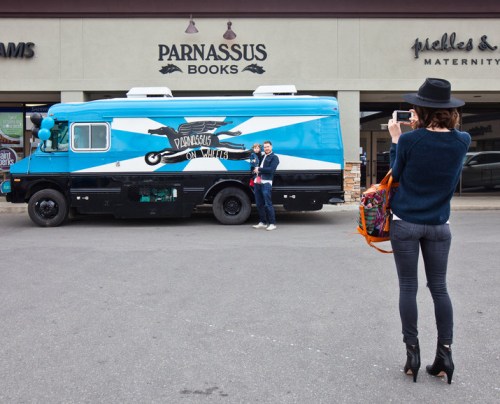
Parnassus takes to the streets of Nashville, TN.
Since Parnassus opened in 2011, Ms. Hayes has wanted a traveling bookstore of her own. She looked at taco trucks and ice cream trucks and felt envious of their freedom to take business wherever people gathered, she said.
“A bookmobile made so much sense, because food trucks work so well in this town,” Ms. Hayes said by telephone. “It’s a great way to get our name out there, too. It’s a rolling advertisement.”
Ms. Hayes found the van on eBay last spring, and bought it for $10,000 from a library in Georgia. The van was already outfitted with angled shelves, which keep the books from flying off, but still needed $20,000 worth of work.
It is a logical and efficient way for a small bookstore to expand its footprint, especially as big chains have shuttered locations, leaving a vacuum for enterprising independent stores to fill. A handful of independent stores around the country have taken the trade on the road, in an effort to stir up business and bring books to neighborhoods and suburbs without a bookstore. Little Shop of Stories, an independent store in Decatur, Ga., used a grant from the author James Patterson to turn a used school bus into a mobile bookstore. Fifth Dimension Books, a bookmobile in Austin, Tex., stocks a rotating selection of science fiction and fantasy books from its collection of 100,000 volumes.
Bookmobiles are not about to become as prevalent as food trucks. But their arrival in Nashville and other cities offers another encouraging sign that independent stores are thriving again, after years of decline. Sales at bookstores rose 2.5 percent in 2015 over the previous year, to $11.17 billion, for the first annual increase since 2007, according to the United States Census Bureau.
Dozens of small bookstores across the country are opening multiple locations, expanding into mini chains. Books Inc., a San Francisco Bay Area independent store, now has 11 locations. Third Place Books in Seattle will soon open a new store, its third. Greenlight Bookstore, a prominent independent store in Fort Greene, Brooklyn, is opening a second Brooklyn store in Prospect-Lefferts Gardens.
In 2015, the American Booksellers Association counted 1,712 member stores in 2,227 locations, a big jump from 2009, when the group had 1,401 stores in 1,651 locations.
“The trend is unmistakable, and we see it not only continuing but growing,” said Oren Teicher, the ABA’s chief executive.
Parnassus is expanding too. It will double in size, adding 2,500 square feet of retail space, when it takes over a recently vacated storefront next door. Its owners considered looking for a second location, but decided the book van would be a better way to expand the store’s geographic range and customer base.
The van packs around 1,000 books, mostly new releases and best sellers — a small fraction of Parnassus’s stock of 20,000 books. Its owners have managed to make the cramped space bright and inviting: customers can walk the narrow aisles between the shelves, and can linger and sample books on one of the padded blue benches.
“One of my hopes is that we’ll be able go into some of the outlying suburbs and cities that don’t necessarily have a bookstore,” said Grace Wright, a Parnassus bookseller who will manage the bookmobile. “There’s nothing like a good bookstore.”
Another bonus: the physical bookstore has four resident dogs — Opie, Belle, Mary Todd Lincoln, and Bear — who love riding around town, Ms. Wright said.
“They seem to have fun in the bus,” she said.
From a recent letter sent home from school involving a class trip coming up in later part of April:
“Hello 7th grade Families and students,
“The time has come to provide some details for the 7th grade trip to Atlanta! The trip dovetails with our … curriculum, and we are excited about what lies ahead for our students.”
Several paragraphs later:
“Although there is no real need for devices, students may bring cellphones or one electronic device on the trip (sic). We want students to fully engage with activities each day, but we realize that there will be many fabulous photo opportunities in our nation’s capital.”
***
Now, I want to know what curriculum are they teaching?
Did they fight the Civil War again, and I missed it?
Filed under 2016, proofreading

Rubber Eraser Day: not just pink parallelograms anymore. With a large enough eraser, what would you “rub out” in your past?
Filed under 2016, photo by David E. Booker, Photo Finish Friday
Away and away /
flies the moments of our past. /
Still — my heart remains.
Filed under 2016, Haiku to You Thursday, poetry by author
6 Hard Truths Every Writer Should Accept
by Dana Elmendorf
1. It won’t be your first novel.

Dana Elmendorf
2. First drafts always suck.
There’s no getting around it. It’s a part of the process we must all accept to make the improvements our manuscripts need. The first words you put on paper will not sparkle like shimmering diamonds. Geological fact, diamonds look like cloudy, dirty rocks until somebody cuts and polishes them. Don’t fight it. Let the suckage happen. It’s a healthy part of growing as a writer. But I’ll tell you a little secret, each first draft sucks a little less than its predecessor.
3. Your husband, mother, sister, best friend, coworker or the neighbor who is a high school English teacher does not qualify as a critique partner.
It doesn’t matter how “honest” they are with you. The truth of the mater is, only another writer can give you what you really need. They understand voice, character development, pacing, story arc, plot points, sub plots, inciting incidents, reversals, character growth, and about six hundred other things that go into writing a book. It doesn’t matter that your bestie reads a hundred books a year. Reading books is only a fraction of what it takes to be a writer. Passion for reading does not equal qualified critique partner. Beta reader, maybe. Critique partner, no. Do your writing a favor and find yourself several qualified critique partners. It’ll be the best decision you ever made for your career.
4. Your journey will not be the same journey as your peer’s journey.
This is where I’m supposed to tell you not to compare yourself to others. But we both know that’s pointless. You’ll do it anyway. We all do. If you’re comparing yourself it’s probably because you’re feeling like you’re not where you’d like to be in your career. Which will most likely result in finding inadequacies within yourself. Instead, when you do compare yourself, be realistic. Realize there aren’t any measurable factors to compare yourself despite how similar your life is to another writer. Because when it comes down to it, some things you just can’t assign a value, like natural talent, motivation, passion, doubt, and many more intangible factors. At the end of the day, it’s the writer who perseveres that will become published.
5. Being good isn’t good enough.
This factor was the hardest for me to accept. It implies that a positive word like “good” only equates to “competent.” There is a sea of talented writers out there. What you need to be to stand out varies. Maybe you need to be different, refreshing, clever, timeless, re-inventive, unique, or my personal favorite…sparkly. The only way to be better than good is through hard work and perseverance. Which leads me to the last point…
6. Pay your dues.
There isn’t any secret advice to getting published. There are no short cuts in this business. Nothing comes easy in this industry. You want to get published? Then put in the time, blood, sweat, and tears that it takes to get you there. Sure some authors make it look easy, but don’t be fooled. They walked that same long road just like the rest of us.
These hard truths aren’t here to disappoint you. They’re here to help you focus on what’s important, your writing. Set your sights on your goal and don’t let these small things trip you up along the way.
—
Column by Dana Elmendorf, author of SOUTH OF SUNSHINE (April 1, 2016, Albert Whitman and Company). Dana lives in southern California with her husband, two boys and her tiny dog Sookie. When she isn’t exercising, she can be found geeking out with Mother Nature or scouring the internet for foreign indie bands.You can also find her dreaming up contemporary YA romances with plenty of kissing. Follow her on Twitter or Facebook.
Filed under 2016, writing tip, Writing Tip Wednesday
A striped cat writer to a spotted cat writer:
Striped cat: “I’m having a hard time writing this scene.”
Spotted cat: “How does it begin?”
Striped cat: “Tabby, or not Tabby.”
Filed under 2016, Monday morning writing joke
The Fairy Tales That Predate Christianity
Using techniques from evolutionary biology, scientists have traced folk stories back to the Bronze Age.
by Ed Yong
Source: http://www.theatlantic.com/science/archive/2016/01/on-the-origin-of-stories/424629/?utm_source=SFFB
Some days, each word can feel like a year.
This is more than a metaphor. It means that scientists can reconstruct the relationships between versions of a story using the same tools that evolutionary biologists use to study species. They can compare different versions of the same tale and draw family trees—phylogenies—that unite them. They can even reconstruct the last common ancestor of a group of stories.
In 2013, Jamie Tehrani from Durham University did this for Little Red Riding Hood, charting the relationships between 58 different versions of the tale. In some, a huntsman rescues the girl; in others, she does it herself. But all these iterations could be traced back to a single origin, 2,000 years ago, somewhere between Europe and the Middle East. And East Asian versions (with several girls, and a tiger or leopard in lieu of wolf) probably derived from these European ancestors.
That project stoked Tehrani’s interest, and so he teamed up with Sara Graça da Silva, who studies intersections between evolution and literature, to piece together the origins of a wider corpus of folktales. The duo relied on the Aarne Thompson Uther Index—an immense catalogue that classifies folktales into over 2,000 tiered categories. (For example, Tales of Magic (300-749) contains Supernatural Adversaries (300-399), which contains Little Red Riding Hood (333), Rapunzel (310), and more amusing titles like Godfather Death (332) and Magnet Mountain Attracts Everything (322).
Tehrani and da Silva recorded the presence of each Tales of Magic to 50 Indo-European populations, and used these maps to reconstruct the stories’ evolutionary relationships. They were successful for 76 of the 275 tales, tracing their ancestries back by hundreds or thousands of years. These results vindicate a view espoused by no less a teller of stories than Wilhelm Grimm—half of the fraternal duo whose names are almost synonymous with fairy tales. He and his brother Jacob were assembling German peasant tales at a time of great advances in linguistics. Researchers were unmasking the commonalities between Indo-European languages (which include English, Spanish, Hindi, Russian, and German), and positing that those tongues shared a common ancestor. In 1884, the Grimms suggested that the same applied to oral traditions like folktales. Those they compiled were part of a grand cultural tradition that stretched from Scandinavia to South Asia, and many were probably thousands of years old.
Many folklorists disagreed. Some have claimed that many classic fairy tales are recent inventions that followed the advent of mass-printed literature. Others noted that human stories, unlike human genes, aren’t just passed down vertically through generations, but horizontally within generations. “They’re passed across societies through trade, exchange, migration, and conquest,” says Tehrani. “The consensus was that these processes would have destroyed any deep signatures of descent from ancient ancestral populations.”
Multilingual Folk Tale Database: http://www.mftd.org/index.php?action=atu
Not so. Tehrani and da Silva found that although neighboring cultures can easily exchange stories, they also often reject the tales of their neighbors. Several stories were less likely to appear in one population if they were told within an adjacent one.
Meanwhile, a quarter of the Tales of Magic showed clear signatures of shared descent from ancient ancestors. “Most people would assume that folktales are rapidly changing and easily exchanged between social groups,” says Simon Greenhill from the Australian National University. “But this shows that many tales are actually surprisingly stable over time and seem to track population history well.” Similarly, a recent study found that flood “myths” among Aboriginal Australians can be traced back to real sea level rises 7,000 years ago.
Many of the Tales of Magic were similarly ancient, as the Grimms suggested. Beauty and the Beast and Rumpelstiltskin were first written down in the 17th and 18th centuries respectively, but they are actually between 2,500 and 6,000 years old—not quite tales as old as time, but perhaps as old as wheels and writing.
The Smith and the Devil is probably 6,000 years old, too. In this story, a crafty blacksmith sells his soul to an evil supernatural entity in exchange for awesome smithing powers, which he then uses to leash the entity to an immovable object. The basic tale has been adapted in everything from Faust to blues lore, but the most ancient version, involving the blacksmith, comes from the Bronze Age! It predates the last common ancestor of all Indo-European languages. “It’s constantly being updated and recycled, but it’s older than Christianity,” says Tehrani.
This result might help to settle a debate about the origins of Indo-European languages. It rules out the idea that these tongues originated among Neolithic farmers, who lived 9,000 years ago in what is now modern Turkey. After all, how could these people, who hadn’t invented metallurgy, have concocted a story where the hero is a blacksmith? A rival hypothesis becomes far more likely: Indo-European languages emerged 5,000 to 6,000 years ago among pastoralists from the Russian steppes, who knew how to work metal.
“We think this is the start of a much bigger project using oral traditions and storytelling as windows into the lives of our ancestors,” says Tehrani.
He now wants to understand why some tales track well with human history but others don’t. Are some plot elements or motifs more stable than others? “There wasn’t anything obvious, no religious or supernatural dimension that stood out, and no gender norms or aspects that might be particular to particular societies,” he says. “But it needs a much more detailed analysis, bringing in historians, ethnographers, and other scholars.”
“Folktales are often disregarded as lesser forms of literature, but they’re valuable sources of information on cultural history,” adds da Silva. “Despite being fictitious, they work as simulations of reality.”
In other words, by understanding our stories, we understand ourselves.
Source: http://www.theatlantic.com/science/archive/2016/01/on-the-origin-of-stories/424629/?utm_source=SFFB
Filed under 2016, fairy tales


 Booker's Blog