
Snow exciting. /
Anticipation as white /
as the first small flakes.
Snow exciting. /
Anticipation as white /
as the first small flakes.
Filed under 2016, Haiku to You Thursday, poetry by author
7 Steps to Creating a Flexible Outline for Any Story
by K.M. Weiland
Mention the word outline in a room full of writers, and you’re sure to ignite a firestorm of passionate debate. Writers either love outlines, or they hate them. We either find them liberating, or we can’t stand how confining they are.

K.M. Weiland
To imbue your writing with the full power of outlining, you need to approach the process from a mindset of flexibility and discovery. When you do this, you’ll end up with a road map to storytelling success. Road maps are there to show you the fastest and surest way to reach your destination, but they certainly don’t prevent you from finding exciting off-road adventures and scenic drives along the way.
At their best, outlines can help you flesh out your most promising story ideas, avoid dead-end plot twists and pursue proper structure. And the greatest part? They save you time and prevent frustration. Sketching out your plot and characters in your first draft can take months of trial and error. Figuring out those same elements in an outline requires a fraction of the time—and then allows you to let loose and have fun in your first draft.
Let’s take a look at how to get the most out of the outlining process, beginning with the shaping of your premise and working all the way through to a complete list of scenes. (Note: Although this outlining method is one I use myself and highly recommend, keep in mind that there is no right or wrong way to outline a story. The only requirement is that you find the groove that works for you. If you start outlining and begin to feel the technique isn’t working for you, rather than denouncing outlines entirely, consider how you might adjust the process to better suit your personality and creative style.)
1. Craft your premise.
Your premise is the basic idea for your story. But it’s not enough to just have an idea. “Guy saves girl in an intergalactic setting” is a premise, but it’s also far too vague to offer much solid story guidance.
This is why your outline needs to begin with a tightly crafted premise sentence that can answer the following questions:
Once you’ve answered these questions, combine them into one or two sentences:
Restless farm boy (situation) Luke Skywalker (protagonist) wants nothing more than to leave home and become a starfighter pilot, so he can live up to his mysterious father (objective). But when his aunt and uncle are murdered (disaster) after purchasing renegade droids, Luke must free the droids’ beautiful owner and discover a way to stop (conflict) the evil Empire (opponent) and its apocalyptic Death Star.
2. Roughly sketch scene ideas.
Armed with a solid premise, you can now begin sketching your ideas for this story. Write a list of everything you already know about your story. You’ll probably come to this step with a handful of scenes already in mind. Even if you have no idea how these scenes will play out in the story, go ahead and add them to the list. At this point, your primary goal is to remember and record every idea you’ve had in relation to this story.
Once you’ve finished, take a moment to review your list. Whenever you encounter an idea that raises questions, highlight it. If you don’t know why your character is fighting a duel in one scene, highlight it. If you don’t know how two scenes will connect, highlight them. If you can’t picture the setting for one of the scenes, highlight that, too. By pausing to identify possible plot holes now, you’ll be able to save yourself a ton of rewriting later on.
Your next step is to address each of the highlighted portions, one by one. Write out your ideas and let your thoughts flow without censoring yourself. Because this is the most unstructured step of your outline, this will be your best opportunity to unleash your creativity and plumb the depths of your story’s potential. Ask yourself questions on the page. Talk to yourself without worrying about punctuation or spelling.
Every time you think you’ve come up with a good idea, take a moment to ask yourself, “Will the reader expect this?” If the answer is yes, write a list of alternatives your readers won’t expect.
3. Interview your characters.
In order to craft a cast of characters that can help your plot reach its utmost potential, you’ll need to discover crucial details about them, not necessarily at the beginning of their lives but at the beginning of the story.
To do this for your protagonist, work backward from the moment in which he will become engaged in your plot (the “disaster” in your premise sentence). What events in your protagonist’s life have led him to this moment? Did something in his past cause the disaster? What events have shaped him to make him respond to the disaster in the way he does? What unresolved issues from his past can further complicate the plot’s spiral of events?
Once you have a basic idea of how your character will be invested in the main story, you can start unearthing the nitty-gritty details of his life with a character interview. You may choose to follow a preset list of questions (you can find a list of more than 100 such questions in my book Outlining Your Novel: Map Your Way to Success), or you may have better luck with a “freehand interview” in which you ask your protagonist a series of questions and allow him to answer in his own words.
4. Explore your settings.
Whether your setting is your childhood neighborhood or the seventh moon of Barsoom, you’ll want to enter your first draft with a firm idea of where your prominent scenes will be taking place.
Don’t choose a setting just because it sounds cool or because you’re familiar with it. Look for settings that will be inherent to your plot. Can you change your story’s primary locale without any significant alterations to the plot? If so, dig a little deeper to find a setting better suited to your plot, theme and characters.
Based on the scenes you’re already aware of, list the settings you think you’ll need. Can you reduce this list by combining or eliminating settings? Nothing wrong with a sprawling story locale, but extraneous settings should be eliminated just as assiduously as unnecessary characters.
5. Write your complete outline.
You’re finally ready to outline your story in full. This is where you will begin plotting in earnest. In Step 2, you solidified the big picture of your story by identifying the scenes you were already aware of and figuring out how they might fit together. Now, you will work through your story linearly, scene by scene, numbering each one as you go. Unlike the “sketches” in Step 2, in which your primary focus was on brainstorming and exploring possibilities, you will now be concentrating on molding your existing ideas into a solid structure.
How comprehensive you want to be is up to you. You may choose to write a single sentence for each scene (“Dana meets Joe at the café to discuss their impending nuptials”), or you may choose to flesh out more details (“Joe is sitting by himself in a booth when Dana arrives; Dana orders coffee and a muffin; they fight about the invitation list”). Either way, focus on identifying and strengthening the key components of each scene’s structure. Who will be your narrating character? What is his goal? What obstacle will arise to obstruct that goal and create conflict? What will be the outcome, and how will your character react to the resulting dilemma? What decision will he reach that will fuel the next scene’s goal?
Work to create a linear, well-structured plot with no gaps in the story (see the checklist on the opposite page). If you can get this foundation right in your outline, you’ll later be free to apply all your focus and imagination to the first draft and bring your story to life.
As you mentally work through each scene, watch for possible lapses of logic or blank areas in how one event builds to another. Take the time to think through these potential problems so they won’t trip you up later. If you get stuck, try jumping ahead to the next scene you know, and then working backward. For instance, if you know where you want your characters to end up, but not how they’ll get there, start at the ending point and then see if you can figure out what has to happen in the preceding events to make it plausible.
6. Condense your outline.
Once you’ve finished your extended outline, you may want to condense the most pertinent points into an abbreviated version. Doing so allows you to weed out extraneous thoughts and summarize the entire outline into a scannable list for easier reference. Because your full outline may contain a fair amount of rambling and thinking out loud on the page, you’re likely to end up with a lot of notes to review (I often have nearly three notebooks of material). Rather than having to wade through the bulk of your notes every time you sit down to work on your first draft, you can save yourself time in the long run by doing a little organizing now.
You may choose to create your abbreviated outline in a Word document, write out your scenes on index cards, or use a software program such as the free Scrivener alternative yWriter.
7. Put your outline into action.
By now, you’ll be feeling prepared and eager to get going on your first draft. Each time you sit down to work on your manuscript, begin by reviewing your outline. Read the notes for your current scene and the scene to follow. Before you start writing, work through any remaining potential problems in your head or on paper. If the time comes (and it will come) when you’re struck with a better idea than what you had planned in your outline, don’t hesitate to go off-road. These ventures into unknown territory can result in some of the most surprising and intriguing parts of your story.
An outline will offer you invaluable structure and guidance as you write your first draft, but never be afraid to explore new ideas as they occur. Remember, your outline is a map showing you the route to your destination, but that doesn’t mean it is the only route.
***
K.M. Weiland is the IPPY and NIEA Award-winning and internationally published author of the Amazon bestsellers Outlining Your Novel and Structuring Your Novel, as well as Jane Eyre: The Writer’s Digest Annotated Classic, the western A Man Called Outlaw, the medieval epic Behold the Dawn, the portal fantasy Dreamlander, and the historical/dieselpunk adventure Storming. When she’s not making things up, she’s busy mentoring other authors on her award-winning blog Helping Writers Become Authors. She makes her home in western Nebraska.
Filed under 2016, writing tip, Writing Tip Wednesday
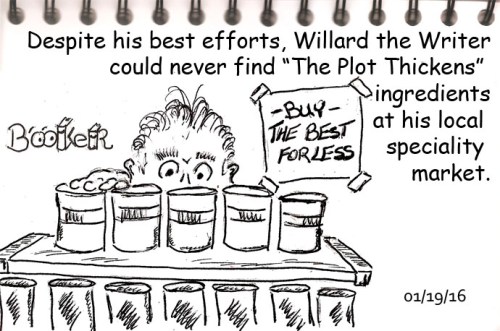
He did find some interesting okra.
Filed under 2016, cartoon by author, CarToonsday
There once was a writer in town /
Who frowned when the critic came around. /
Still, he tried one day /
To smile anyway: /
The day he saw the critic gagged and bound.
Filed under 2016, Monday morning writing joke, poetry by author
Japanese bookshop stocks only one book at a time
by Alison Flood
Owner of Morioka Shoten in Tokyo says the strategy adds up to a dedicated exhibition for each volume it sells
Source: http://www.theguardian.com/books/2015/dec/23/japanese-bookshop-stocks-only-one-book-at-a-time

With hundreds of thousands of books published every year, the choice of what to stock can prove bewildering for booksellers. The owner of one small bookshop in Tokyo has taken an unusual approach to the problem: Morioka Shoten, located in the luxury shopping district of Ginza, offers just one title to its customers.
Owned by experienced bookseller Yoshiyuki Morioka, the store opened in May, stocking multiple copies of just one title, which changes weekly. Books to have featured in the shop include Finnish author Tove Jansson’s novel The True Deceiver, in which a young woman fakes a burglary of an elderly artist’s house to persuade her she cannot live alone, and Hans Christian Andersen’s Fairy Tales.
“Before opening this bookstore in Ginza, I had been running another one in Kayabacho for 10 years. There, I had around 200 books as stock, and used to organise several book launches per year. During such events, a lot of people visited the store for the sake of a single book. As I experienced this for some time, I started to believe that perhaps with only one book, a bookstore could be managed,” said Morioka.
“This bookstore that sells only one book could also be described as ‘a bookstore that organises an exhibition derived from a single book’. For instance, when selling a book on flowers, in the store could be exhibited a flower that actually appears in the book. Also, I ask the authors and editors to be at the bookstore for as much time as possible. This is an attempt to make the two-dimensional book into three-dimensional ambience and experience. I believe that the customers, or readers, should feel as though they are entering ‘inside a book’.”
Other titles to have featured in Morioka Shoten include Tsukiyo To Megane (Moon Night and Glasses) by Mimei Ogawa, Karachi No Moto (Source of Form) by Akito Akagi, Koichi Uchida and Takejiro Hasegawa, and Karl Blossfeldt: Working Collages, a collection of the artist’s photographs of plants. The first title to be sold next year will be Maseru Tatsuki’s photo anthology Fish-Man.
“The concept of this bookstore seems to have gained the sympathy of a lot of people, and I receive a number of guests from all over the globe,” said Morioka, who has sold 2,100 books so far.
The bookseller added that while “the current book market seems to be taking second billing to ebooks and other media such as social networking services”, he believes that “a book is a physical object with special attraction that has been, is and will always be the same, and that many will continue to utilise physical books, especially as a communication tool”.

A piece of the sky.
The blue fedora
Try as he might;
try as he will
it became apparent
there was nothing for him still.
He worked to the bone
and then he worked beyond.
When one day somebody asked
he was already gone.
Air apparent to a world
that had passed him by.
With his blue fedora
he took off for the sky.
Maybe some day he’ll make it
up there to one of the stars.
Some say that’s far enough;
others say it’s much too far.
Maybe some day you’ll see him
chasing dreams or chasing a cat
the air apparent man
and his blue fedora hat.
–David E. Booker

The blue fedora man and the world he left behind.
In honor of National Hat Day.
Filed under 2016, photo by David E. Booker, Photo Finish Friday, poetry by author
We leave the light on— /
not to provide you guidance /
but to give us hope.
Filed under 2016, Haiku to You Thursday, poetry by author
9 Ways to Stop Your Novel from Stalling
by Tracey Barnes Priestley
I would be willing to wager that most writers have made New Year’s resolutions regarding their writing practices. I know I have.
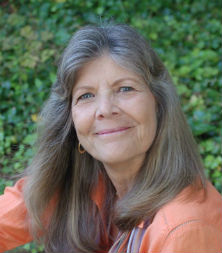
Tracey Barnes Priestley
Curious about this, I canvassed a few of my writer friends. Sure enough, many of them had frequently participated in this annual tradition that dates all the way back to the Babylonians. Each writer had faced January with a deep commitment and heartfelt enthusiasm for those resolutions. One promised herself she’d “finish the first draft” of her novel. Another told me she had written on her dry-erase board, in big, bold letters, “I will clean up the dialogue mess that’s drowning this book.” The least experienced of them, an as yet unpublished young man full of enthusiasm for his craft, swore he would “silence my inner critic and keep writing, no matter what.”
I followed up by asking them how successful they had been in keeping those resolutions. Unfortunately, all had experienced the same thing: disappointment. No matter how hard they tried, they had ultimately been unable to make good on what they had resolved to do.
I knew exactly what they were talking about. I gave up creating New Year’s resolutions about my writing years ago when I found myself at the end of yet another cold January, with nothing more to show for all of my efforts than an exercise in futility. I was left feeling a range of emotions, from guilty to downright silly.
It’s actually quite comical just how few of us keep our New Year’s resolutions. It’s estimated only 45 percent of the population even tries to resolve making changes in the New Year. Of these brave souls, a mere 8 percent are successful.
Yet I’ve wondered if writers might be even more inclined than the general public to approach the New Year with a list of things we want to change, accomplish or do differently. We seem ripe for this kind of experience. As creative thinkers, we face a unique set of circumstances when it comes to producing our work. Alone in whatever space we can manage for our writing, we pound away at the keyboard, with our thoughts, our characters, our struggles and the never-ending reality that we aspire to a tough, highly competitive profession. Why wouldn’t we try to capitalize on the fresh start, the clean slate that January offers us? Magical thinking is right up our alley!
Why Our Writing Can Stall
In my work as a life coach, I’ve come to believe that our writing can be derailed because of two fundamental processes. The first, naturally, is the very nature of our craft, the writing process itself—think plotting, character development, etc. Unfortunately, this intrinsic set of challenges dwells right alongside our individual writing processes—complete with procrastination, destructive thought patterns, negative experiences, ambiguous motivation, unrealistic expectations, etc. And we wonder why we can’t keep our writing resolutions.
By now you’re probably ready to chuck your computer out the window. Don’t! Think of these two processes as valuable tools. Once you understand how they may be driving your inability to meet your writing resolutions, you will be poised to utilize effective strategies that support you and your writing every step of the way.
What’s Holding You Back?
Let’s begin by identifying the warning signs that your writing may be about to stall out. Consider current or previous writing resolutions you failed to keep. Ask yourself if you have experienced any of the following: lack of initiative; inability to prioritize writing tasks; frequent distraction; failure to establish a consistent writing pace/routine; inner dialogue that is one negative message after another; finding yourself simply “too busy” to get anything done. This is hardly an exhaustive list. Reasons writers stall can be varied and unique. Your task is to be as exact—and as honest with yourself—as you can in identifying what gets in the way of your ability to make progress on your projects. Make a list.
Next, evaluate this list from the perspective of the work-in-progress itself. As an example, let’s use my writer friend’s resolution to finish her first draft.
Every time she sat down at her computer, this writer felt lost about where the story should go next, and unclear about the relationship between her two main characters. She found herself thinking, This is useless, and, It’s not a strong enough idea for an entire book—maybe I should ditch the entire thing.
First, she tried to address the problems in the work itself. She sought craft and technique help with her plot and eventually resolved some backstory problems that had delayed the action and confused things between her characters. But the problems with her own lack of clarity persisted. Now she was fairly certain that the problem was within her writing process.
That meant facing off with her inner critic, which is always the most efficient place to begin. She looked her frustration in the eye and began to unravel the negative messages ricocheting around inside her head. Why exactly was this project “useless”? After some contemplation, she surprised herself with her answer: “Because I don’t have the patience for anything but short stories—certainly not a full-length novel.” This statement got her wheels turning in a new direction. She rethought her word choice (she is, after all, a writer) and decided it wasn’t really a lack of patience—this gifted writer was actually lacking confidence. She found herself wondering:
I’ve had some success with short stories, so why am I risking my time and energy on something I don’t know much about? She realized she’d been rationalizing away the entire project, even though writing a novel really was something she wanted to try.
Once you are able to identify what is really preventing you from pushing ahead, you’ll be freed up to construct writing goals that will actually yield productive results. For my friend, this meant not just correcting her self-defeating thoughts, but lifting the expectations she was unconsciously placing on her unwritten manuscript. It didn’t have to be a “success,” as her published short stories had been, to be worth her while—or at least, she needed to redefine what success meant to her. Once you decide that writing something you want to write is never a waste of time, regardless of whether or not it’s published in the end, you might just find that those negative voices quiet down on their own.
Let’s consider another example, the young writer who swore he would “silence my inner critic and keep writing, no matter what.”
When he viewed his writing from the perspective of each of these two processes, he discovered some distinct problems. He admitted to himself that he felt foolish in the eyes of others for turning his back on the profession he had trained for—engineering—and that he felt like a fraud because he had not been formally trained to be a writer. Those were demons he had to face if he ever wanted to get past Chapter 1.
Next, from the perspective of the writing process, he realized that while writing a novel was on his bucket list, he had not really worked out enough of a story idea to be able to take action on the page.
If you’re intimidated by the prospect of writing an entire novel (and who isn’t?), why not set a goal of writing, say, three chapters? By the time you meet that smaller, more achievable goal, you might just find you have an idea for Chapter 4. When it comes to writing, the laws of momentum apply—it’s infinitely easier to move toward something when you’re already in motion than it is to start from a dead stop.
How to Avoid Stalling: 9 Ways
Now that you’ve seen how fundamentals that have very little to do with actual words on a page can derail a writer’s progress, let’s take a look at what else we can to do make sure we keep moving.
1. Ditch the word resolution entirely.
It’s a setup, one that has been riding on the backs of people for thousands of years. Instead, set a goal, objective or even intention.
2. Understand what truly motivates you.
For some writers, identifying a positive outcome and working toward it is the most effective form of motivation. Conversely, other writers are spurred on by a degree of unrest, even fear.
Write down exactly what is motivating you to meet your writing goal. Is it a good fit? Does it ring true? If not, identify a more appropriate motivation. When finished, post it where you can see it when you are writing.
3. Break it down.
It can be quite worthwhile, exciting even, to set large goal. “Yes, I will finish my novel this year!” But make sure it’s specific—which usually means breaking it down into smaller goals you can cross off along the way. Remember my friend’s resolution, “I will clean up the dialogue mess that’s drowning this book”? It would have been more attainable to separate this vague notion into three separate goals: (1) When I hear myself saying negative things like “I’m drowning this book,” I will stop, write the negative message down, put it into my complaint box and get back to work (a good practice for anyone working toward any goal, by the way); (2) Over the next two weeks I will identify the dialogue passages that are giving me grief; and (3) By the end of January, I will have rewritten at least one scene that includes dialogue. Note that the goals are not just well defined, but action oriented, and that the second and third goals include a targeted time frame. Most of us will be more successful if we give ourselves reasonable deadlines.
4. Be realistic.
Changing behaviors, attitudes and habits is a process. Rarely does change occur because of one event or a date on the calendar. (Curious to know more about why this is? Do some research on the neuroscience of change—you will be astounded by what is required for our poor brains to shift into a new mode.)
5. If you feel frustrated, pick a single task—the smaller the better.
It should be related to your work-in-progress, but it doesn’t have to be what chronologically comes next in your manuscript’s progression. It does, however, need to be so simple you can’t possibly fail. For example, it may seem like rewriting one page should be easy enough to accomplish, but if you’re not succeeding, the task is too big. Instead, aim to rewrite one paragraph or even just one sentence. When you are finished, move onto the next small task. This approach fights frustrations with success, and builds forward progress into your writing practice.
6. Pair up.
Ask another writer to join you in working toward your individual goals in the months ahead. You’ll both benefit from being accountable to one another, and the mutual support will motivate you to follow through.
7. When all else fails, take a break.
It can be as simple as getting up from your computer and walking around the house, or as significant as putting your project on hold for a month. Stepping away from the source of our frustration can give us a fresh perspective and renewed momentum. But be sure to designate an end point to this refueling period to ensure that it is in fact a break—and not an excuse not to get up from that chair and never sit back down.
8. Realize that setbacks are part of the process.
Every writer’s road is full of tight curves, jarring potholes and unexpected bumps. Accept this inevitability, and you won’t be as surprised when you slam into something that brings you to a screeching halt. By eliminating the element of surprise, you minimize disappointment, which will help you to recover and get moving again.
9. Above all, be patient!
Meeting your writing goals takes time and effort. When you throw out that laundry list of resolutions and focus your attention on just one or two well-crafted objectives, you’re already one step ahead of where you were last year. Remember that 12 months is plenty of time to accomplish your writing goals if you approach them with understanding, clarity and objectivity. Here’s wishing you every success in 2015. Happy New Year!
—
About the author: Tracey Barnes Priestley is a columnist, blogger and novelist. She is the author of the novel Duck Pond Epiphany as well as a life coach who teaches writers organization, communication and stress management skills useful for today’s publishing world. Contact her at tracey@thesecondhalfonline.com
Filed under 2016, writing tip, Writing Tip Wednesday

Young Willard liked to read, but he wasn’t sure he wanted a Free Adult for doing it. He already had two. Wasn’t that enough?
Filed under 2016, cartoon by author, CarToonsday
A writer, a priest, and a politician walk into a bar.
After a few drinks, the politician walks over to the priest and says, “I hate to admit it, father, but I have told some pretty big whoppers in my time.”
“I’m sure,” the priest says. “I have probably heard them all.”
The politician pauses for a moment and then says, “How could you? I’m not Catholic. I’ve never been to confession. Some of my biggest ones have been in private.”
“I’m a priest. We know these things.”
The politician takes his drink and quickly leaves.
The priest then turns to the writer. “Now, what is your problem?”
“Well, father, in my time, in order to make ends meet, I have written for politicians, even crafting some of their ‘big whoppers.’ Including some said in private.”
“So you know what I’m talking about and you came seeking forgiveness?”
“No, father. Until you scared him off, I came to get paid.”
Filed under 2016, Monday morning writing joke


