

Willard never saw Mr. Firestone after 6th grade, except in his nightmares.
Willard never saw Mr. Firestone after 6th grade, except in his nightmares.
Filed under 2015, cartoon by author, CarToonsday
There once was a writer from Glasgow /
Whose writing was always a slow go. /
When turtles would mate /
He could write and relate; /
But for meeting deadlines he was always a no-show.
***
There was a writer who sent twenty different puns to his friends, with the hope that at least ten of the puns would make them laugh. No pun in ten did?!
Filed under 2015, Monday morning writing joke, poetry by author
Award-winning book banned in New Zealand. First time in 22 years.
by Simon Collins
Source: http://www.nzherald.co.nz/entertainment/news/article.cfm?c_id=1501119&objectid=11509128
The author of the first book to be banned in New Zealand for at least 22 years is asking: “Will I be burnt next?”
Ted Dawe, 64, the head of studies at Taylors College for international students in Auckland, is the unlikely subject of the first interim restriction order on a book under the Films, Videos and Publications Classification Act 1993.
His award-winning book for teenagers, Into The River, has been banned from sale or supply under the order issued by the president of the Film and Literature Board of Review, Dr Don Mathieson, QC.
The order took effect when it was issued on September 3 and applies until the full board meets to decide on a permanent classification for the book. Dr Mathieson said that would be as soon as possible and “may very well be at the end of this month”.
In the meantime, media law expert Professor Ursula Cheer has said it was illegal to supply the book even to a friend.
“Having it for your own personal use is okay. Passing it around to your friends is not,” she said.
Mr Dawe said he was “blindsided” by the ban, which was sought by lobby group Family First after deputy chief censor Nic McCully removed a previous R14 restriction on the book on August 14, making it totally unrestricted.
“It’s extraordinary,” Mr Dawe said. “I’ve had quite a few emails from people who share that sense of outrage. Do we live in a country where books get banned? I’ll get burnt next.”
He said Family First director Bob McCoskrie and Dr Mathieson, who wrote a dissenting view advocating an R18 restriction when the majority of the board rated the book R14 in 2013, were overstepping the rules of a democratic society.
“Those two individuals are united in their determination to establish this as a line that will not be crossed. I feel they have wildly overstepped the whole mechanism of looking at art and making judgments on it,” he said.
“New Zealand has taken a giant step towards that sort of regulatory moralising that I think most people felt we had left far in our past.”
He said it was not easy to write a book that teenagers would want to read, or to get it published.
“People involved with teaching boys, especially English teachers, know how important books like this are because they speak to boys about the things that other boys’ books don’t have the firepower or the vitality to do effectively,” he said.
“The book was never about sex and drugs, it was always about bullying people and how that damages people for the rest of their lives. That is really the underlying theme, everything else is just the trappings that go along with that.”
Ms McCully’s decision last month quoted another writer for teenagers Bernard Beckett as saying that sex, violence and bad language were common in books that were taught in schools such as his own 2014 novel Home Boys, which “includes a boy showing his friend how he masturbates, and ends with an explicit sex scene”.
“Thinking back to the classic school texts, Catcher in the Rye started it all,” he said. “A Clockwork Orange is as brutal as they come, and is frequently taught in senior school.”
Libraries Association director Joanna Matthew said Auckland Libraries submitted a British graphic novel Lost Girls to the censor this year because it included images of sexual activity by children. The censor rated it R18.
But she said libraries generally supported freedom of speech and saw the ban on Into The River as “a tragedy”.
“If we censor literature that talks frankly about some of these issues, then I think we run the risk of burying them,” she said.
“We would be much more effective as a society if we worked to counter the problems that the book articulates rather than trying to restrict the book.”
The NZ Booksellers Association has placed a notice on its website warning bookshops that they face fines of up to $3000 for an individual or $10,000 for a business if they supply the book.
However the book is still on sale on Amazon at US$24.99 in paperback or US$9.99 on Kindle.
Source: http://www.nzherald.co.nz/entertainment/news/article.cfm?c_id=1501119&objectid=11509128
Filed under 2015, book banning, books

Profile photo: is this Richard Nixon reincarnated as a tomato?

Top view: you decide. Is Tricky Dick at it again?
Filed under 2015, photo by David E. Booker, Photo Finish Friday
Highway traffic churns: /
R-P-Ms, heat, wheel, anger. /
Asphalt is man’s hell.
Filed under 2015, Haiku to You Thursday, poetry by author
After researching and writing my novel Orphan #8—which was published by William Morrow in 2015 and is the August Target Club Pick and an Indie Next Great Read—I put together this list of eight rules for historical fiction research. For each I’ll give you an example of how I applied that rule of research to writing my novel.
By Kim van Alkemade
1. Take bad notes.
In 2007, I took some brief notes about a woman doctor who X-rayed eight children at a Jewish orphanage. I didn’t even write down her name. Yet these bad notes inspired me to write my first historical novel, Orphan #8. Only after the novel was finished, sold, and rewritten did I go back to this archive to consult the source of my notes. There, I learned the real name of this doctor, Elsie Fox, and with a little more research I learned she had been born in Austria, educated at Cornell, conducted X-ray research at the Home for Hebrew Infants, and founded a school for radiology in the Bronx. The character I created from my bad notes is named Mildred Solomon. She was born in the United States, went to medical school in New York, conducted X-ray research at the fictional Hebrew Infant Home, and went on to have a career in radiology at a hospital. The parallels are spooky, but I’m glad my bad notes allowed my imagination free reign to create a character who is entirely my own.
2. Use archives.
You don’t have to be an academic or a librarian to use archival materials. Archives are maintained for the purpose of preserving and sharing documents. Find an archive that relates to your period and subject. I did most of my archival research at the Center for Jewish History in New York where the American Jewish Historical Society has the archives of the Hebrew Orphan Asylum. I found amazing information at the New York Academy of Medicine Library, and they later invited me to write a blog post about my research for the novel. But I’ve also used both paper and digital collections at the New York Pubic Library and materials from the Lesbian Herstory Archives in Brooklyn. When you use archival materials, look for quirky details and be open to inspiration.
3. Study old pictures.
Evocative historical writing is made up of more than facts and figures. By examining old pictures—either paintings or photographs—you can glean impressions that inspire your imagination and details that populate your descriptions. Many digital archives are now coming online, making this aspect of historical research easier than every before. I relied on the New York Public Library’s Old New York collection, where you can see a photograph of the Hebrew Orphan Asylum. I also used the Beck Archives Photograph Collection at the University of Denver, where I saw a photograph that informed my description of heliotherapy (a real treatment for tuberculosis) and inspired my fictional Hospital for Consumptive Hebrews. The photograph below of a dormitory at the Hebrew Orphan Asylum was crucial for the setting of several important scenes in the novel.
4. Go on location.
Sometimes you have to go away from your desk and out of your house to get first-hand experience of your setting. I made two trips to Colorado while researching Orphan #8 and the descriptions based on those visits are more sensory than anything I could have gotten from a book or photograph. Your artistic impression of a place is crucial to creating an historical world that rings true for you as a writer. Landscapes may be the same as they were centuries ago; some city neighborhoods haven’t changed in a hundred years; ancient ruins can still be inspiring. If possible, talk to people while you are on location; their memories and impressions can yield invaluable details. I learned so much from Hy Bogan, who I interviewed at the location of the Hebrew Orphan Asylum.
5. Read old books.
6. Visit museums.
7. Use the Internet.
8. Stop researching, start writing.
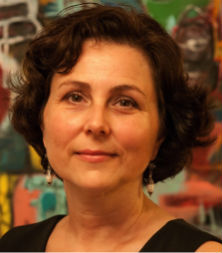
Kim van Alkemade
Filed under 2015, writing tip, Writing Tip Wednesday
There once was a party writer from Beijing /
Who couldn’t get published one thing. /
So, he took an American name /
And tried publishing all the same: /
Suddenly his words had a following.
***
Two cannibals are eating a comedy writer. One says to the other: “Does this taste funny to you?”
The other says: “No, and it doesn’t even taste like chicken.”
Filed under 2015, Monday morning writing joke, poetry by author
Poet Michael Derrick Hudson was published in The Best American Poetry 2015 anthology under the name “Yi-Fen Chou.” Hudson claims to use this name as a “strategy” for getting poems published.
by Isaac Fitzgerald
Source: http://www.buzzfeed.com/isaacfitzgerald/yi-fen-chou-is-michael-derrick-hudson#.ljkm9RZAe1
The poetry world was shocked Monday to discover that Yi-Fen Chou, a poet who appears in the anthology The Best American Poetry 2015, is actually the pen name of Michael Derrick Hudson.

Michael Derrick Hudson a/k/a Yi-Fen Chou via poetryfoundation.org
Hudson’s poem “The Bees, the Flowers, Jesus, Ancient Tigers, Poseidon, Adam and Eve” was both originally published in Prairie Schooner and reprinted in The Best American Poetry 2015 under the name Yi-Fen Chou.

In his bio for the anthology, Hudson admits that he used the pen name of Yi-Fen Chou as a strategy for getting his poems accepted by literary journals:
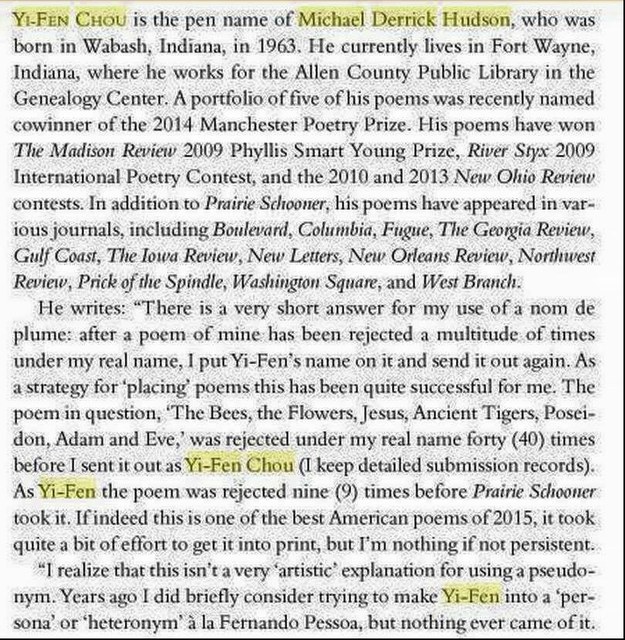
Many in the literary community took to social media to raise their concerns about the publication of Hudson’s poem in light of his nom de plume.
But Sherman Alexie, guest editor of The Best American Poetry 2015 — and in some sense originally a victim of a hoax — defended his decision to publish the poem, even after learning that Yi-Fen Chou was a pseudonym.
Details at: http://www.buzzfeed.com/isaacfitzgerald/yi-fen-chou-is-michael-derrick-hudson#.ljkm9RZAe1
The award-winning novelist discusses the intersection of race, sexual identity, and science fiction.
by Cecilia D’Anastasio
Source: http://www.thenation.com/article/samuel-r-delany-speaks/
When he was 11, Samuel R. Delany stayed overnight at a Harlem hospital for observation. It was 1953, and nearly a decade before Delany would publish his first science-fiction novel. He had already realized he was gay. With trepidation, he asked the doctor, a white man, how many gays existed in America. The doctor laughed. “[He] told me it was an extremely rare disease,” Delany says. “No more than one out of 5,000 men carried it.” Rest assured, the doctor added, no medical records existed confirming the existence of black homosexuals. “Simply because I was black,” Delany says, “I didn’t need to worry!”

Samuel R. Delany
CD: You have said, “For better or for worse, I am often spoken of as the first African-American science-fiction writer.” What did you mean by that?
SD: What did I mean by “for better or for worse?” It’s a placeholder. It holds a place for ghosts—the ghosts around any such discussion as this, ghosts sometimes useful to evoke in discussions of any practice of narrative writing, science fiction or other.
In my 1998 essay “Racism and Science Fiction” that you quote, I mention some of those ghosts in the paragraphs following my sentence: M.P. Shiel, Martin Delany (no relation), Sutton E. Griggs, Edward A. Johnson, W.E.B. Du Bois (certainly the best known), and George Schuyler—black Americans (or, in Shiel’s case, Caribbean), who wrote books or stories that we can read as science fiction. Full disclosure: Before I started writing science fiction, I’d looked through a copy of Shiel’s The Purple Cloud but had not known he was black by the current laws that made me so.
Today, I want to amend the sentence, in that I am the first broadly known African-American science-fiction writer to come up through the commercial genre that coalesced before and after the term “science fiction” began to appear more and more frequently in Hugo Gernsback’s magazine Amazing Stories between 1929 and 1932. Octavia E. Butler was the second. She was briefly my student in the summer of 1970 and my friend until her death in Washington State in 2006. We read together at the Schomburg library in New York City or shared panels at the Franklin Institute in Philadelphia, at a book fair in Florida, twice in Atlanta; and once we presented together for the Smithsonian on a rainy DC night.
But another set of ghosts are needed to make our own discussion here make sense—ghosts who come from the genre (and I used the word advisedly) we call “the literary.” For an idea of how much literature has changed since I first entered the field as a writer in 1962, or perhaps when, in 1966, I attended my first science-fiction convention in Cleveland, consider first what the academy that gives us our sense of what literature is teaches today—and then consider how that differed from what it taught in 1967. In that year, there were no virtually black studies classes (much less programs or departments); there were no women’s studies classes or programs, and no gay studies or queer studies classes or programs.
CD: It may be fair to say, then, that few writers were using the genre of what Darko Suvin has called “cognitive estrangement” to address personal experiences of marginalization before you.
SD: Here’s one I’ve written about in a narrative contained in my book of stories Atlantis: Three Tales—the second story in the book. Though the story does not narrate the first time; nor does it tell the last.
The first person to call me a nigger was not some hostile white man or woman. (Though, before I’d gone to my first science-fiction convention, some had.) Like many, many, many blacks all through this country, certainly in those years, and even today, it was my dad—whenever he got really frustrated with me. He was a black man—and a black from the American South, born before World War I. We were not poor. But we were nobody’s rich, either. And when my dad got really riled, I was a “stubborn, thickheaded nigger.” I didn’t think much of it. It was one of the most common words on the streets on which I lived, and I knew perfectly well I wasn’t supposed to say it at all. So I didn’t. But it prepared me for the first time a white person did—which we’ll talk about later.
To say that literature—one of the several cultural products that supported this system—was a very different thing (as science fiction, hemmed around by it, was a different thing) is another way of saying the world itself was simply different. To me, it seems neither fair nor accurate [to say that no one was using science fiction to address personal experiences of anti-black racism before me]. The problem here is that I’m not sure how the personal experiences of marginalization and the personal experiences of blackness have to be related. Do both the experiences and the blackness have to be mine to be personal? Could they be observed by someone else? If they were, would they be less personal? Is personal there the same as subjective, and in what way? Or are they not?
Around us, here, I see all those literary ghosts, who I picture as pressing closer to see the outcome as to how we will handle those questions, the ghost of Dickens’s Oliver Twist, David Copperfield; Balzac’s Cousin Bette, le père Goriot; Becky Sharp, Jane Eyre, Heathcliff, Hawkeye, Chingachgook, Ishmael, Queequeg, Jean Valjean, and Raskolnikov, Huck Finn, Jim, the nameless hero of Hamsun’s Hunger, Steinbeck’s Tom Joad, and Fitzgerald’s James Gatz. These ghosts are pushed forward by the black characters behind them. In their own tales, all these ghosts, black and white, are marginalized characters, some clearly so, some only suggestively, in the societies their writers portray, for better or worse (still a placeholder for more emendations, more ghosts that can’t demand them but can explain why they are needed); poor boys who grow up to be poor men or got their money dishonorably or died; socially impoverished poor relations trapped in families who resented having them at all. All of them required their writers to create fictive strategies to present that marginalization.
The ghosts above have alerted their readers to the fundamental ways in which poverty, economics, the social blindness, and hypocrisy of others as well as small-mindedness and the way small-town propriety chastens and destroys.
CD: What other writers were doing this kind of work in ways that resonated with you?
SD: The first white writer who wrote a black character I personally found believable—and I read lots and lots, both inside and outside science fiction—was Thomas M. Disch, in his 1968 New Wave novel Camp Concentration, first serialized in the British science-fiction magazine New Worlds, whose first installment appeared in its first tabloid-style issue. The presentation of Mordecai is one reason I think it’s such an important book in science fiction’s history. Yes, that book passed my own Turing test in a way that, for me, Faulkner’s black characters did not—as, indeed, many of his white characters failed to do for me as well, though I always found his language exacting, when it wasn’t exhausting. Tom told me later that he’d modeled Mordecai on a black classmate of his in the Midwest. But, boy, did I recognize him from my memories of myself and my black friends on the Harlem streets.
Till that point, all of the white attempts to do this, in my experience, had failed. But that’s narration. That’s science fiction. That’s literature—or perhaps that’s a place where, sometimes, instead of trying to strangle one another, the three become congruent. But it also suggests that the way to succeed is a matter of a writer’s being observant, intelligent, and creative, with a sense that the more cliché the characters are, the more likely (but not certainly) they are to be unbelievable, while at the same time they can’t be so idiosyncratic as to be irrelevant, and that is more important than the race of the writer.
The novel [Camp Concentration] takes place only an indeterminate 10 or 15 years after it was written—in short, it has undergone the transition all science fiction is doomed to follow, from historical speculation to historical fantasy. The United States is fighting a war—which may be an extension of the war in Vietnam or another, in Malaysia. It’s purposely unclear. Our protagonist is a conscientious objector and a poet—and the book is his journal. In 1967, when I first read Camp Concentration in its New Worlds serialization, after it had failed to find a US publisher, I can think of two things that were then inconceivable: The first is that 50 years later, we would have a black president. But by 2005, it was very thinkable. Morgan Freeman had played the current president of the United States in Deep Impact, with at least two other black actors representing the POTUS on various running series—so that, if anything, when Obama got in in ’08, today hindsight makes it look more inevitable than surprising.
And in the early ’70s [in “Angouleme,” from 334, published in 1972], Disch was the first science-fiction writer to conceive of gay marriage as lying in a foreseeable future. I wasn’t. I’d already worked through all my interest in marrying anyone and was pretty sure it was not an institution for me. I still am.
CD: Could you tell me about another experience of yours, growing up in mid-century Harlem, that found its way into your fiction?
 SD: All the experiences that were used in my own stories and books were black experiences—why? Because they were mine. In my books, sometimes the central characters were white—as in Trouble on Triton. Sometimes, as in The Fall of the Towers, Babel-17 (where the main character is Asian), or The Einstein Intersection, Dhalgren (where the main character has a white father and a Native American mother), or the Return to Nevèrÿon series, many or sometimes all were non-Caucasian.
Here is something that I think as an almost purely black experience (it is only that racial experiences are never pure that keeps such purity a metaphor), one that I’ve told many of my black friends, fewer of my white friends, and written about fairly indirectly in my Return to Nevèrÿon fantasy sequence.
All my life, one of the things people—white people in particular—had been telling me was that I looked white. I didn’t particularly believe them—though sometimes I wondered. My parents had told me that I was black and I should be proud of it, as both of them were, but one day in late September or among the first days of Indian summer (I was still in elementary school, so I was probably 10 or 11), I was sitting on a bench in Central Park, with my school notebook open, doing my math homework, when, with unkempt blond hair and steel-blue eyes, a kid about 20—today, from the state of his jeans and sneakers and T-shirt you would know immediately he was homeless, and, though “homeless” was not part of our vocabulary then, I realized it—walked up in front of me, his grin showing not very good teeth. “Hey,” he said with the thickest Southern accent I’d heard in a while, “you a nigga ain’ ya, there, huh?” I looked up, surprised. “Yeah, you a nigga. I can tell. Tha’s cause I’m from Alabama. See I can always tell. You ain’ gonna get nothin’ by me. I can see it, right in yo’ face there. The mouth, the nose. All that—naw, I can see it. You ain’t gonna fool somebody like me, get away with nothin’.” Then, still grinning, he turned and walked off, through the sunny park.
And that was the first time I was called a nigger by a white guy—a homeless Alabama drifter coming up to an urban black kid on a bench doing his math homework.
Frankly, I got less upset over that one than I did over my father’s. Because at least it taught me something. I mean, he was right. There’s nothing unpleasant for a black person to be recognized, especially when, I assume, they feel they are telling you something that for some reason they think you want to hear.
And sometimes it happened with black folk. Yet more stories. At this point, I don’t remember whether it was the fifth or sixth time [that happened], but after one of the men or women left, frowning after them, I said to myself: You thickheaded nigger, you better stop believing all these white assholes who keep telling you how white you are, because obviously there are a whole lot of white people in this city—in the country (by then, it had happened a couple of times outside New York)—who have nothing else to do but go around on the lookout for any black person they think might be racially passing, and remind them that they can’t. But this is one very small way in which a race gets constituted socially.
Rest of the article: http://www.thenation.com/article/samuel-r-delany-speaks/
Filed under 2015, author interview, authors


 Booker's Blog