Monthly Archives: June 2015

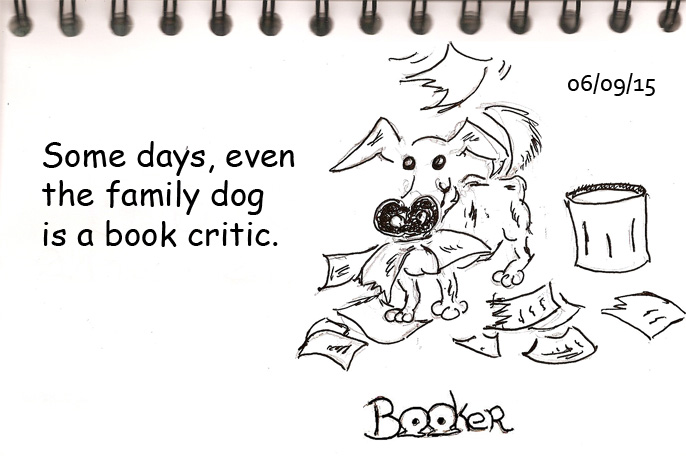
cARtOONSDAY: “pICKY”

Sometimes it is hard to decide if the next idea will blossom into a full-fledged story.

Sometimes it is hard to decide if the next idea will blossom into a full-fledged story.

Leave a comment

Filed under 2015, cartoon by author, CarToonsday

Monday morning writing joke: “Psychological”

A writer and a monkey walk into a bar. First the writer climbs up on a bar stool. Then the monkey does. The writer orders a soft drink. Then the monkey does.

The bartender, when she has a moment, asks the writer what is going on.

“Well,” the writer says, “I have run out of ides. My well is dry. I don’t want to call it writer’s block, but I thought I would do my own experiment. I had heard somebody claim that if you put a group of monkeys in a room and gave them each a typewriter, eventually you’d get Shakespeare. I can’t afford a room full of monkeys. But I thought maybe with a little more time, one monkey might turn out something, even a crappy something that I could then use.”

The bartender walks away, but comes back after serving another customer. “Isn’t that like plagiarism?”

The writer nods. “Maybe.”

This goes on for several months until one evening the writer walks in alone.

After serving him, the bartender asks, “Where’s your … writing partner?”

The writer shots her a sour look, “Stupid monkey. After months of my investing him, teaching him all I know. Just when he starts to write some stuff I can use, he ups and quits on me.”

“What? He found out what you were going to do and got mad at you?”

“I wish. It would have been easier if he had.”

The bartender gets called away to serve another customer, but then returns. “Well, what happened?”

The writer sighs. “It’s a long story, but let me say this. I taught that monkey all I knew and he was getting good at writing a paragraph or two, here or there. Then he got the bright idea that he needed an agent.”

“So?”

“So, he only wanted one agent, a B.F. Skinner,” the writer says, taking a sip of his drink. This time it was something harder than soda.

“Never heard of him. He doesn’t come in here, anyway.”

“I can’t find him. But the monkey says he won’t do any more work until I do.”

“So, what now?”

“I’ve already moved on to another animal. I thought I’d try a dog this time. Thought he might be more loyal.”

“And how has that worked out?”

The writer shakes his head. “It was fine. Then the dog said he wanted to talk to somebody named Pavlov.”

Leave a comment

Filed under 2015, Monday morning writing joke

Up the Amazon with the BS Machine

Up the Amazon with the BS Machine,

or

Why I keep Asking You Not to Buy Books from Amazon

by Ursula K. Le Guin

Source: http://bookviewcafe.com/blog/2015/06/01/up-the-amazon/

Amazon and I are not at war. There are vast areas in which my peaceful indifference to what Amazon is and does can only be surpassed by Amazon’s presumably equally placid indifference to what I say and do. If you like to buy household goods or whatever through Amazon, that’s totally fine with me. If you think Amazon is a great place to self-publish your book, I may have a question or two in mind, but still, it’s fine with me, and none of my business anyhow. My only quarrel with Amazon is when it comes to how they market books and how they use their success in marketing to control not only bookselling, but book publication: what we write and what we read.

Best Seller lists have been around for quite a while. Best Seller lists are generated by obscure processes, which I consider (perhaps wrongly) to consist largely of smoke, mirrors, hokum, and the profit motive. How truly the lists of Best Sellers reflect popularity is questionable. Their questionability and their manipulability was well demonstrated during the presidential campaign of 2012, when a Republican candidate bought all the available copies of his own book in order to put it onto the New York Times Top Ten Best Seller List, where, of course, it duly appeared.

If you want to sell cheap and fast, as Amazon does, you have to sell big. Books written to be best sellers can be written fast, sold cheap, dumped fast: the perfect commodity for growth capitalism.

The readability of many best sellers is much like the edibility of junk food. Agribusiness and the food packagers sell us sweetened fat to live on, so we come to think that’s what food is. Amazon uses the BS Machine to sell us sweetened fat to live on, so we begin to think that’s what literature is.

I believe that reading only packaged microwavable fiction ruins the taste, destabilizes the moral blood pressure, and makes the mind obese. Fortunately, I also know that many human beings have an innate resistance to baloney and a taste for quality rooted deeper than even marketing can reach.

If it can find its audience by luck, good reviews, or word of mouth, a very good book may become a genuine Best Seller. Witness Rebecca Skloot’s Immortal Life of Henrietta Lacks, which for quite a while seemed to have immortal life among the Times Top Ten. And a few books work their way more slowly onto BS lists by genuine, lasting excellence — witness The Lord of the Rings, or Patrick O’Brian’s sea stories. Not products of the BS Machine, such books sell because people actually like them. Once they get into the BS Machine, they are of course treated as products of the BS Machine, that is, as commodities to exploit.

Making a movie of a novel is a both a powerful means of getting it into the BS Machine and a side-effect of being there.

Read the rest: http://bookviewcafe.com/blog/2015/06/01/up-the-amazon/

Leave a comment

Filed under 2015, writer

Photo finish Friday: “Weekend”

Whichever way the weekend blows, it can only be better than the week.

Whichever way the weekend blows, it can only be better than the week.


O’ Come Weekend

O’, come weekend, come on soon
the week’s been hell, been like a bassoon
played off-key and played next to my ear,
or a pipe clattering, trying to get clear
of the air trapped inside when the taps turned on
whopping and whopping like a bad song.
O’, come weekend, come on soon
the week’s been hell, been like a baboon
locked in a small cage, tossing poop and food
flashing its teeth – O’ it’s been in a mood.
So come on weekend, get your ass here.
I’ve had more than I can take. Am I being clear?!

–Photo and poem by David E. Booker

Leave a comment

Filed under 2015, photo by David E. Booker, Photo Finish Friday, poetry by author

Haiku to you Thursday: “Pockets”

Deep in my pockets /

the dead ends of empty hands /

grasp at threadbare hope.

Leave a comment

Filed under 2015, Haiku to You Thursday, poetry by author

Writing tip Wednesday: “Writer’s Voice”

Don’t Muzzle (or Muffle) Your Writing Voice

By TOM BENTLEY

Source: http://www.writersdigest.com/online-editor/dont-muzzle-or-muffle-your-writing-voice?et_mid=758567&rid=239626420

I think about the issue of voice in writing quite often. You know, your writing voice, that whiff of brimstone or reverberant cello note or cracked teeth and swollen tongue that stamps your writing as having been issued from you alone. Many writers, particularly younger ones, struggle to find their voice: the word choice, the cadence, the tone, the very punctuation—the stuff that slyly suggests or that screams that you wrote it.

You’d never mistake Donald Barthelme for Ernest Hemingway; the word blossoms gathered in Virginia Woolf’s garden would have flowers not found in the window-box plantings of Joan Didion. So your writing and your writing voice shouldn’t be confused with Schlomo Bierbaum’s—it should be yours alone.

One of the things that made me think of a person’s voice was a literal voice: a few years ago I saw Ricki Lee Jones in concert, and was so struck by her uniqueness as a performer (and possibly as a person). She was cuckoo and mesmerizing in the best of ways on stage: banging on the roof of the piano, exhorting the other players, talking to them in asides during some songs. She played a lunatic version of Don’t Fear the Reaper(!), beating out a slapclap on the top of her piano. The performance was so Rikki Lee Jones: singular, eccentric, passionate, moody. You wanted to be around her just to see what she might do or say (or sing) next. Her voice was hers and hers alone.

Your Writing Voice Is There for the Singing

When you’re developing your writing voice, you might be so painstakingly wrapped up in expressing yourself JUST SO that you drain the blood out of your writing, or pull the plug on the electricity of your ideas. You might have read an essay by Pico Iyer or a story by Alice Munro or a novel by Cormac McCarthy and you might be trying so hard to source and employ the rhythms, humors and tics of those gifted writers that you spill onto the page a fridge full of half-opened condiments that cancel each other’s flavors.

Be yourself behind the pen, be the channel between what cooks in your brain and what courses through the keyboard. Even if that self is one day the grinning jester and another the sentimental fool, be fully that person, unmasked, on the page. Maybe you grew up in a slum in Mumbai or have a pied-à-terre in every European capital, maybe your adolescence was a thing of constant pain, maybe you never made a wrong move, maybe you never moved at all—it should be in your writing, whether in its proclamations or its subtext. Your voice is all the Crayons in your box.

For instance, if you’re inclined to the confessional (like all us old Catholics), turn to your sins: I was a very enterprising shoplifter in high school, running a cottage resale business on the side. While I don’t recommend they teach my techniques in business school, I later forged my history of happy hands into an award-winning short story, and then turned the account of having won that short story contest into a published article in a Writer’s Market volume. Ahh, the just desserts of an empire of crime.

A Voice, and Its Chorus

Of course it’s no monotone: Sometimes I might write about Sisyphus and sometimes I might write about drool (and sometimes I might speculate whether Sisyphus drooled while pushing the rock up that endless hill). By that I mean your short stories might have a female narrators, male narrators, be set in a tiny town one time and in a howling metropolis the next. But you still must find the voice—your voice—for that story.

I like to write essays that often take a humorous slant, but at the same time, that isn’t the limit or restriction I put on my own expression. I published a piece on not actually knowing my father despite my years with him, and another that discusses never finding out what happened to my high school girlfriend after she vanished in Colombia. Both had a tone of pathos. That pensive tone is also one of my voices, and its sobriety doesn’t cancel the chiming of my comic voice. So your voice might be part of a choir.

Rest of the article: http://www.writersdigest.com/online-editor/dont-muzzle-or-muffle-your-writing-voice?et_mid=758567&rid=239626420
Leave a comment

Filed under 2015, writing tip, Writing Tip Wednesday

cARtOONSDAY: “bITES”

She thought some of the chapters were a bit "rough."

She thought some of the chapters were a bit “rough.”

Leave a comment

Filed under 2015, cartoon by author, CarToonsday

Monday morning writing joke: “Taxing situation”

A man was sitting next to a writer in a bar when he turned and asked: “Where do you get your ideas?”

The writer thought for a moment, then asked, “Do you really want to know?”

The man took a swallow of his drink, then nodded.

“Okay,” said the writer. “Buy me a drink and I’ll tell you.”

The man buys the writer a drink.

The writer says, “On the fifth Tuesday of each month I go to a tiny shop in a hidden building about a block from where I live. That’s why I live there. The shop is called Noideaer. For a fee the woman who works there will sell me several prints of story ideas. I take the one I like best and go to the framing shop next door, called The Hang Out, and he frames it for me so I can see the big picture of the story. Then I take it home and when I’m in the right frame of mind, I look at the picture and write the story.”

“Wow!” said the man at the bar. “Can I go there and you know get me up a group of ideas, have one of them framed up like you know you do and then take it home and write?”

The writer looked down at his drink, then looked back at the man and said, “As long as you can pay the syntax.”

The man cursed the government up one side and down the other, and eventually slowed down enough to say if he had to pay a sin tax, he’d rather do without. He then slid off his bar stool and stumbled away.

The bartender came over and nodded toward the man leaving. “Third one this week.”

“The syntax gets them every time.”

Leave a comment

Filed under 2015, Monday morning writing joke

John Scalzi, Science Fiction Writer, Signs $3.4 Million Deal for 13 Books

Mr. Scalzi said he hoped books like “Lock In” could draw more readers toward science fiction, since many, he said, are still “gun-shy” about the genre.

By JOHN SCHWARTZ

Source: http://www.nytimes.com/2015/05/25/business/media/science-fiction-writer-signs-a-3-4-million-deal.html?ref=books&_r=2

John Scalzi, a best-selling author of science fiction, has signed a $3.4 million, 10-year deal with the publisher Tor Books that will cover his next 13 books.

Mr. Scalzi’s works include a series known as the “Old Man’s War” and the more recent “Redshirts,” a Hugo-award-winning sendup of the luckless lives of nonfeatured characters on shows like the original “Star Trek.” Three of his works are being developed for television, including “Redshirts” and “Lock In,” a science-inflected medical thriller that evokes Michael Crichton. Mr. Scalzi’s hyper-caffeinated Internet presence through his blog, Whatever, has made him an online celebrity as well.

Mr. Scalzi approached Tor Books, his longtime publisher, with proposals for 10 adult novels and three young adult novels over 10 years. Some of the books will extend the popular “Old Man’s War” series, building on an existing audience, and one will be a sequel to “Lock In.” Mr. Scalzi said he hoped books like “Lock In” could draw more readers toward science fiction, since many, he said, are still “gun-shy” about the genre.

Patrick Nielsen Hayden, the executive editor for Tor, said the decision was an easy one. While Mr. Scalzi has never had a “No. 1 best seller,” he said, “he backlists like crazy.”

“One of the reactions of people reading a John Scalzi novel is that people go out and buy all the other Scalzi novels,” Mr. Nielsen Hayden said.

He said Mr. Scalzi sells “a healthy five-figure number of his books every month,” and that he “hasn’t even begun to reach his full potential audience.”

Science fiction films like “2001: A Space Odyssey” and “Star Wars” have been considered popular classics for decades, “but there’s a lot of work to be done,” Mr. Scalzi said, in bringing readers to the genre. He said the long-term contract would allow him to continue experimenting with different forms of publishing, including online serialization, a technique he has tried with some success.

Mr. Scalzi, who lives in Ohio, said he was still trying to come to grips with the size and scope of the deal. He said his wife, Kristine, had kept his ego from going supernova.

“My celebration, personally, has just been standing around,” exclaiming with profane expressions of delight, he said. “And my wife saying, ‘Yes, now go take out the trash.’ ”

Leave a comment

Filed under 2015, writer

Books about women less likely to win prizes, study finds

Study of six major awards in the last 15 years shows male subjects the predominant focus of winning novels.

by ALISON FLOOD

Source: http://www.theguardian.com/books/2015/jun/01/books-about-women-less-likely-to-win-prizes-study-finds

Analysis of the last 15 years of winners of six major literary awards by the critically acclaimed author Nicola Griffith has found that a novel is more likely to land a prize if the focus of the narrative is male.

Griffith looked at the winners of the Pulitzer, Man Booker, National Book award, National Book Critics’ Circle award, Hugo and Newbery medal winners over the last 15 years. She collated the gender of the winners, and that of their protagonists, finding that for the Pulitzer, for example, “women wrote zero out of 15 prize-winning books wholly from the point of view of a woman or girl”.

The Man Booker, between 2000 and 2014, was won by nine books by men about men or boys, three books by women about men or boys, two books by women about women or girls, and one book by a woman writer about both. The US National Book award over the same period, found Griffith, was won by eight novels by men about men, two books by women about men, one book by a man about both, three books by a woman about both, and two books by women about women.

“It’s hard to escape the conclusion that, when it comes to literary prizes, the more prestigious, influential and financially remunerative the award, the less likely the winner is to write about grown women. Either this means that women writers are self-censoring, or those who judge literary worthiness find women frightening, distasteful, or boring. Certainly the results argue for women’s perspectives being considered uninteresting or unworthy. Women seem to have literary cooties,” wrote Griffith in a piece laying out her analysis in a series of pie charts.

“The literary establishment doesn’t like books about women. Why?” she asked. “The answer matters. Women’s voices are not being heard. Women are more than half our culture. If half the adults in our culture have no voice, half the world’s experience is not being attended to, learnt from or built upon. Humanity is only half what we could be.”

Her analysis came as the summer issue of Mslexia, the magazine for women writers, explores the the “silent takeover by men of the top jobs” in British publishing. Industry expert Danuta Kean laid out how, since 2008, the “women at the top of the three biggest corporate publishing houses have stepped aside – in each case to be replaced by men”.

Penguin managing director Helen Fraser retired in 2009, pointed out Kean, Random House chair and chief executive Gail Rebuck stepped down from the day-to-day running of the company in July 2013, and Victoria Barnsley has been replaced at HarperCollins by Charlie Redmayne. Little, Brown chief executive Ursula Mackenzie has also recently announced she would be stepping down from her position in July, replaced by David Shelley.

Rest of the article: http://www.theguardian.com/books/2015/jun/01/books-about-women-less-likely-to-win-prizes-study-finds

Leave a comment

Filed under 2015, literary awards, study