
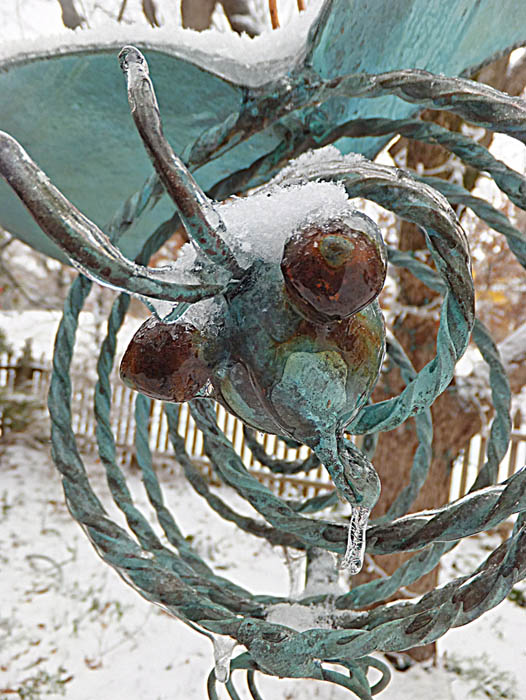
The attack of the metal-eating bugs from Mars was stopped dead in its tracks not by military firepower or industrial genius, but by rust and cold weather.
What will happen come Spring? Nobody is sure.
The attack of the metal-eating bugs from Mars was stopped dead in its tracks not by military firepower or industrial genius, but by rust and cold weather.
What will happen come Spring? Nobody is sure.
I watch you sleeping /
the drugs doing all I can’t — /
except loving you.
Filed under 2015, Haiku to You Thursday, poetry by author
SHORT STORY AWARD for NEW WRITERS guidelines

Glimmer Train
Most entries run from 1,500 – 6,000 words, but any lengths up to 12,000 words are welcome.
Held quarterly. Open to submissions in FEBRUARY, MAY, AUGUST, and NOVEMBER. Next deadline: November 30. *
Winners are announced in the May 1, August 1, November 1, and February 1 bulletins, respectively, and contacted directly one week earlier.
To submit: http://www.glimmertrainpress.com/writer/html/index2.asp
Filed under 2015, writing tip, Writing Tip Wednesday

Poetry and Writing Workshops in June and July 2015.

Details of the workshops and where to get more information.
Filed under 2015, writing tip, Writing Tip Wednesday
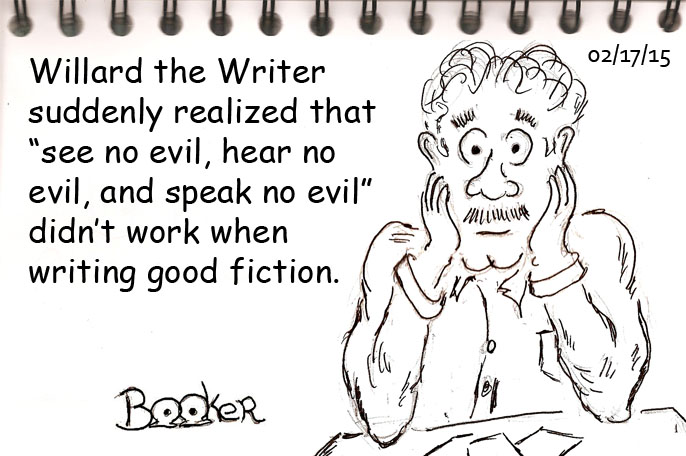
Without evil, Willard did not know what to do.
Filed under cartoon by author, CarToonsday

“I’m stuck in Frozen Prison and time keeps draggin’ on.”
Frozen Prison
I hear the sleet a comin’
It’s rollin’ ’round the bend
And I ain’t seen the sunshine
Since, I don’t know when.
I’m stuck in Frozen Prison
And time keeps draggin’ on
But frozen rain keeps a-fallin’.
Oh, when will you be gone?
Why it was just yesterday
The weatherman told me, “Run!
Tomorrow won’t be a good day
And you won’t see the sun.”
But I walked around the town
Because I thought he lied
Now I hear that sleet a-fallin’
and hang my head and cry.
I bet there’s salt trucks rollin’
Up and down streets near and far.
Wrecker drivers drinkin’ coffee
And waitin’ for wrecked cars.
Well, I know it’s now a-comin’
I know it will be a big freeze.
Yet people keep a-movin’
And that’s what frightens me.
I saw the KUB truck rollin’
Easin’ down my street
Lookin’ for those wires
Hangin’ heavy with that sleet.
Well, if they freeze me in this prison
If that freezin’ rain falls fine
I bet it’ll be for days
I’ll have broken power lines.
Far from Frozen Prison
That’s where I want to stay
And I’d let that warmer weather
Blow all that blue away.
But I’m stuck in Frozen Prison
And time keeps draggin’ on.
That frozen rain keeps a-rollin’.
Oh, when will you be gone?
[–with apologies to Johnny Cash. Parody of “Folsom Prison,” which was written and sung by Johnny Cash. Parody by David E. Booker.]
Filed under 2015, absurdity, parody, poetry by author, Random acts of poetry
Q.: What do you call a cab with three writers stuck in traffic while on the way to a writing conference?
A.: Writers blocked.
Filed under Monday morning writing joke
Mysterious Indo-European homeland may have been in the steppes of Ukraine and Russia
by Michael Balter
What do you call a male sibling? If you speak English, he is your “brother.” Greek? Call him “phrater.” Sanskrit, Latin, Old Irish? “Bhrater,” “frater,” or “brathir,” respectively. Ever since the mid-17th century, scholars have noted such similarities among the so-called Indo-European languages, which span the world and number more than 400 if dialects are included. Researchers agree that they can probably all be traced back to one ancestral language, called Proto-Indo-European (PIE). But for nearly 20 years, scholars have debated vehemently when and where PIE arose.
Two long-awaited studies, one described online this week in a preprint and another scheduled for publication later this month, have now used different methods to support one leading hypothesis: that PIE was first spoken by pastoral herders who lived in the vast steppe lands north of the Black Sea beginning about 6000 years ago. One study points out that these steppe land herders have left their genetic mark on most Europeans living today.
The studies’ conclusions emerge from state-of-the-art ancient DNA and linguistic analyses, but the debate over PIE’s origins is likely to continue. A rival hypothesis—that early farmers living in Anatolia (modern Turkey) about 8000 years ago were the original PIE speakers—is not ruled out by the new analyses, most agree. Although the steppe hypothesis has now received a major boost, “I would not say the Anatolian hypothesis has been killed,” says Carles Lalueza-Fox, a geneticist at Pompeu Fabra University in Barcelona, Spain, who participated in neither of the new studies.
Up until the 1980s, variations of the steppe hypothesis held sway among most linguists and archaeologists tracking down Indo-European’s birthplace. Then in 1987, archaeologist Colin Renfrew of the University of Cambridge in the United Kingdom proposed that PIE spread with farming from its origins in the Fertile Crescent of the Middle East, moving west into Europe and east further into Asia; over time the languages continued to spread and diversify into the many Indo-European languages we know today.
Traditional linguists, meanwhile, painstakingly reconstructed PIE by extrapolating back from modern languages and ancient writings. (Listen to a short fable spoken in PIE here: http://news.sciencemag.org/2015/02/sound-proto-indo-european.) They disdained Renfrew’s idea of an Anatolian homeland, arguing for example that the languages were still too similar to have begun diverging 8000 years ago.
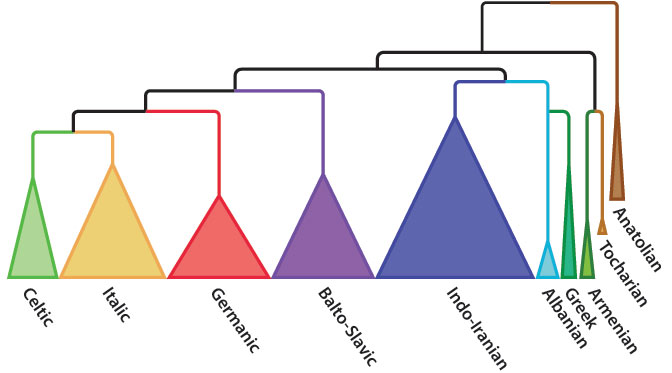
More than 400 Indo-European languages diverged from a common ancestral tongue; the earliest ones (top right), Anatolian and Tocharian, arose in today’s Turkey and China, respectively.
Rest of the article: http://news.sciencemag.org/archaeology/2015/02/mysterious-indo-european-homeland-may-have-been-steppes-ukraine-and-russia?utm_source=facebook&utm_medium=social&utm_campaign=facebook

Happy Valentine’s Day
Novelists and writers:
Zora Neale Hurston: “Love makes your soul crawl out from its hiding place.”
James Baldwin: “Love takes off masks that we fear we cannot live without and know we cannot live within.”
Novelist Iris Murdoch: “Love is the difficult realization that something other than oneself is real.”
Also: “People often start by falling in love, and they go on for years without realizing that love must change into some other love which is unlike the original.”
W. Somerset Maugham: “We are not the same person this year as last; nor are those we love. It is a happy chance if we, changing, continue to love a changed person.”
Ursula K. Le Guin: “Love doesn’t just sit there, like a stone; it has to be made, like bread, remade all the time, made new.” [Editor’s note: Is this what is meant by love being “kneady”?]
Andre Maurois: “A successful marriage is an edifice that must be rebuilt every day.”
Norman Mailer: “Love asks us that we be a little braver than is comfortable, a little more generous, a little more flexible. It means living on the edge more than we care to.”
Psychological and religious thinkers
Some love advice, courtesy of psychologist James Hillman: “For a relationship to stay alive, love alone is not enough. Without imagination, love stales into sentiment, duty, boredom. Relationships fail not because we have stopped loving but because we first stopped imagining.”
Words from a Buddhist about love: “You can search throughout the entire universe for someone who is more deserving of your love and affection than you are yourself, but that person is not to be found anywhere. You yourself, as much as anyone, deserve your love and affection.”
Poets
A statement attributed to French poet Paul Valery. “Love is being stupid together,” he said. [Editor’s note: does that mean it is better than being stupid apart?]
Poet Pablo Neruda: “I hunger for your sleek laugh and your hands the color of a furious harvest. I want to eat the sunbeams flaring in your beauty.”
Also: “Our love is like a well in the wilderness where time watches over the wandering lightning. Our sleep is a secret tunnel that leads to the scent of apples carried on the wind. When I hold you, I hold everything that is–swans, volcanoes, river rocks, maple trees drinking the fragrance of the moon, bread that the fire adores. In your life I see everything that lives.”
The words of poet Elizabeth Barrett Browning: “I love you not only for what you are, but for what I am when I am with you. I love you not only for what you have made of yourself, but for what you are making of me. I love you for the part of me that you bring out.”
Two final thoughts:
Clarissa Pinkola Estes wrote this in Women Who Run With the Wolves. “The desire to force love to live only in its most positive form is what causes love ultimately to fall over dead.”
And from The Simpsons‘ creator Matt Groening: “Love is a snowmobile racing across the tundra and then suddenly it flips over, pinning you underneath. At night, the ice weasels come.”
Creation writing: is sci-fi a 21st-century religion?
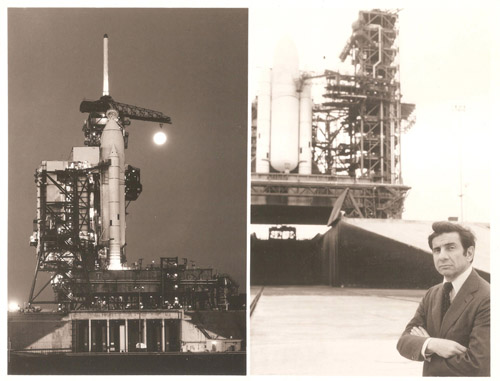
Space shuttle during the early years.
Source: http://www.theguardian.com/books/booksblog/2015/jan/16/sci-fi-21st-century-religion-universe-hubble
Ever since mankind began to count, the uncountable stars have been filling us with awe. But the splendour revealed by a cloudless night reveals only a fraction of the universe’s truly awe-inspiring scale. The Hubble space telescope reveals a tiny smudge in the sky such as Andromeda to be a galaxy vaster than our own, teeming with a trillion stars, one of a hundred million other galaxies spread across the heavens.
Science today shows us a very different universe than the clockwork model imagined by Isaac Newton in his description of gravity. Jules Verne could imagine shooting a rocket from the Earth to the moon in 1865, but could not have imagined the vastness even of our solar system’s Kuiper belt. It was only when Edwin Hubble identified the first star beyond the Milky Way, and only when the telescope that bore his name photographed 3,000 galaxies in a single patch of “empty” space, that the human eye could glimpse the near infinite depths of space.
The work of the most ambitious SF authors like Iain M Banks, Vernor Vinge and David Brin manages to capture the true scale of the universe in fiction. And even then SF can detail only the tiniest portion of a cosmos some 93bn light years wide (and expanding ever more quickly), shaped by the unifying force of gravity, where the elements of life are created in supernova explosions and destroyed in black holes. The scientific model of the universe begins to look eerily like that expressed by Hindu astronomers over 3,000 years ago, in which the cycles of the universe are measured in aeons 1.28tn years long, reality is maintained by the force of Vishnu, and all things are created by Brahma and destroyed by Shiva.
Perhaps it’s these mythic resonances that have seen science fiction trend more and more towards religious zeal in recent years. The Singularity, a point in the near future when technology evolves so fast that it allows life to transcend all physical boundaries, is now a common idea in SF, explored by writers from Damien Broderick to Charlie Stross. Its believers style themselves as singulatarians and transhumanists, but their rhetoric of life after death in silicon virtual realities so deeply echoes fundamentalist Christianity that no one is joking when they call it the Rapture of the Nerds.
More at: http://www.theguardian.com/books/booksblog/2015/jan/16/sci-fi-21st-century-religion-universe-hubble
Filed under science fiction


 Booker's Blog