Monthly Archives: December 2014

Writing tip Wednesday: “We have our ways”

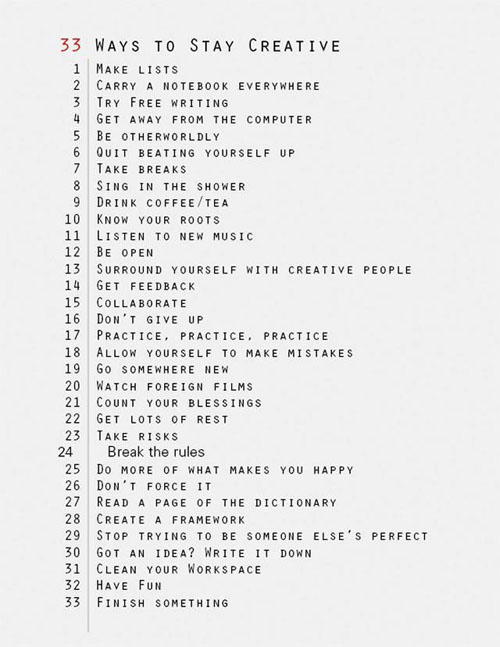
With one year about to close and another about to open, writers often make lists of what they want to accomplish the coming year: finish that novel, publish 10 short stories, win the Nobel Prize in Literature. Things like that. Below is a list that might help you in another way. That way is a list of tips for staying creative. Not sure where I picked this up, but I thought I would pass it along. Happy New Year and good luck with your writing.

List not all-inclusive, but it might help in the coming year. It's a new year, make your own

List not all-inclusive, but it might help in the coming year. It’s a new year, make your own.

1 Comment

Filed under Writing Tip Wednesday

cARtOONSDAY: “wEIGHTY sUBJECT”

Lift that noun. Tote that verb.

Lift that noun. Tote that verb.

1 Comment

Filed under cartoon by author, CarToonsday

Monday morning writing joke: “Running late”

Their three kids, all successful, agreed to a Sunday dinner in their honor.

“Happy Anniversary Mom and Dad,” gushed Son No. 1. “Sorry I’m running late. I had an emergency at the hospital with a patient, you know how it is, and I didn’t have time to get you a gift.”

“Not to worry,” said the father. “Important thing is we’re all together today.”

Son No. 2 arrived. “You and Mom look great, Dad. I just flew in from LA between depositions and didn’t have time to shop for you.”

“It’s nothing,” said the father. “We’re glad you were able to come.”

Just then the daughter arrived. “Hello and happy anniversary! Sorry, but my boss is sending me out of town and I was really busy packing so I didn’t have time to get you anything.”

After they had finished dessert, the father said, “There’s something your mother and I have wanted to tell you for a long time. You see, we were really poor, but we managed to send each of you to college. Through the years your mother and I knew we loved each other very much, but we just never found the time to get married.”

The three children gasped and said, “WHAT? You mean we’re bastards?”

“Yep”, said the father, “Cheap ones too.”

1 Comment

Filed under Monday morning writing joke

Throw up

by David E. Booker

I throw up for no good reason:
any time and any season.
A piece of lint is in the air.
It floated up from my underwear.
It is there now; it frightened me.
I’ll either throw up or go pee pee.
I can see now my sensitive ways
cause my parents problems many days.
When we travel for hours in a car
they have wonder just how far
we can go before I begin
to say, “I’m sensitive to throwing up again.”
I take a deep breath and feel the bile.
Has it only been a little while?
My older brother sits next to me.
He hopes I’ll hurl on my DVD.
We still have many miles to go
but I don’t have that much self-control.
A bug goes SPLAT against the window.
I can feel my tummy start to billow.
That bug’s guts are the color
of what I’ll throw up from my supper.
I throw up for no good reason:
any time and any season.
Even when I feel I’m okay,
my stomach throws up just like I say.

Leave a comment

Filed under poetry by author

Flannery O’Connor: Friends Don’t Let Friends Read Ayn Rand (1960) | Open Culture

Flannery O'Connor: Friends Don't Let Friends Read Ayn Rand (1960) | Open Culture.

In a letter dated May 31, 1960, Flannery O’Connor, the author best known for her classic story, “A Good Man is Hard to Find” (listen to her read the story here) penned a letter to her friend, the playwright Maryat Lee. It begins rather abruptly, likely because it’s responding to something Maryat said in a previous letter:

I hope you don’t have friends who recommend Ayn Rand to you. The fiction of Ayn Rand is as low as you can get re fiction. I hope you picked it up off the floor of the subway and threw it in the nearest garbage pail. She makes Mickey Spillane look like Dostoevsky.

The letter, which you can read online or find in the book The Habit of Being, then turns to other matters.

Details at: http://www.openculture.com/2014/06/flannery-oconnor-friends-dont-let-friends-read-ayn-rand-1960.html

1 Comment

Filed under writers on writers, Writers on writing

Photo finish Friday: “A bit deflated”

Christmas is over, the presents are delivered, and Santa and his reindeer are exhausted and needing a little help to get in the air for that final trip home.

Christmas is over, the presents are delivered, and Santa and his reindeer are exhausted and needing a little help to get in the air for that final trip home.

Leave a comment

Filed under Photo Finish Friday

Haiku to you Thursday: “Stubble”

Hard against life’s past /

old headstones, dead crops winter. /

Stubble knots dark ground.

Leave a comment

Filed under Haiku to You Thursday, poetry by author

Merry Christmas & Happy New Year

Homemade holidays are the best.

Homemade holidays are the best.

Leave a comment

December 25, 2014 · 12:06 am

Writing tip Wednesday: “Introductions”

Write Better: 3 Ways To Introduce Your Main Character

by Les Edgerton

Source: http://www.writersdigest.com/online-editor/write-better-3-ways-to-introduce-your-main-character?et_mid=711152&rid=239626420

1. Keep physical description minimal.

A character’s physical description—unless markedly different than the norm—does relatively little to draw the reader in. The character’s actions, or details such as his occupations and interests, are much more useful. The readers will furnish a perfectly good description on their own if you simply let them know that the Uncle Charley of your story is a butterfly collector, or the elderly toll-gate keeper on the Suwannee River. Doing so will accomplish more than 10 pages of describing hair and eye color, height, weight and all of that kind of mundane detail.

My own writing contains very little description of any of my characters—it’s virtually nonexistent—yet for years I’ve asked readers if they can describe a character I pick at random from my stories, and invariably they come up with a detailed description, no matter which character I choose. When I tell them I haven’t ever described the character mentioned, they’re surprised, and some swear that I did, even going so far as to drag out the story and skim for where I’ve included the description. They never find it.

2. Characterize through action.

Bestselling British writer Nick Hornby starts his novel How to Be Good by taking us through his protagonist’s inciting incident, revealed in an action that is contrary to her normal behavior and personality.

I am in a car park in Leeds when I tell my husband I don’t want to be married to him anymore. David isn’t even in the car park with me. He’s at home, looking after the kids, and I have only called him to remind him that he should write a note for Molly’s class teacher. The other bit just sort of … slips out. This is a mistake, obviously. Even though I am, apparently, and to my immense surprise, the kind of person who tells her husband that she doesn’t want to be married to him anymore, I really didn’t think I was the kind of person to say so in a car park, on a mobile phone. That particular self-assessment will now have to be revised, clearly. I can describe myself as the kind of person who doesn’t forget names, for example, because I have remembered names thousands of times and forgotten them only once or twice. But for the majority of people, marriage-ending conversations happen only once, if at all. If you choose to conduct yours on a mobile phone, in a Leeds car park, then you cannot really claim that it is unrepresentative, in the same way that Lee Harvey Oswald couldn’t really claim that shooting presidents wasn’t like him at all. Sometimes we have to be judged by our one-offs.

Wow! Don’t you wish you’d written that? I sure do!

3. Instill Individuality and Depth.

A very different example of establishing the protagonist’s character from the start is found in crime novelist Michael Connelly’s Lost Light:

There is no end of things in the heart.

Someone once told me that. She said it came from a poem she believed in. She understood it to mean that if you took something to heart, really brought it inside those red velvet folds, then it would always be there for you. No matter what happened, it would be there waiting. She said this could mean a person, a place, a dream. A mission. Anything sacred. She told me that it is all connected in those secret folds. Always. It is all part of the same and will always be there, carrying the same beat as your heart.

I am fifty-two years old and I believe it. At night when I try to sleep but can’t, that is when I know it. It is when all the pathways seem to connect and I see the people I have loved and hated and helped and hurt. I see the hands that reach for me. I hear the beat and see and understand what I must do. I know my mission and I know there is no turning away or turning back. And it is in those moments that I know there is no end of things in the heart.

What makes this opening different? Well, it’s by a brand-name author with a sizable audience already in place. Michael Connelly’s books have made the bestseller lists at least 19 more times than I’ve hit a grand-slam walk-off home run at Yankee Stadium as a member of the Bronx Bombers. This means he can write just about any opening he wants and it’s going to get published. It also means that in the hands of a writer without a ready-made audience such as Connelly enjoys, opening with the protagonist’s bit of philosophy might not work, if not done well. It could easily come across as sentimental or self-indulgent.

More details at: http://www.writersdigest.com/online-editor/write-better-3-ways-to-introduce-your-main-character?et_mid=711152&rid=239626420

Leave a comment

Filed under Writing Tip Wednesday

cARtOONSDAY: “cHRISTMAS wISH”

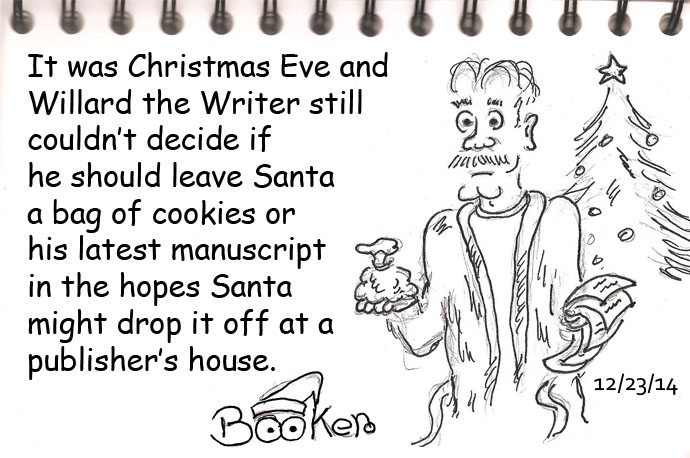
Willard at a crossroads.

Willard at a crossroads.

1 Comment

Filed under cartoon by author, CarToonsday