Forlorn and sitting on the couch
a friend in need about the house.
A note, a fix, a hope today
that the friend can still play.
Attempts are made but none work.
Attempts are made but dog inert.
Forlorn and sitting on the couch
a friend in need about the house.
A note, a fix, a hope today
that the friend can still play.
Monthly Archives: February 2014
Photo finish Friday: “Fix me!”
Filed under Photo by author, Photo Finish Friday, poetry by author
Haiku to you Thursday: “Oak leaves”
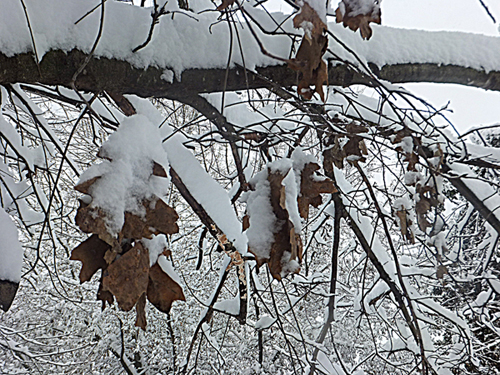
Autumn bats hanging down /
painted white with falling snow /
clutching hope for spring.
Filed under Haiku to You Thursday, Photo by author, poetry by author
Writing tip Wednesday: “The End”
Dos and Don’ts for the Last 10,000 Words of Your Story
By James V. Smith Jr.
DON’T INTRODUCE ANY NEW CHARACTERS OR SUBPLOTS.
Don’t introduce anything new. Any appearances within the last fifty pages should have been foreshadowed earlier, even if mysteriously. What this means: If you bring in a new character this late, your audience will feel cheated, as if you’ve been holding back important information for a cheap surprise. They want clues throughout the novel so that way, even if they couldn’t solve it early, they can look back and say “Oh yeah, now that makes sense.”
DON’T DESCRIBE, MUSE, EXPLAIN, OR PHILOSOPHIZE.
In other words, keep the author out of the story, and don’t let it drag. By this point in the story, setup is done, complication is wrapping up, and resolution should be entirely uncluttered so you and the reader can make an unimpeded dash to the finish line. Keep description to a minimum, action and conflict to the max.
What this means: No long details about the setting or sudden dishing about backstory. This is what your story is all about. Your protagonist has sacrificed and made wrong turns to get to this moment. Make these pages as face-paced as possible.
DO CREATE THAT SENSE OF OH, WOW!
Once or twice on every page, if possible, more frequently.
What this means: Stories that play out “Then this happened. Then this happened. Then this happened.” in the final moments aren’t memorable. It’s better to put in an “But unexpectedly …” as the final chapters close up your story, especially if it ties up moments you’ve foreshadowed earlier in your novel.
DO ENMESH YOUR READER DEEPLY IN THE OUTCOME OF YOUR STORY.
Make her unable to put down your novel to go to bed, to work, or even to the bathroom until she sees how it turns out.
What this means: Like in sports, the most captivating part is the final minutes or innings of a close game. You can’t take your eyes off of it because you not only want to know the outcome, you feel like you need to know the outcome—and you need to know it immediately. Think of your ending in those terms.
To learn more, go to: http://www.writersdigest.com/how-to-improve-your-writing-skills-the-last-10000-words?et_mid=656501&rid=239626420
Filed under writing tip, Writing Tip Wednesday
Monday morning writing joke: “eaten”
Q. If a writer were turned into a zombie, whose brains would he eat first?
A. His critics’.
Filed under Monday morning writing joke
New words to live by: “obsolute”
It is the second weekend of the month and time again for a new word to live. This is a word or phrase not currently in use in the U.S. English lexicon, but should be considered. Other words, such as obsurd, crumpify, subsus, flib, congressed, and others, can be found by clicking on the tags below. The new word for February is obsolute. This is a combination of obsolete and absolute.
Obsolete, adj. has several variations of meanings, but in general means: no longer in general use or fallen into disuse or a discarded or outmoded type, even something out of date.
Absolute, adj. also has several variations of meanings ranging from free from imperfection, complete or perfect.
2. not mixed or adulterated, pure.
3. complete or outright, such as an absolute lie; an absolute denial.
4. free from restriction or limitation.
5. unrestrained or unlimited by a constitution, counterbalancing group, etc.
Obsolute, adj. something completely or thoroughly no longer in general use.
2. a pure, unadulterated discard.
3. a complete or outright outdated mode of thinking, believing, speaking, or reasoning.
Examples: Often something obsolute is still believed or held by a few. An obsolute religion, an obsolute lie. Creationism or Intelligent Design are examples of an obsolute idea. Belief that President Obama was born in Kenya is an obsolute lie. Belief that the earth is flat is an obsolute belief.
Filed under new word, New words to live by
Never Put Two Spaces After A Period – Business Insider
Never Put Two Spaces After A Period – Business Insider.
Can I let you in on a secret? Typing two spaces after a period is totally, completely, utterly, and inarguably wrong.
And yet people who use two spaces are everywhere, their ugly error crossing every social boundary of class, education, and taste.
You’d expect, for instance, that anyone savvy enough to read Slate would know the proper rules of typing, but you’d be wrong; every third e-mail I get from readers includes the two-space error. (In editing letters for “Dear Farhad,” my occasional tech-advice column, I’ve removed enough extra spaces to fill my forthcoming volume of melancholy epic poetry, The Emptiness Within.)
The public relations profession is similarly ignorant; I’ve received press releases and correspondence from the biggest companies in the world that are riddled with extra spaces. Some of my best friends are irredeemable two spacers, too, and even my wife has been known to use an unnecessary extra space every now and then (though she points out that she does so only when writing to other two-spacers, just to make them happy).
What galls me about two-spacers isn’t just their numbers. It’s their certainty that they’re right. Over Thanksgiving dinner last year, I asked people what they considered to be the “correct” number of spaces between sentences. The diners included doctors, computer programmers, and other highly accomplished professionals.
Everyone—everyone!—said it was proper to use two spaces. Some people admitted to slipping sometimes and using a single space—but when writing something formal, they were always careful to use two. Others explained they mostly used a single space but felt guilty for violating the two-space “rule.” Still others said they used two spaces all the time, and they were thrilled to be so proper.
Read more: http://www.slate.com/articles/technology/technology/2011/01/space_invaders.2.html#ixzz2sjI4n4vN
Filed under writing tip
Haiku to you Thursday: “Whisper”
Clouds whisper your name /
Lips the touch of echoed dreams /
flutter like flowers.
Filed under Haiku to You Thursday, poetry by author
Writing tip Wednesday: “Raise the stakes, honey!”
By Kathi Appelt
I have been a writer my whole life long, beginning with writing on walls as a toddler to writing professionally as an adult. In that life-long career, I have written articles, picture books, non-fiction, poetry, essays, short stories, a memoir, and even a song or two.
But for years and years the novel was a form that absolutely eluded me.
NOVEL PROBLEMS
For a long time, I told myself that I didn’t need to write a novel. After all, I had plenty of published work to stand on, and I had plenty of ideas for new works.
But I was kidding myself, because in my heart of hearts, it was a novel that I wanted to write. So, I took courses, I bought how-to books, I went to workshops. I did all of the required groundwork. Why couldn’t I crack this genre?
In the meantime, I had drawer after drawer, boxes stacked upon boxes, of half-finished novels that were just that: half-finished.
It seemed like I could create wonderful characters, interesting landscapes, and great, colorful details. My characters, despite their goals, just didn’t seem to make much progress. I’d get about half way through and then my story would lose steam and whimper into oblivion.
It wasn’t until I took an on-line course with master teacher Dennis Foley that I realized that the essential element missing from my work was tension.
GETTING TENSE
Now, plots are plots. I knew how to create plots. They involve a character who is moving toward a goal. And as Dennis so aptly puts it: “a goal is nothing more than whatever your character is trying to achieve, overcome or acquire.” Easy peasy.
Yeah, right!
How could it be that I could have a character, in search of a goal, with all of the other elements in place, but still come up short?
As it turns out, in order for a reader to care about your story, the stakes have to be raised. You can have a character overcome incredible odds and obstacles, but if there’s nothing at stake, then there’s no reason to pull for that same character.
Let’s consider an example. Say we have a great guy named Phillip who is a cross-country racer and whose goal is to win the regional track meet. We’ll put Phillip at the starting line and pull the trigger on the starting pistol. Kapow! Off he goes.
If we use a basic plot, with three obstacles of increasing difficulty, we can first have Phillip develop an annoying blister on his heel. But because Phillip is tough, he runs through the pain. Next, it starts to snow. Now Phillip is having trouble seeing the track because of the snow, and his blister is getting worse, so the odds against his winning are increasing. Finally, he stumbles and turns his ankle. The entire pack is well ahead of him and Phillip is trailing badly.
WHY DOES IT MATTER?
We’ll leave it there. Whether Phillip wins or not doesn’t really matter. But what is missing from this story is the why of it. Why is it so important that Phillip win this race?
You see, there’s nothing wrong with this plot, nothing wrong with the obstacles, nothing wrong with the character. But we have no idea what the stakes are and why it matters so much to Phillip to win that race. Is a college scholarship at stake? Is he racing to prove something to his family, something
about honor, about perseverance, about stamina? Is he racing to win enough money to buy medicine for his little daughter?
What will be irrevocably lost if he doesn’t win? Why is it so important to Phillip?
And that’s the key word – important. The stakes have to be so important to the main character that if they don’t achieve, acquire or overcome their goal, we the reader will care. If not, then it’s just a race.
Winning or losing doesn’t matter unless the stakes are high.
Raise ’em, honey. Otherwise, nobody will care.
___

Kathi Appelt is a National Book Award finalist (for THE UNDERNEATH), and the author of over 20 books for kids and teens. Her tales havewon numerous national and state awards, and she serves on the faculty of the Vermont College of Fine Arts’ MFA in Children’s Writing program. Catch up with her online at: www.kathiappelt.comFiled under Writing Tip Wednesday
cARtOONSDAY: “fLIGHT”
Filed under cartoon by author, CarToonsday