Monthly Archives: July 2013

Writing tip Wednesday: “Plotting, part 2”

MAKE PLOTTING EASIER WITH THE PLOTCLOCK – PART 2

By JOYCE SWENEY

FROM LOW POINT TO DENOUEMENT

Plotting time

Plotting takes time.


Last time we covered the first half of the Plotclock template, up through Act 1; this month, we’re taking it home with the rest of the story structure.

Act 2 is usually a series of failures, losses and attempts to navigate the new world using the old skills. Events will punish the main character for refusing to change until they are at a breaking point and all seems lost. Fun to observe that at this point in stories, main character is often actually shown making a physical descent of some kind, like a symbolic falling to their knees. The story “breaks” them here and opens them to:

THE CHANGE

Right after The Low Point in the beginning of Act 3, the main character makes a major tactical change, the one the reader has been hoping for: the shy person starts to speak up, for instance. In Act 3, the main character is rewarded for the change by gaining strength and power. But at the same time, the forces against her react and also become stronger.

Stakes and hopes for the reader begin to climb in Act 3, but reader is encouraged to think no one can stop our Main Character now until:

THE TURNING POINT

More like a curveball, this is a surprise that comes from left field and changes the game, raising the stakes and making the eventual climax look much more difficult for the main character than we ever could have guessed. This is the most often overlooked plot point and probably the one that separates a good plotter form a great plotter. The classic example would be Luke Skywalker doing very well in his battle with Darth Vadar until….”Luke, I am your father.”

THE CLIMAX

Another moveable plot point, this is the mother-of-all battles in the novel, when the main character gets his final exam, as it were… when all the marbles are at stake and tension is at the highest. The climax will change everything one way or another. In action/adventure, it’s literally a battle, but there should be a high stakes climax even in the quietest, most literary work.

A main character who stands up to a bully might just do it with words, but it should still be big and powerful as a moment. In a very commercial story, the climax comes almost at the end (because who cares about denouement when the monster is dead?) In a literary story you can take almost a quarter of the book to clean up the emotional havoc wreaked at the climax.

THE DENOUNEMENT

Whatever you need to clean up the mess and let the reader know what they need to know about how things turned out after the battle was won. No more, no less.

The joy of The Plot Clock is this: that it guides you when you’re lost, helps you realize which plot points you might be missing, clears up the terror on where to begin, and just in general, is a good friend to hold your hand as you plot your novel. If you’re a plotter, you probably will consult it before you even start to write. If you like to plunge and discover as you go, it’s a great revision tool.

—-

Joyce Sweeney is the author of 14 novels for young adults and one book of poetry. A writing teacher and mentor to aspiring authors, she runs writer’s workshops, critiques manuscripts, and conducts classes and seminars throughout the state of Florida. This article is just one of the ten lessons included in her Fiction Writing Essentials which starts in July and is taking registrations now at: www.sweeneywritingcoach.com.

[Editor’s note: This entry comes courtesy of Bruce Hale. Bruce has written and illustrated over 25 books for kids. His Underwhere series includes Prince of Underwhere and Pirates of Underwhere. His Chet Gecko Mysteries series includes: The Chameleon Wore Chartreuse, The Big Nap, The Malted Falcon, Hiss Me Deadly, and others. More at http://www.brucehale.com/]
Leave a comment

Filed under Writers on writing, Writing Tip Wednesday

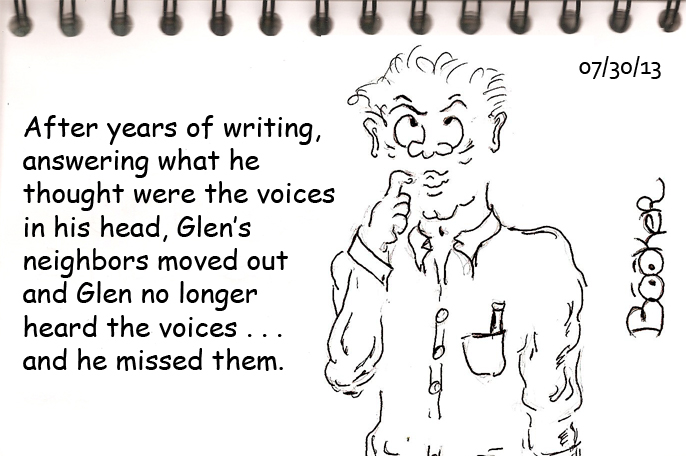
cARtOONSDAY: “a-mUSING vOICES”

You may never know  when the muse will come or when the muse will go.

You may never know
when the muse will come
or when the muse will go.

Leave a comment

Filed under cartoon by author, CarToonsday

Monday (morning) writing joke: “Dead again, ” part 1

In honor of all the zombie movies over the past year, and books about zombies and other dead creatures, here is the first of two or three “dead” jokes, puns, bits of humor. Groan as you see fit.

Q.: What do you call…

…a dead psychiatrist?

A.: A dead head.

…a dead musician?

A.: A dead beat.

…a dead twin bell musician?

A.: A dead ringer.

…a dead sailor?

A.: Dead lee

…a dead radio personality?

A.: Dead air

…a dead royal radio personality?

A.: Dead air apparent.

…a dead conservative?

A. Dead to rights

…a dead writer’s last sentence?

A. A deadline.

2 Comments

Filed under Monday morning writing joke

The Devil’s Dictionary: “Law,” part 1

A young Ambrose Bierce

A young Ambrose Bierce

In our continuing quest to revisit a classic, or even a curiosity from the past and see how relevant it is, we continue with The Devil’s Dictionary by Ambrose Bierce. Originally published in newspaper installments from 1881 until 1906. You might be surprised how current many of the entries are.

For example, here are definitions related to the law. The Old definitions are Bierce’s. The New definitions are mine or somebody else contemporary. The new definitions can also be simply examples of The Devil’s Dictionary definitions. From time to time, just as it was originally published, we will come back to The Devil’s Dictionary, for a look at it then and how it applies today. Click on Devil’s Dictionary in the tags below to bring up the other entries.

OLD DEFINITION:

APPEAL, v.t. In law, to put the dice into the box for another throw.

ARREST, v.t. Formally to detain one accused of unusualness.
God made the world in six days and was arrested on the seventh. –The Unauthorized Version

FORMA PAUPERIS. [Latin] In the character of a poor person–a method by which a litigant without money for lawyers is considerately
permitted to lose his case.

When Adam long ago in Cupid’s awful court
(For Cupid ruled ere Adam was invented)
Sued for Eve’s favor, says an ancient law report,
He stood and pleaded unhabilimented.
“You sue in forma pauperis, I see,” Eve cried;
“Actions can’t here be that way prosecuted.”
So all poor Adam’s motions coldly were denied:
He went away — as he had come — nonsuited.
G.J.

HABEAS CORPUS. A writ by which a man may be taken out of jail when confined for the wrong crime.

HANGMAN, n. An officer of the law charged with duties of the highest dignity and utmost gravity, and held in hereditary disesteem by a populace having a criminal ancestry. In some of the American States his functions are now performed by an electrician, as in New Jersey, where executions by electricity have recently been ordered—the first instance known to this lexicographer of anybody questioning the expediency of hanging Jerseymen.

HOMICIDE, n. The slaying of one human being by another. There are four kinds of homicide: felonious, excusable, justifiable, and praiseworthy, but it makes no great difference to the person slain whether he fell by one kind or another–the classification is for advantage of the lawyers.

NEW DEFINITION

APPEAL, v.t. In law, to put the dice into the box for another throw. If you have enough money, you can keep throwing until you get the role you want.

ARREST, v.t. Formally to detain one accused of unusualness or even being a little different.
God made the world in six days and was arrested on the seventh. –The Unauthorized Version

FORMA PAUPERIS. [Latin] In the character of a poor person–a method by which a litigant without money for lawyers is considerately
permitted to lose his case.

When Adam long ago in Cupid’s awful court
(For Cupid ruled ere Adam was invented)
Sued for Eve’s favor, says an ancient law report,
He stood and pleaded unhabilimented.
“You sue in forma pauperis, I see,” Eve cried;
“Actions can’t here be that way prosecuted.”
So all poor Adam’s motions coldly were denied:
He went away — as he had come — nonsuited.
G.J.

If you cannot afford an attorney in a crime case, one can be appointed for you. Of course, he or she might not be making much more money than you.

HABEAS CORPUS. A writ by which a man may be taken out of jail when confined for the wrong crime. How he was confined to begin with, one may never know given how long it might before the writ is written.

HANGMAN, n. An officer of the law charged with duties of the highest dignity and utmost gravity, and held in hereditary disesteem by a populace having a criminal ancestry. In some of the American States his functions are now performed by an electrician, as in New Jersey, where executions by electricity have recently been ordered—the first instance known to this lexicographer of anybody questioning the expediency of hanging Jerseymen.

A way of making a habeas corpus into a plain corpus.

Today this has been replaced in most states by injection. Contributes less to climate change (global warming) this way.

HOMICIDE, n. The slaying of one human being by another. There are four kinds of homicide: felonious, excusable, justifiable, and praiseworthy, but it makes no great difference to the person slain whether he fell by one kind or another — the classification is for advantage of the lawyers and certain segments of the media who present opinion reportedly under the guise of news.

Leave a comment

Filed under Devil's Dictionary

Photo Finish Friday: “Ditty”

Sometimes a little unincorporated Ditty is all you need.

Sometimes a little unincorporated Ditty is all you need.

Leave a comment

Filed under Photo by author, Photo Finish Friday

Haiku to you Thursday: “Snake”

Love puts forth a leaf. /

In my garden of desire /

the snake has purpose.

Leave a comment

Filed under Haiku to You Thursday, poetry by author

Monday (morning) writing joke: “Under a spell (checker)”

Ode to the Spell Check

Eye halve a spelling chequer

It cam with my pea sea

It plainly marques four my revue

Miss steaks eye kin knot sea.

Eye strike a key and type a word

And weight four it two say

Weather eye am wrong oar write

It shows me strait a weigh.

As soon as a mist ache is maid

It nose bee fore two long

And eye can put the error rite

Its rare lea ever wrong.

Eye have run this poem threw it

Leave a comment

Filed under Monday morning writing joke

Photo Finish Friday: “No Exit”

This way be madness...

This way be madness…


John Sartre moved to town, running away from an existential crisis. he did not know what he wanted to do. He had tried his hand at art, play writing, film writing, essays, history, and philosophy. He felt he had succeeded at any of those. Then he came across the street sign and saw it as an omen, a talisman, a message — he would move in here and become a poet and he would not leave until he had succeeded. To date, no one has read the poems of John Sartre, and every time he sees the sign he sighs and wishes he were a sign maker. Then he could make sign to paste over this one and he could escape. Maybe then, there would be an outlet for his creative spirit.

[Editor’s note: now it is your turn. Take this image as inspiration and writing something funny, serious, sensible, or silly. Let inspiration be your guide and whimsy your muse.]

Leave a comment

Filed under Photo by author, Photo Finish Friday

Haiku to you Thursday: “All embracing”

All embracing — /

flowers, raindrops, light gone wild — /

wonder fills the day.

Leave a comment

July 18, 2013 · 4:10 pm

Writing tip Wednesday: “Three pieces of advice”

In his recent 2013 ThrillerFest session “The Series Character: How to Do it Right,” Michael Connelly (author of the Harry Bosch series) offered three of his favorite bits of advice that he’s collected from other writers.

“I’ve carried these with me for decades,” he said. “I think they really sum up where you should be if you’re going to do this”—especially if you want to write crime fiction.

1. The best crime novels are not how cops work on cases; it’s how cases work on cops.
–Joseph Wambaugh

In other words, Connelly said, it’s all about character. Character is key, especially in series fiction. Readers don’t return to your work because of a plot twist—they return because of character.

2. Every character should want something, even if it is only a glass of water.
–Kurt Vonnegut

Regarding series characters, Connelly said this ties into a character’s sense of searching (which, he added, when unfulfilled, is what draws people to the next book).

3. When you circle around a murder long enough, you get to know a city.
–Richard Price

Connelly said this was Price’s reply when asked why a great writer would spend their time writing crime fiction. He pointed out that a writer should have a higher aspiration in their work—to use the form to say something about society, something about one’s city.

Source: http://www.writersdigest.com/online-editor/3-of-michael-connellys-favorite-bits-of-writing-advice?et_mid=627736&rid=1985858

Leave a comment

Filed under Writing Tip Wednesday