Monthly Archives: May 2013

Adventures In Editing, Part V

Step up, sit down, and read about one editor’s adventures in editing. If you are a writer, it is worth your time, and if you are a reader, it is also worth you time. And if you don’t do either, well, then, shame on you.

Tom Dupree's avatarYou and Me, Dupree

editing

One day, Bantam publisher Irwyn Applebaum summoned me into his office and asked, “How do you respond when I say, ‘Tom Robbins’?” Without even thinking, I said, “one of the great prose stylists of his generation.” He said, “That’s what I thought. I want you to go out to Seattle and meet him. You might become his editor.” (Spoiler Alert: I did, and I did. But I’m getting ahead of myself.)

In past pieces in this series, I’ve tried to give you some idea of what life is really like from the editor’s point of view. I began writing “Adventures In Editing” because I rarely read about that aspect of the publishing business, and the little I did read described only a cookie-cutter, stereotypical, author-v.-editor relationship that tended to come from the author’s side of the negotiating desk: much of it seemed to emanate from Writer’s Digest

View original post 1,755 more words

Leave a comment

Filed under editor

Writing tip Wednesday: “Frankly, my plot doesn’t give a….”

WHY DOESN’T MY PLOT WORK?

by BRUCE HALE and MICHAEL STEARNS

http://www.brucehalewritingtips.com/

Getting perspective on your own writing is tougher than two-year-old Halloween caramels. You squint at the story, mull it over, and suspect something isn’t working, but it’s hard to say what, exactly.

At a recent conference, my friend and former editor, Michael Stearns, offered up one of the best cures I’ve seen for this problem. His series of diagnostic questions can help you turn your plot from wimpy to wicked-strong.

Reprinted with his permission, here’s an excerpt from Michael’s list of questions, together with my explanations.

1. Do you have something pulling the character forward?
Every character needs a powerful goal or desire. Make sure it’s compelling enough to believably motivate them.


2. Do you have something pushing the character from behind?

Add a meddlesome mom, a pursuing villain, an obnoxious rival — someone who applies pressure.

3. Have you remembered clocks?
This refers to a deadline that must be met, or else. Think of Marty McFly in Back to the Future, who must drive his time machine
past the clock tower at the right moment, or remain stuck in the past.

4. Have you made the character lie — to others and to us?
Everybody lies. And whether it’s a big lie or a little one, the truth wants to come out. This energy helps invigorate your plot.

5. Do you know your character’s motives inside and out?
Often, plots bog down when you lose sight of why your hero wants to do something. Unmotivated action rings false.

6. Does all the above apply to even minor characters?
The villain, the best friend, even the bit players have a reason for doing what they do. And when you get clear on that reason, their actions will be make more sense.

7. Have you buried the ends of chapters?
Don’t immediately resolve the issue or question that gets raised near the chapter’s end. Resolve it in the next chapter — or better yet, the chapter after that. Your readers will curse you while they keep on reading.

8. Have you been as mean as possible to your characters?
We’re talking about Job mean, Sophie’s Choice mean, evil-punk-the-reader-will-hate-you-forever mean. Don’t just give your hero grief, give her the worst day imaginable.

9. Do you always go for the extreme?
What keeps readers reading is high-stakes action. In the words of Spinal Tap, dial it up to 11. The higher the stakes, the better the book.

Michael Stearns is an agent and partner of Upstart Crow Literary Agency. You can visit his website at: http://clicks.aweber.com/y/ct/?l=O8uEK&m=IsxyiV6D9FLsQz&b=7cPIzxf9UuUk28zsEYoWSw

___________

Bruce Hale

Bruce Hale

About Bruce…
Bruce Hale began his career as a writer while living in Tokyo, and continued it when he moved to Hawaii in 1983. Before entering the world of children’s books, he worked as a magazine editor, surveyor, corporate lackey, gardener, actor, and deejay.

Bruce has written and illustrated over 25 books for kids. His Underwhere series includes Prince of Underwhere and Pirates of Underwhere. His Chet Gecko Mysteries series includes: The Chameleon Wore Chartreuse, The Big Nap, The Malted Falcon, Hiss Me Deadly, and others. More at http://www.brucehale.com/

Leave a comment

Filed under writing tip, Writing Tip Wednesday

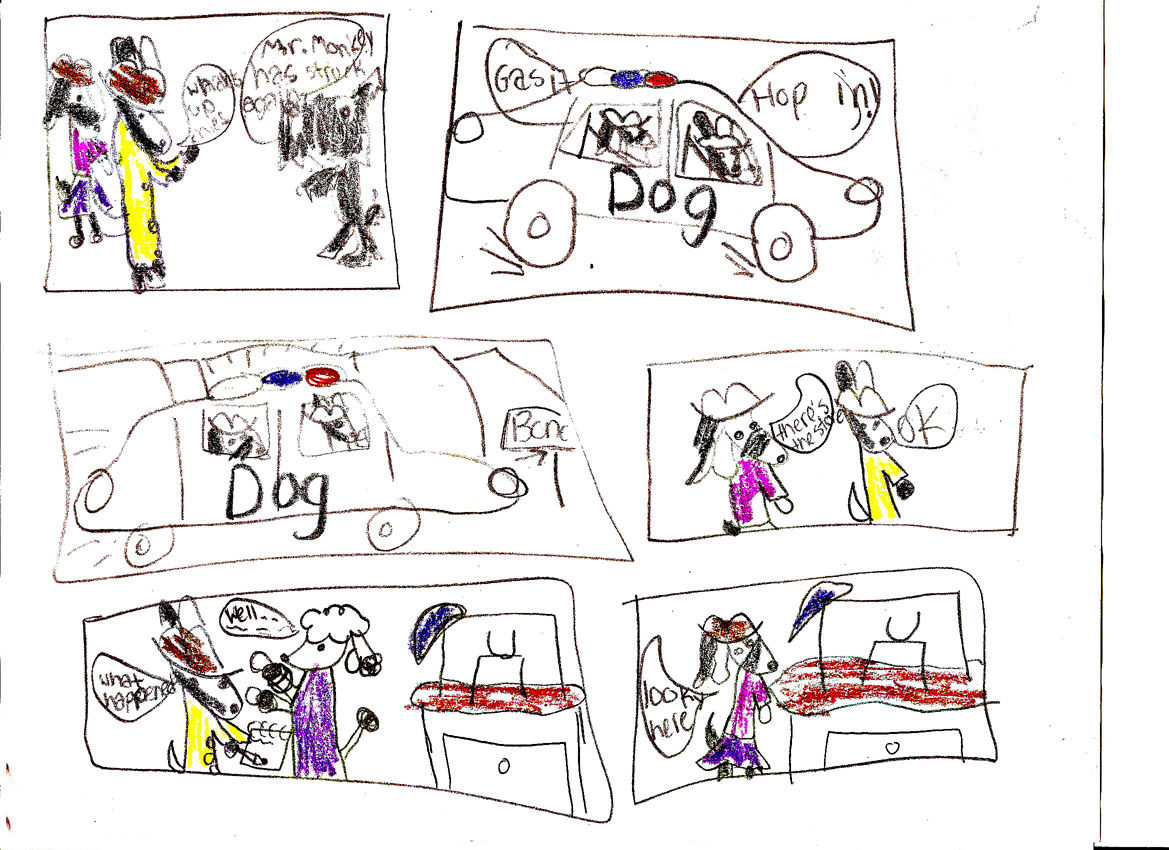
Eleanor and Rose, and “The Case of the Fleaing Colors,” Credits

Cartoonist: Lauren Booker

Cartoonist: Lauren Booker

This has been a Talltalestogo presentation of The Case of the Fleaing Colors.

Starring: Eleanor and Rose
Special appearance: Kali

Drawings by Lauren Booker

Coloring by Lauren Booker

Non-coloring by Lauren Booker

Story adapted for the blog screen by David E. Booker from a story told to him by Lauren Booker.

Editing by David E. Booker

Layout by David E. Booker

Concept by Lauren Booker

Any resemblance to dogs or monkeys real or imagined may not be completely coincidental.

Copyright 2013 by Lauren Booker and David E. Booker

Thank you for reading The Case of the Fleaing Colors

A Talltalestogo presentation.

To re-view any or all of the mystery strong>The Case of the Fleaing Colors, click on the links below, especially the one that reads: “The case of the fleaing colors”.

Story by: Lauren Booker and David E. Booker

Story by: Lauren Booker and David E. Booker

Leave a comment

Filed under cartoon by author, Eleanor and Rose, Story by author

Monday morning writing joke: “the screen and the bulb”

Q.: How many screenwriters does it take to screw in a light bulb?

A.: Why does it have to be changed?

Leave a comment

Filed under Monday morning writing joke

Just For Openers

An interesting rumination on some well-known opening sentences.

Tom Dupree's avatarYou and Me, Dupree

The sky above the port was the color of television, tuned to a dead channel.

That’s one of the greatest opening lines in literary history, for my money. It has stuck with me for nearly thirty years. In fact, I just quoted it by heart (double-checking only to make sure I got the comma right: I did). As everybody else who has encountered it also doubtless remembers, William Gibson’s brilliant novel NEUROMANCER begins with this sentence. I haven’t read the book since it was first published in 1984, but I still remember this line perfectly, because it smacked me like an open hand.

We know instinctively that a musical melody can get under our skins. Even a tune we had had quite enough of remains inside us, in some primal part of our brains that can whisk us back to the moment when it was contemporary and conjure long-forgotten emotions, both fond…

View original post 1,727 more words

Leave a comment

Filed under Uncategorized

Eleanor and Rose, and “The Case of the Fleaing Colors,” part 25

Part 25: The End, except for the credits

Part 25: The End, except for the credits

Leave a comment

Filed under cartoon by author, Eleanor and Rose, Story by author

Haiku to you Thursday: “Scatters”

Lightning, thunder, rain — /

wind scatters all that remains: /

memory, leaves, love

Leave a comment

Filed under Haiku to You Thursday, poetry by author

Eleanor and Rose, and “The Case of the Fleaing Colors,” part 24

Part 24: One last reveal

Part 24: One last reveal

Leave a comment

Filed under cartoon by author, Eleanor and Rose, Story by author

Monday morning writing joke: “Hording the light”

Q.: How many cover blurb writers does it take to screw in a light bulb?

A.: A VAST AND TEEMING HORDE STRETCHING FROM SEA TO SHINING SEA!!!!

Leave a comment

Filed under Monday morning writing joke

Eleanor and Rose, and “The Case of the Fleaing Colors,” part 23

Part 23: Crypt-ic ending

Part 23: Crypt-ic ending

Leave a comment

Filed under cartoon by author, Eleanor and Rose, Story by author