Monthly Archives: June 2012

Workshop Weekend: Roadmap for this blog

In case you’re wondering, and even if you aren’t, I would like to take a few moments and explain the new layout I am adopting for this blog. I have decided to make at least every work day specific to something. For example, Monday morning writing joke will be a joke focused on writing or about writing. It might also be a limerick (though nothing too naughty) or pun, which is something I have a weakness for.

Next: CarToonsday will be a cartoon, usually based in some way around writing, but not always.

Writing Tip Wednesday will have writing tips. It could also have recommendations of writing books to try, or information about writing conferences, or agents looking for new clients.

Haiku to you Thursday will be a haiku. At least for as long as I can write what I consider to be good quality ones. Sometimes I’m sure I’ll spit out a clunker, but sometimes you have to fail in order to succeed.
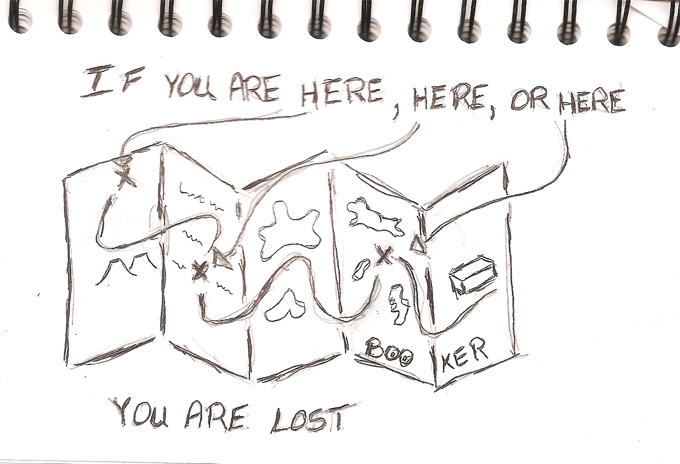
Map

At times, the roadmap might be under construction.

Freeform Friday will be another poem, maybe not a haiku but something else, or writing such as a Blathering idiot installment, The Devil’s Dictionary, an essay. Maybe even something I haven’t tried before. Could even be another cartoon. (As if one a week is not enough.)

Story Saturday will be a part of a story. Something I am working on. Could also be a Found Story (photo with piece of writing about the photo). Could even be a whole story, if short enough. Or I may write something about my struggles to write stories, though I am sure that would get old and boring quickly.

Sunday? I may just take off. Or take off Saturday and make it Story Sunday. Or the whole weekend could be titled Workshop Weekend.

I have noticed on weekends there are usually fewer visitors to my blog. People are off doing other things, I assume. Plus a day off won’t hurt. I have a regular job, family obligations, and am working on a novel and short stories as well. On my days off, I aim for between 300 and 400 words of new writing on my stories or novel. So doing that and a blog entry can be tough. I might also skip a day here and there if I don’t have something that fits that day’s theme.

Certainly, comments and suggestions are welcome. And visits, too. The more the better. I aim to keep humor and wit of one stripe or another going on this blog. You may not be rolling in the floor laughing and sometimes you might even be rolling your eyes and groaning at the puns, but at least you’re not having to pay for the self-inflicted humor wound.

Last, but not least, thank you to all who have visited my blog and especially so to those who have linked up to receive notification when I post something new. I do appreciate it. Very much. Part of the reason for trying to more regularize the format is so that you know what’s coming.


3 Comments

Filed under blog, Workshop weekend, writing

Freeform Friday: “Tonight the Moon”

Tonight the Moon comes walking down the middle of the street dropping her clothes.
Within the city, small men rail against the things they cannot do.
She blows them kisses;
they do not notice
or reflect on her milky promise.

Her clothes float down around them like notes from a forgotten song:
a lullaby of childhood lost,
a hymn of piety unclaimed,
a love song that makes tatters of the night.

To a man, their ears are tin
and their voices clang like hungry pots,
empty even in the embrace of words.

Tonight the moon comes walking down the middle of the street dropping her clothes.
Even in her fullness the small men find no solace in her naked joy,
and they rail against the things they cannot be
or believe.

Leave a comment

Filed under Freeform Friday, poem, poetry by author, Tonight the Moon

Haiku to You Thursday: Flicker

Fireflies flicker. /
Evening sun lingers with us. /
Your face holds the light.

Leave a comment

Filed under Flicker, haiku, Haiku to You Thursday, poem, poetry by author

Writing tip Wednesday: Setting the Scene

By David E. Booker

The earlier entry about scene writing covered one aspect of it. Here, for your consideration, are three other items related to scene description in a story or novel.

    1) Scene description is not a list of things in a room, valley, planet, or universe. The writer is not a cataloger for a moving company, listing everything or even most thing in a scene. Scene description is a description of the important items in that scene.

    2) Scene description is about movement. When describing clouds, describe them in motion. In The Great Gatsby, when F. Scott Fitzgerald describes what Nick sees, there is almost always something moving in the scene description.

    When describing grass, describe it as a breeze rustles through it, or if it’s brown with drought, describe how crunchy it feels and sounds to a character.

    Or give a sense of movement by describing something metaphorically or with simile. For example, describe an old, rundown house by writing: “The house slumped on its foundation like a tired old man struggling with a cane to keep upright. It creaked and smelled and sighed from its efforts, and the scaffolding along one side was not much of a cane.”

    3) Describe scenery from a character’s point of view. If you are writing a first person story, that is the only way to describe scenery. But consider it even when writing from a third person point of view. And when doing so, consider two questions:

      A) What is important enough for that character to notice? Focus, at least to start, on the two or three most important things.

      B) How does the character react of feel about the items in the scene? This does not necessarily have to be a straightforward mater, such as: It was night and he was afraid of the dark. It can be subtilized by writing: “The fading daylight always brought with it a feeling of apprehension. Mike didn’t know if it was childhood and bad dreams still lurking around, or if it was because he heard sounds he could not easily identify or dismiss with a nod and a shrug. No, the sounds of the night had an insidiousness about them that he was unable to pin down or run away from.”

    ,

And that brings us to a final thought on setting the scene in stories and novels: don’t forget the other senses: touching, hearing, tasting, smelling – all the tools that can help you tell the reader how a character feels about a scene and in doing so, set the scene dynamically for the reader.

Leave a comment

Filed under scene setting, setting the scene, Writing Tip Wednesday

CarToonsday: Where’d you bury the woman I married?

Man in Undershirt

“Where’d you bury the woman I married?”

Leave a comment

Filed under cartoon by author, CarToonsday

Monday morning writing joke: The double negative

A linguistics professor was lecturing to his English class one day. “In English,” he said, “a double negative forms a positive. In some languages, though, such as Russian, a double negative is still a negative. However, there is no language wherein a double positive can form a negative.”

A voice from the back of the room piped up, “Yeah, right.”

8888

A little writing humor on the day that often feels a bit like a double negative.

6 Comments

Filed under Monday morning writing joke, writing humor

Writing a novel…

Writing a novel is …

Simple.

Deceptive.

Seductive.

And an Act of Defiance.

That’s why so many feel they can do it, and why so few do it successfully.

2 Comments

Filed under writing, writing tip

Found story and haiku: tough times

We Buy Gold

All that glitters could be in your past.

A shack where she once
sold you your future, she now
buys your gold. Tough times.

[Editor’s note: at the university near where I live, this booth was for several years, a place where you could go to have your fortune told. Now, you go there to sell gold. such is how higher education has changed (pardon the pun). When I went to the same university, I don’t remember seeing as many Volvo, Mercedes Benz, and other high-end cars as I do now. I am sure there were many well-to-do students when I attended, and I’m also sure there are many middle- to lower-middle class students driving less prestigious cars. But as higher education costs continue to rise faster than inflation, maybe this booth is an indication of more than tough times.]

Leave a comment

Filed under Found story, haiku, Photo by author, poem, poetry by author, tough times

The Devil’s Dictionary: Abatis and Aborigines

In our continuing quest to revisit a classic, or even a curiosity from the past and see how relevant it is, we continue with The Devil’s Dictionary by Ambrose Bierce. Originally published in newspaper installments from 1881 until 1906. You might be surprised how current many of the entries are.

For example, here is a definition for the words Conservative and Republican, which have become synonymous. The Old definitions are Bierce’s. The New definition is mine or somebody else contemporary. From time to time, just as it was originally published, we will come back to The Devil’s Dictionary, for a look at it then and how it applies today. Click on Devil’s Dictionary in the tags below to bring up the other entries.

OLD DEFINITION
Abatis, n. Rubbish in front of a fort, to prevent the rubbish outside from molesting the rubbish inside.

Aborigines, n. Person of little worth found cumbering the soil of a newly discovered country. They soon cease to cumber; they fertilize.

Corollary: they succumb to abatis.

NEW DEFINITION
Abatis, n. Rubbish in front of the U.S. Congress, placed there to prevent the rubbish outside, the people, from molesting the rubbish inside, the bought and paid for representatives and senators. Often this rubbish is lobbyist, who themselves are many times former congressmen and senators making sure the people who hired them get what they want before the people, voters, do. See lobbyist in an earlier installment of The Devil’s Dictionary.

Aborigines, n. Person of little worth found cumbering the voting booths at election time. They soon cease to cumber; they fertilize or fodder for the plutocratic machine that is the U.S. Congress. unfortunately, this has also become increasing true of state congresses, too.

Corollary: they succumb to abatis.

Leave a comment

Filed under Abatis, Aborigines, Ambrose Bierce, Devil's Dictionary

Writing tip: Setting

Using Setting as a Character: a Tip for Novelists

Source: http://www.rachellegardner.com/2012/06/using-setting-as-a-character-a-tip-for-novelists/

Guest Blogger: MaryLu Tyndall @MaryLuTyndall

Choosing the right setting is just as important as choosing the right characters, plot, and dialogue. Setting grounds your readers, helping them to experience the action and drama more effectively. But it does so much more than that! A setting can be so vibrant and alive that it becomes one of the characters in your story, assisting or hindering your protagonist in achieving his/her goals.

Setting as Friend

A beach at sunset or a hike to a tranquil waterfall can provide nearly as much comfort and encouragement as any good friend. If your hero has just defeated a dragon, don’t send him to a lively night club or a bull fight. Turn his setting into a place where he can recuperate and reflect, where he can hear the voice of God in the breeze.

Setting can also aid the hero in his quest. A jungle or a crowded bus station can hide the hero from his enemies just as easily as quicksand can devour them.

Setting as Antagonist

Just like a villain, the proper setting can introduce conflict, cause trouble, or thwart the hero’s plans. Consider a vicious storm, a flood, a moonless night that blinds the hero, a jungle where he gets lost, bumper-to-bumper traffic that keeps him gridlocked, an earthquake, rock slide, etc. These settings take on a life of their own, and do everything in their power to keep your hero from succeeding. You’ve heard it said that if your scene is falling flat, have someone pull out a gun. I say transport your scene to a setting filled with conflict.

Setting as Mentor

Like a wise old sage, setting can also be a mentor. Perhaps your hero must learn something before he can move on. Have him wander into a library, an old book store, a cave with ancient, mysterious writings on the walls, an archeological dig, a museum. Or perhaps your hero must survive some ordeal in order to move forward such as climb a mountain or cross a river to overcome his fears and gain the confidence he needs to achieve his goals.

Setting as a Shadow for Your Protagonist

A shadow is anything or anyone that reflects your hero’s deepest flaws. If your hero has an alcohol problem, put him in a bar where he can watch what alcohol does to others. If he’s a control freak, put him in prison. If he’s selfish, put him in a homeless shelter or soup kitchen. If he’s greedy, place him at the New York Stock Exchange. Use the appropriate setting to open his eyes to his own flaws.

Setting as a Model of What the Protagonist Wants to Be

A church, a mission trip, a charitable foundation, free medical clinic, the palace of a wise king, the courtroom of a just judge, and a loving home are all settings that can provide an atmosphere that fosters qualities to which the hero aspires.

How about using setting as a shapeshifter, a joker, a symbol of the hero’s past, a guardian? Choosing setting as a character is only limited by your imagination!

As an example: Let’s say you’re writing a breakup scene between two of your characters. Now, imagine the difference if that scene were set: at home in the living room, in a crowded restaurant, on a ship out at sea, on a ski slope, a shooting range, a fencing match. Each setting becomes a third character that determines how the scene will play out.

Setting can be a dynamic, breathing character that can either assist or hinder your hero. So, choose wisely, and you’ll add an entirely new dimension to your story.

Can you think of any favorite scenes in books you’ve read where setting is an important character? What about your own writing—how have you incorporated setting this way?

MaryLu Tyndall’s latest novel, Veil of Pearls, releases July 1 and is available for pre-order at Amazon, Barnes & Noble, and ChristianBook.com.

Leave a comment

Filed under MaryLu Tyndall, setting, writing tip