Monthly Archives: May 2012

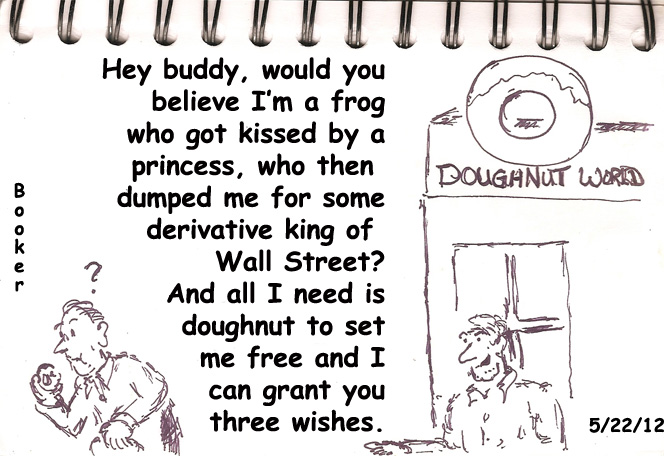
CarToonsday: The Prince and the doughnut

Man begging for Doughnut

The Princess had her pea, the Frog Prince his doughnut

Leave a comment

Filed under Cartoon, cartoon by author

The question

Love is not the answer

The question begets the answer.

Leave a comment

Filed under haiku, Photo by author, poetry by author

The Kibitzer and The Kidd, part 8

[Editor’s note: Parts 1 – 7 of The Kibitzer and the Kidd are available by clicking on “Kidd” or “Kibitzer” in the tag section. This is science fiction western with more than dollop of humor and satire.]

888888

The Kibitzer couldn’t help himself. The flames were everywhere. Smoke embraced the air and made it suffocating.

He didn’t believe in the devil or demons – other than the ones you create or marry into – but the unholiness of the air made him wonder if there wasn’t something otherworldly afoot.

Then there was the quote running through his head, the one where the fat comedian turns to the skinny one with the big chin and doofus grin, and says, “This is a fine mess you’ve gotten use into.”

At a time of impending death, one shouldn’t be thinking of comedy, especially when you couldn’t remember the names of the comedians, especially the one with big chin and the doofus grin.

He heard voices beyond the flames, or at least thought he did. One voice kept yelling over and over: “Swallow the lozenges!”

The Kibitzer wasn’t sure what to make of the voice. The fire was loud and crackling. He never realized how much noise a fire made. If there was a hell and there were people in it and it was composed of fire, the people would not be able to talk to each other. Would not be able to listen to their own thoughts.

He felt for the lozenges. They were in a paper sack in his shirt pocket, but they felt soft, like warmed candle wax. Not yet liquid, but would soon be.

A new wall of flames sprouted up around him, forcing him to run further into the stable.

“Trust the lozenges.”

It sounded like a woman’s voice.

He heard the whinnying of a horse. The Kibitzer glanced around. He thought he had freed all the animals, except himself.

“Trust the lozenges.”

This time the words came with an image. It was the comedian with the doofus grin. The fat comedian with the small bowler hat standing next to him was breathing fire at him, smoke spewing out of the comedian’s ears. But the skinny comedian kept the same big grin.

The lozenges felt very soft when he touched his pocket.

Flames were everywhere. The air was hot, smoky, and unbreathable. But he was still breathing. Sweat flowed off the end of his nose.

The Kibitzer reached for the lozenges. Nobody was going to rescue him. Not now. Not ever. Not even the Kidd.

He heard the whinny again. Louder this time. Followed by kicking.

He had the lozenges out. They were oozing out of their wax paper wrappers and onto his fingers. The liquid was warm, but he could not feel its warmth.

He brought his fingers up to his lips.

The wall in front of him exploded inward, toward him. A part of the wall hit him, knocking him backwards, toward the wall of flames.

He couldn’t breathe. He couldn’t feel. He wasn’t sure he had swallowed. And as he started passing out, he heard the fat comedian say, “Well, Kibbey, this is another fine mess you’ve gotten us into.”

Except the comedian wasn’t talking to him, unless he was a … duacorn?

(To be continued.)

Leave a comment

Filed under satire, science fiction and western story, story, The Kibitzer and The Kidd

Rattles

The garden wall leans.
The wind rattles old vines as
the cold chains my heart.

2 Comments

Filed under haiku, poem, poetry by author, rattles

Spoken words

I crave the sound of your voice,
the touch of your syllables to my ear,
a kindness of words only you can speak.
Sentences that mean nothing
when spoken by others –
a clattering of consonants to these empty ears –
are wonder of time on your lips.
Your voice carries the lightness of words,
the weight of our history,
and the magic of the moment yet to be.

2 Comments

Filed under free verse, poem, poetry

Writing humor

My day, my life, my meme.

Leave a comment

Filed under word play, writing humor

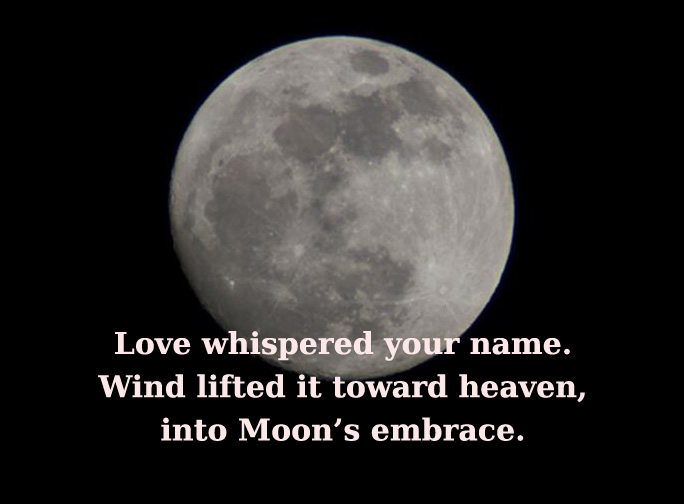
Whispered embrace

Love whispered your name

Whispered embrace

2 Comments

Filed under haiku, moon, photograph

Writing tip Wednesday: knock-off anyone?

[Editor’s commentary: “It was a dark and stormy night.” How many times have you as a writer been told not to copy. Don’t copy somebody’s homework. Don’t copy the way somebody looks. Seems somewhere along the line may have changed. Or, at least, knock-offs of something may be okay. Or at least what publishers are looking for. That’s what this article suggests. So, maybe what you need to do is find some best selling novel and “spice” it up in some way, and see if an agent or publisher will buy it. I say it with a bit of tongue-in-cheek. Therefore, I don’t know that I so much say this is a writing tip and maybe a way to get started writing if you feel stuck. Take something out there, a classic maybe, and bend it some, change it in some way. Many of the stories of King Arthur’s knights of the round table were retold in just such a fashion. Each new writer taking what had been written before about a certain knight and adding his own inflections to it. In some ways, we may not be quite as far beyond the Middle Ages as we would like to think.]

“Fifty shades” of knock-offs?

Source: http://www.hlntv.com/article/2012/05/14/fifty-shades-grey-knock-offs?hpt=hp_c2

By Matthew Carey

updated 11:31 AM EDT, Mon May 14, 2012

An erotic bestseller has publishers fantasizing… about how to repeat its runaway success.

The “Fifty Shades of Grey” trilogy by author E. L. James has sold an amazing three million copies in just a few weeks, seducing readers with its sadomasochistic tale of virginal college student Anastasia Steele and her troubled billionaire lover Christian Grey. Universal snapped up the film rights for a reported $5 million.

The “Fifty Shades” boom “is a very big deal,” says Jim Milliot of Publishers Weekly. “I think it’s safe to say it’s a mini-phenomenon.” Milliot says publishing houses are pouring over ideas hoping to duplicate “Shades’” achievement.

“This is a notoriously copycat industry… This industry jumps on whatever big thing comes along,” Millot explains.

But it’s tricky to imitate what you don’t quite understand — and many industry pros are baffled by the trilogy’s success.

“A lot of people are kind of scratching their heads about what has made this thing pop,” Milliot says. “It’s not just the sex thing that’s selling. There’s way more explicit stuff out there if you want it. It’s more than that.”

Milliot credits word of mouth, plus “Shades’” distinctive cover art (a silver necktie) and what he calls a “secret sauce” — that mystery ingredient that can turn something ordinary into a big hit.

Already, some rival publishers are promoting titles with their own recipe for “secret sauce”:

• “Bared to You” by Sylvia Day is described as a compelling combo of “love, lust and secrets.” Heroine: Young Eva Tramell. Troubled, rich boyfriend: Gideon Cross.

• “Big Game”, the latest in the “Vampire Vacation Inn” series by C. J. Ellisson, which could be called a cross between “Twilight” and “Fifty Shades of Grey.” Heroine: 580-year-old vampire Vivian. Sexy soulmate: Rafe.

Like “Fifty Shades,” Ellisson’s books contain a “heavy erotic element,” the author told HLN (though she notes the hot action involves a married couple). Ellisson began publishing her series before the “Shades” explosion, but all the media attention on James’ trilogy may benefit her sales too.

“I love that [“Fifty Shades of Grey”] has brought erotic literature into the mainstream. I think that’s terrific,” says Ellisson.

There’s an irony in publishers trying to imitate “Fifty Shades of Grey,” because it basically began as an imitation itself of Stephanie Meyer’s “Twilight” series. E.L. James’ story originated on a Twilight “fan fiction” website, and her main characters were first called Bella and Edward (not Anastasia and Christian).

Milliot says — imitation or not — “Shades” is not in “Twilight”‘s league, despite those impressive sales figures and a movie in the early stages of development.

“I think you see how books two and three (in the series) do and you have to see how the movie gets made and if the books have legs. It’s not there (yet) to be compared to ‘Twilight’ and ‘Harry Potter.’”

But Milliot adds, “It has the foundation to do that.”

Leave a comment

Filed under knock-off, writing, writing tip

“Hal, tell me a story.”

[Editor’s note: this is the second half of the “Hal” articles. The first article appears under “Hal, open the keyboard. Hal….” and is about a computer application writing non-fiction articles. I am not sure what to fully make of either article, but they seemed oddly linked to each other. It seems storytelling is something genetic in humans. We are born to tell stories. maybe in some strange way Alzheimer’s is a “revenge” on humans for not valuing storytelling enough.]

Alzheimer’s Patients Turn To Stories Instead Of Memories

Source: http://www.npr.org/blogs/health/2012/05/14/152442084/alzheimers-patients-turn-to-stories-instead-of-memories

by Joanne Silberner, NPR

May 14, 2012

Ask family members of someone with Alzheimer’s or another dementia: Trying to talk with a loved one who doesn’t even remember exactly who they are can be very frustrating.

But here at a senior center in Seattle, things are different.

On one recent day, 15 elderly people were forming a circle. The room is typical — linoleum floors, cellophane flowers on the windows, canes and wheelchairs, and walkers lined up against the wall.

Linda White is leading a session based on a program called TimeSlips. The idea is to show photos to people with memory loss, and get them to imagine what’s going on — not to try to remember anything, but to make up a story.

Storytelling is one of the most ancient forms of communication — it’s how we learn about the world. It turns out that for people with dementia, storytelling can be therapeutic. It gives people who don’t communicate well a chance to communicate. And you don’t need any training to run a session.

White walks around the circle holding up a stock photo of a fit elderly man. He’s wearing a banana-yellow wet-suit vest and is water-skiing.

The man is smiling broadly at the camera, perfectly framed by a big arc of water.

“He’s experienced and he’s cool; he’s happy,” says White. “Look at the grin on his face.”

Many of the people in this group don’t talk much on their own. But they’re enthusiastic about making up a life story for the water-skier — he’s a retired guy who’s been divorced several times. He’s got four children and a wife onshore, waiting to be taken out to dinner.

Most people with dementia live at home and don’t have the opportunity for this kind of session, run by someone who’s been trained to do it. But storytelling can be done at home, according to the founder of the program, Anne Basting.

“Anybody can do this,” says Basting.

She directs the Center on Age and Community at the University of Wisconsin, Milwaukee. She started work on storytelling as a way to give people with dementia a low-stress way to communicate, one that did not rely on their memories. She sees it as giving caregivers a chance to reconnect with their loved ones.

“People with dementia start to forget their social role; they might not remember they’re a spouse … a parent,” says Basting. “They need a social role through which they can express who they are, and the role of storyteller really supplies that.”

One study co-authored by Basting in The Gerontologist, a journal, found that storytelling made people more engaged and alert, and that staff members at residential facilities had more positive views of their patients. An independent study published in Nursing Research showed participants were happier and better able to communicate in general.

Basting says one of the biggest hurdles to getting the program going has been skeptical family members.

“Resistance comes when people say, ‘My dad would never do that; he’s a very distinguished man. It’s beneath him; it’s childish,’ ” says Basting.

And then Dad hops right in.

Basting tells of one man who came to her in tears of thanks. For the past three years, he had been driving his wife crazy, trying to get her to talk about shared memories. He tried her on storytelling so they could talk about the story and play with the plot line. And eventually, he was able to communicate with her again.

Leave a comment

Filed under Hal, make believe, storytelling

“Hal, open the keyboard. Hal….”

Could a computer write this story?

Source: http://www.cnn.com/2012/05/11/tech/innovation/computer-assisted-writing/index.html?hpt=hp_bn11

By John Sepulvado, CNN

updated 3:21 PM EDT, Fri May 11, 2012

(CNN) — Computer applications can drive cars, fly planes, play chess and even make music.

But can an app tell a story?

Chicago-based company Narrative Science has set out to prove that computers can tell stories good enough for a fickle human audience. It has created a program that takes raw data and turns it into a story, a system that’s worked well enough for the company to earn its own byline on Forbes.com.

Kristian Hammond, Narrative Science’s chief technology officer, said his team started the program by taking baseball box scores and turning them into game summaries.

“We did college baseball,” Hammond recalled. “And we built out a system that would take box scores and historical information, and we would write a game recap after a game. And we really liked it.”

Narrative Science then began branching out into finance and other topics that are driven heavily by data. Soon, Hammond says, large companies came looking for help sorting huge amounts of data themselves.

“I think the place where this technology is absolutely essential is the area that’s loosely referred to as big data,” Hammond said. “So almost every company in the world has decided at one point that in order to do a really good job, they need to meter and monitor everything.”

Narrative Science hasn’t disclosed how much money is being made or whether a profit is being turned with the app. The firm employs about 30 people. At least one other company, based in North Carolina, is working on similar technology.

Meanwhile, Hammond says Narrative Science is looking to eventually expand into long form news stories.

That’s an idea that’s unsettling to some journalism experts.

Kevin Smith, head of the Society of Professional Journalists Ethics Committee, says he laughed when he heard about the program.

“I can remember sitting there doing high school football games on a Friday night and using three-paragraph formulas,” Smith said. “So it made me laugh, thinking they have made a computer that can do that work.”

Smith says that, ultimately, it’s going to be hard for people to share the uniquely human custom of story telling with a machine.

“I can’t imagine that a machine is going to tell a story and present it in a way that other human beings are going to accept it,” he said. “At least not at this time. I don’t see that happening. And the fact that we’re even attempting to do it — we shouldn’t be doing it.”

Other experts are not as concerned. Greg Bowers, who teaches at the Missouri School of Journalism, says computers don’t have the same capacity for pitch, emotion and story structure.

“I’m not alarmed about it as some people are,” Bowers said. “If you’re writing briefs that can be easily replicated by a computer, then you’re not trying hard enough.”

[Editor’s note: This is one half of an interesting set of articles. I will post the second one here soon. By story in this article, it doesn’t mean a fiction story or a poem. I’m not sure when, if ever, a computer application or program will be able to create a convincing fictional story. But it is something innate in humans, as the next article points out. The article deals with Alzheimer’s patience and their ability to tell stories even when they have problems with their memories.]

2 Comments

Filed under Hal, non-fiction, software application, technology, writing