

Top of young tree broken by human hand just leaves are budding out.
Touch Nature’s beauty;
even the hand that twists the
tree free of its growth.
Top of young tree broken by human hand just leaves are budding out.
Touch Nature’s beauty;
even the hand that twists the
tree free of its growth.
[Editor’s note: I believe it was the late Rodney Dangerfield who had a comedy routine based on “I don’t get no respect.” The lack of respect could come from anybody, anywhere, including his wife. Below is a playwright Rodney could empathize with. He writes to Dear Abby, and she responds. I have known one or two other writers in the same situation. Maybe you, do, too.]

Sometimes respect is hard to come by for a writer, or a comic. Just ask Rodney Dangerfield.
I have won this prize four times – more than any other writer in the history of the contest. But is my family impressed? Not at all! My wife told me she thinks I write everything the same way and have simply repeated myself four times.
I am up in years. It’s unlikely I will ever again win this prize. So how do I respond to such indifference? What do you do when you feel you have accomplished something important and the response is, “so what else is new?”
–Looking for Validation in Florida
DEAR LOOKING FOR VALIDATION: My hat’s off to you. That you have won this prize more than any other writer in the history of the contest is a notable achievement. Attend the production, take your well-earned bow in the spotlight, and accept that the less you look to your wife for validation, the happier your life will be.
Wise author Paul Coelho writes: Contrary to glasses and windows, a broken heart remains intact.
Unwise wit responds: That’s because it’s a pain of a different sort.
The window pain ... in The Twilight Zone.
Filed under pain, Paul Coelho, wit, Woirds to live by, word play, words, writer
[Editor’s note: yesterday I posted an article about the Encyclopedia Britannica going online only. Now, here is a New York Times article about a California man and family working to preserved physical copies of books, a sort of Noah’s Ark for books. I guess there won’t be future copies of the Encyclopedia Britannica in this collection.]
March 3, 2012
By DAVID STREITFELD
RICHMOND, Calif. — In a wooden warehouse in this industrial suburb, the 20th century is being stored in case of digital disaster.
Forty-foot shipping containers stacked two by two are stuffed with the most enduring, as well as some of the most forgettable, books of the era. Every week, 20,000 new volumes arrive, many of them donations from libraries and universities thrilled to unload material that has no place in the Internet Age.
Destined for immortality one day last week were “American Indian Policy in the 20th Century,” “All New Crafts for Halloween,” “The Portable Faulkner,” “What to Do When Your Son or Daughter Divorces” and “Temptation’s Kiss,” a romance.
“We want to collect one copy of every book,” said Brewster Kahle, who has spent $3 million to buy and operate this repository situated just north of San Francisco. “You can never tell what is going to paint the portrait of a culture.”
As society embraces all forms of digital entertainment, this latter-day Noah is looking the other way. A Silicon Valley entrepreneur who made his fortune selling a data-mining company to Amazon.com in 1999, Mr. Kahle founded and runs the Internet Archive, a nonprofit organization devoted to preserving Web pages — 150 billion so far — and making texts more widely available.
But even though he started his archiving in the digital realm, he now wants to save physical texts, too.
“We must keep the past even as we’re inventing a new future,” he said. “If the Library of Alexandria had made a copy of every book and sent it to India or China, we’d have the other works of Aristotle, the other plays of Euripides. One copy in one institution is not good enough.”
Mr. Kahle had the idea for the physical archive while working on the Internet Archive, which has digitized two million books. With a deep dedication to traditional printing — one of his sons is named Caslon, after the 18th-century type designer — he abhorred the notion of throwing out a book once it had been scanned. The volume that yielded the digital copy was special.
And perhaps essential. What if, for example, digitization improves and we need to copy the books again?
“Microfilm and microfiche were once a utopian vision of access to all information,” Mr. Kahle noted, “but it turned out we were very glad we kept the books.”
An obvious model for the repository is the Svalbard Global Seed Vault, which is buried in the Norwegian permafrost and holds 740,000 seed samples as a safety net for biodiversity. But the repository is also an outgrowth of notions that Mr. Kahle, 51, has had his entire career.
“There used to be all these different models of what the Internet was going to be, and one of them was the great library that would offer universal access to all knowledge,” he said. “I’m still working on it.”
Mr. Kahle’s partners and suppliers in the effort, the Physical Archive of the Internet Archive, are very glad someone is saving the books — as long as it is not them.
The public library in Burlingame, 35 miles to the south, had a room full of bound periodicals stretching back decades. “Only two people a month used it,” said Patricia Harding, the city librarian. “We needed to repurpose the space.”
Three hundred linear feet of Scientific American, Time, Vogue and other periodicals went off to the repository. The room became a computer lab.
“A lot of libraries are doing pretty drastic weeding,” said Judith Russell, the University of Florida’s dean of libraries who is sending the archive duplicate scholarly volumes. “It’s very much more palatable to us and our faculty that books are being sent out to a useful purpose rather than just recycled.”
As the repository expands — from about 500,000 volumes today toward its goal of 10 million — so does its range. It has just started taking in films.
“Most films are as ephemeral as popcorn,” said Rick Prelinger, the Internet Archive’s movie expert. “But as time passes, the works we tried to junk often prove more interesting than the ones we chose to save.”
At Pennsylvania State University, librarians realized that most of their 16-millimeter films were never being checked out and that there was nowhere to store them properly. So the university sent 5,411 films here, including “Introducing the Mentally Retarded” (1964), “We Have an Addict in the House” (1973) and “Ovulation and Egg Transport in the Rat” (1951).
“Otherwise they probably would have ended up in a landfill,” said William Bishop, Penn State’s director of media and technology support services.
Not everyone appreciates Mr. Kahle’s vision. One of the first comments on the Internet Archive’s site after the project was announced in June came from a writer who said he did not want the archive to retain “any of my work in any form whatsoever.”
Even some librarians are unsure of the need for a repository beyond the Library of Congress.
“I think the probability of a massive loss of digital information, and thus the potential need to redigitize things, is lower than Brewster thinks,” said Michael Lesk, former chairman of the department of library and information science at Rutgers. But he conceded that “it’s not zero.”
If serious “1984”-style trouble does arrive, Mr. Lesk said, it might come as “all Internet information falls under the control of either governments or copyright owners.” But he made clear he thought that was unlikely.
Under a heated tent in the warehouse’s western corner the other day, Tracey Gutierres, a digital records specialist, worked on a new batch. If a volume has a bar code, she scans it to see if the title is already in the repository. If there is no bar code, she checks the International Standard Book Number on the copyright page. If the book is really old, she puts it aside for manual processing.
Before the books make it the 150 feet to the shipping containers for storage, some will have to travel 12,000 miles to China. The Chinese, who are keen to build a digital library, will scan the books for themselves and the archive and then send them back. The digital texts will be available for the visually impaired and other legal purposes.
As word about the repository has spread, families are making their own donations.
Carmelle Anaya had no idea what to do with the 1,200 books her father, Eric Larson, left when he died. Then she heard about the project. “He’d be thrilled to think they would be archived so maybe someone could check them out a hundred years from now,” said Ms. Anaya, who lives in California’s Central Valley.
Her daughter Ashley designed a special bookplate. Any readers across the centuries will know where the copies came from. “The books will live on,” Ms. Anaya said, “even if the people can’t.”
Filed under books, preserving, publishing
CHICAGO—Hours after Encyclopaedia Britannica Inc. announced it will stop publishing print editions of its flagship encyclopedia for the first time in more than 200 years, someone among the editing minions of free online rival Wikipedia made an irony-free note of that fact.
“It was announced that after 244 years, the Encyclopaedia Britannica is going out of print, instead focusing on its online encyclopedia,” the entry read.
The book-form of Encyclopaedia Britannica has been in print since it was first published in Edinburgh, Scotland, in 1768. It will stop being available when the current stock runs out, the company said. The Chicago-based company will continue to offer digital versions.
Officials said the end of the printed, 32-volume set has been foreseen for some time.
“This has nothing to do with Wikipedia or Google,” Encyclopaedia Britannica Inc. President Jorge Cauz said. “This has to do with the fact that now Britannica sells its digital products to a large number of people.”
The top year for the printed encyclopedia was 1990, when 120,000 sets were sold, Cauz said. That number fell to 40,000 just six years later in 1996, he said. The company started exploring digital publishing in the 1970s. The first CD-ROM edition was published in 1989 and a version went online in 1994.
The final hardcover encyclopedia set is available for sale at Britannica’s website for $1,395.
“The sales of printed encyclopedias have been negligible for several years,” Cauz said. “We knew this was going to come.”
The company plans to mark the end of the print version by making the contents of its website available free for one week, starting Tuesday.
Online versions of the encyclopedia now serve more than 100 million people around the world and are available on mobile devices, the company said. The encyclopedia has become increasingly social as well, Cauz said, because users can send comments to editors.
“A printed encyclopedia is obsolete the minute that you print it,” Cauz said. “Whereas our online edition is updated continuously.”
Lynne Kobayashi of the Language, Literature & History section of the Hawaii State Library notes some people will always prefer using print sources, but that readers are becoming attuned to online searching because of a proliferation of electronic publishing.
“There are many advantages to online searching, chief among them the ability to search within the text,” Kobayashi said. “The major disadvantage is the need for a computer or devices with access to the Internet.”
Kobayashi said her decision to use traditional or online resources depends on the question she wants answered.
“Sometimes subject knowledge and familiarity with standard resources may get faster results than keying in a search and sifting through results,” she said. “If the search is broader, searching across several online sources may yield more options.”
Britannica has thousands of experts’ contributors from around the world, including Nobel laureates and world leaders such as former President Bill Clinton and Archbishop Desmond Tutu. It also has a staff of more than 100 editors.
“To me, the most important message is that the printed edition was not what made Britannica,” Cauz said. “The most important thing about Britannica is that Britannica is relevant and vibrant because it brings scholarly knowledge to an editorial process to as many knowledge seekers as possible.”
Kobayashi said as information professionals, librarians see an important part of their role as directing patrons to trustworthy information sources.
“While Wikipedia has become ubiquitous, the Britannica remains a consistently more reliable source,” she said.
——
Online: http://www.britannica.com
Filed under encylopedia, online, publishing
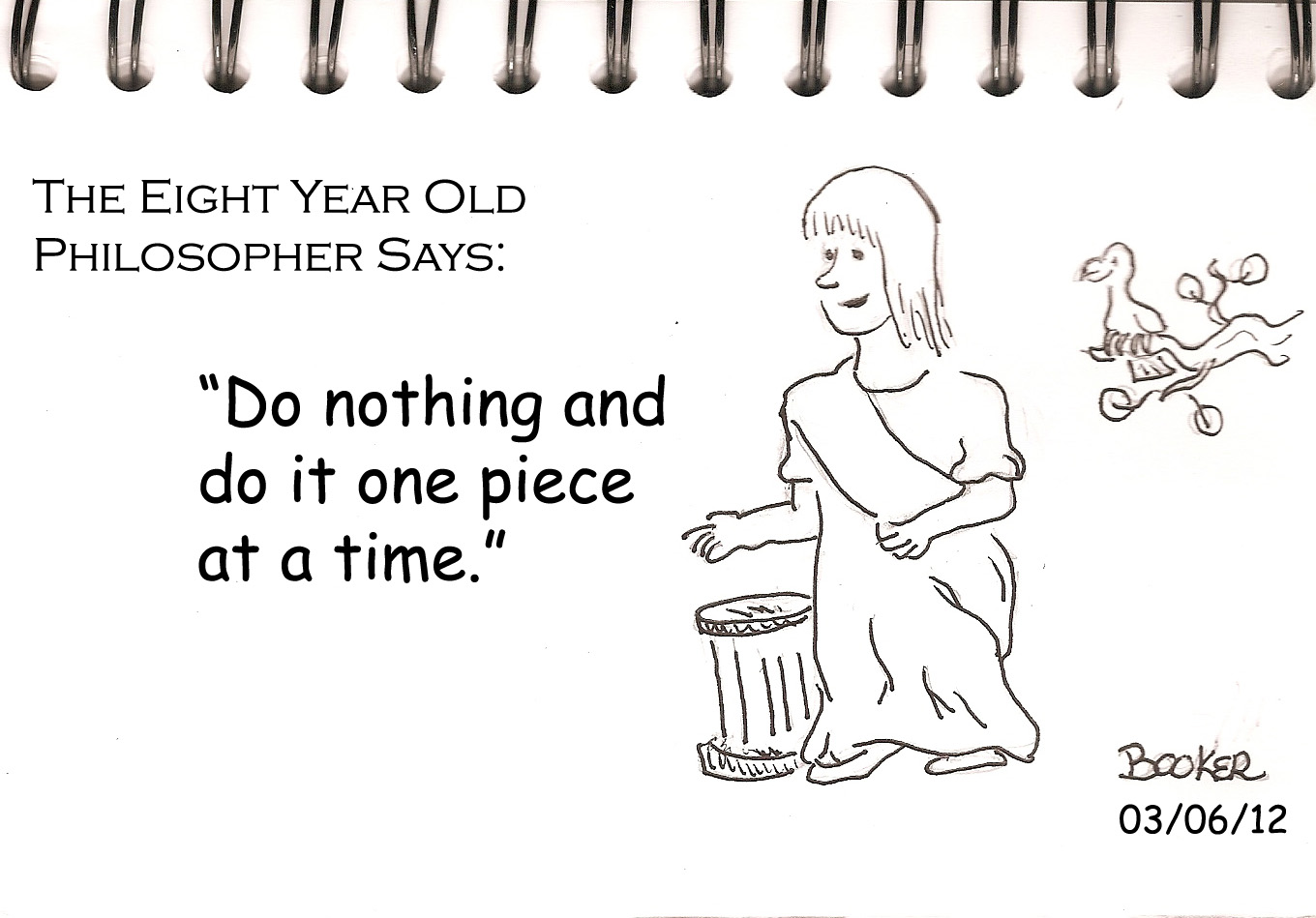
Doing nothing should not be rushed.
Filed under Cartoon, humor, Philosopher
Dear Congress,
I want my hour back.
The one you stole from me
To take up all the slack
Of saving energy.
A supercilious stance
Of the previous administration
Is giving me morning headaches
And hours of constipation.
Spring has not yet sprung
But an “extra” hour blooms
We’re supposed to use less fossil fuels
But you were a fool to assume.
You now fight over light bulbs
Some invoking “my right to chose.”
Yet, when robbing me of one hour,
You said I had nothing to lose.
There is no proof this hour
Is saving the country power.
I get up in the night, turn on several lights
As I make my way to the shower.
I use more electricity
As I start each day of work
All because you fell asleep
And forgot to think. What jerks.
You pander to the lobbyist
And engage in high mediocrity.
All the time wasting hours
On political pomposity.
By making daylight longer.
As I’m driving more for less
On gas I’ve forced to squander
While you show little or no regrets.
I’m losing sleep because I cannot be
Awake while the sun still shines
But with a jerk, the hour to start work
Finds me ever more behind.
I want my hour back.
The one you stole from me
And do not counterattack
With your light bulb skullduggery.
Even though my eyes are bleary
And my outlook a bit less cheery
I can still see quite clearly
And let you know sincerely:
I want my hour back.
The one you stole from me
To take up all the slack
Of saving energy.
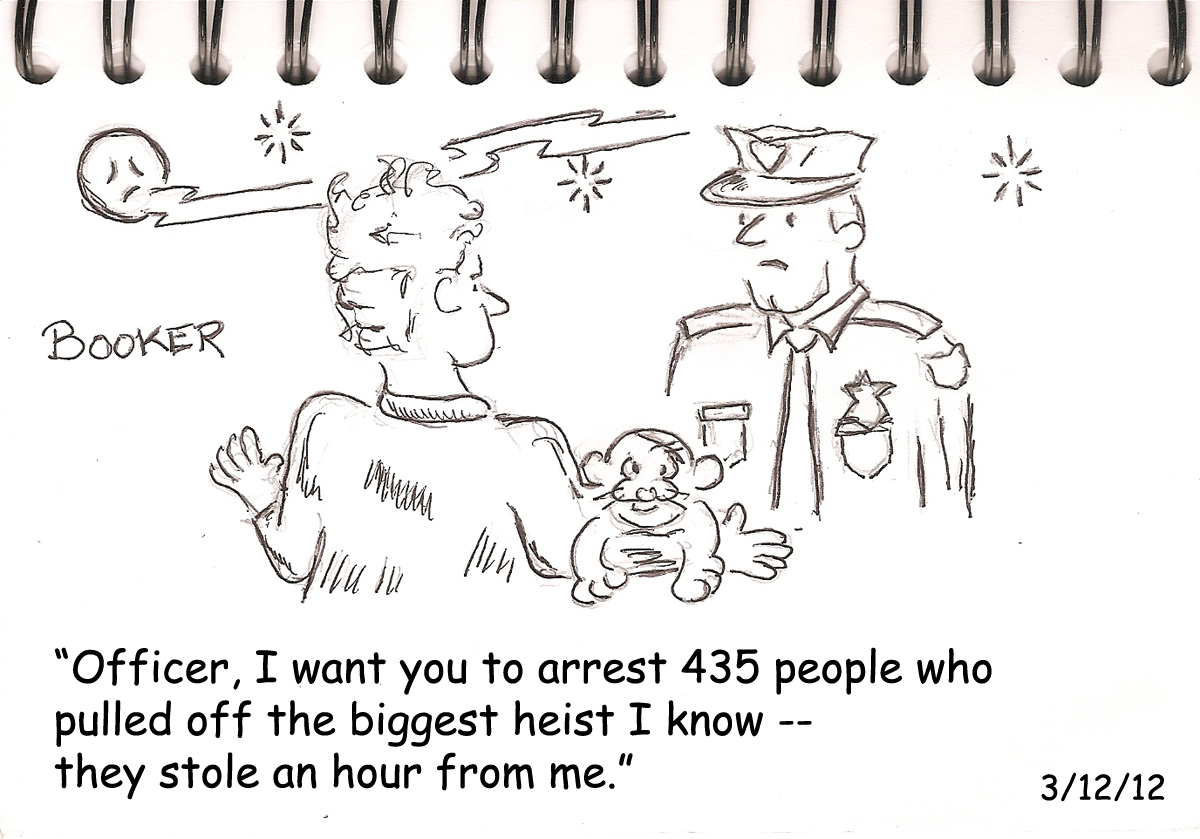
The heist of some lifetime
Filed under Cartoon, heist, humor, poem, poetry, political humor, politicians, satire, story poem, theater of the absurd
Some insight worth reading concerning e-books.
Looks like the Justice Department is taking an interest in the pricing of e-books by major publishers. The Wall Street Journal’s Jeff Trachtenberg had the story yesterday, and the New York Times followed up this morning. DOJ is threatening a suit over the “agency model” of e-book pricing, in which the publisher sets the retail price and nobody is allowed to undercut it. Until a couple of years ago, e-books were sold under a “wholesale model,” in which the publisher sells for a set wholesale price, usually about half the “suggested” cover price, and retailers can discount however they like. (Physical books are still sold this way, which is why you frequently see an e-book that costs more than a paper one.)
DOJ is investigating Apple and five major publishers (curiously, the largest one of all, Random House, is not listed; at first they balked at the “agency model,”…
View original post 419 more words
Filed under Uncategorized
888888
It wasn’t fair. Not only did he have a nickname he didn’t like – Kibbey – but he was also sleeping in the stable with the horses. Horse and hay, flatulence and flies, though it seemed odd that there were so many flies at night. He wondered if a fly got zapped by lightning, would it be resurrected.
Even the popcorn they delivered to him was stale and a little soggy from the humidity it picked up from the air. He had a bag of his own, but it had started raining again, so he couldn’t pop it outside. He looked around to see if the blacksmith’s workshop was part of the stables or nearby.
There was not a blacksmith’s forge, so he was on his own to create a fire.
He understood that the Kidd was the hero, having shot the pistol out of the floor-faced man’s hand. He knew that kibitzers were not easily or fully accepted into society. They were witnesses and scribes, and they reported to an authority most didn’t know about or understand. He certainly wasn’t sure why he had been selected. His family were not kibitzers. Nor any of his friends. And when they came in the middle of the night and told him he was selected, they did not give him a chance to say goodbye to his wife and two sons. Only a short note, quickly scribbled. It read: I’ve been selected. Don’t wait up.
He wasn’t sure how long ago that was, what his wife was like now, if his sons even remembered him.
The Kibitzer piled some hay in one area of mostly dirt. It was turning cold. He’d need the fire for more than popcorn.
Popcorn was his only solace. Bags of it turned up at the oddest times in the oddest places. He took it as a sign he was doing a good job.
He kept a book of matches dry and buried deep in a saddle bag. They were hard to get and he usually sparked a fire with a piece of flint and a piece of steel he carried; but they were both wet from rain. He was also too tired to try.
He added a piece of dried horse manure to the hay pile.
He found the matches, walked back to the pile of straw and dried other things and selected one from the box.
It was then somebody, head draped in a hood, stepped into the stable and tossed a torch on a larger pile of hay nearby. As the man left, he said, “Don’t wait up.”
At least that’s what the Kibitzer thought he said. The words were muffled by the hood. The words stunned him. By the time the Kibitzer recovered, the fire had spread to other parts of the stable, and the culprit was gone, and the Kibitzer was trapped.
(To be continued.)
Filed under humor, kibitzer, kidd, science fiction, story, storytelling, western, word play, words, writing
Madness leads my life.
Thunder and snow break my heart.
Tears ring with new ice.


 Booker's Blog