Monthly Archives: January 2012

Epic fight to put awesome in its place

http://www.latimes.com/news/local/la-me-holland-20120106,0,2183189.column

Trying to drive a stake through a conversational staple

British-born poet and journalist John Tottenham says that saying ‘awesome’ in his presence is like ‘waving a crucifix in a vampire’s face.’

Gale Holland, Los Angeles Times

January 6, 2012

“Awesome,” according to one dictionary of slang, is “something Americans use to describe everything.”

The linguistic overkill horrifies John Tottenham. So the British-born L.A. poet, painter and journalist has launched what he calls the Campaign to Stamp Out Awesome, or CPSOA.

“Saying the word in my presence is like waving a crucifix in a vampire’s face,” Tottenham says. “It’s boiled down to one catchall superlative that’s completely meaningless.”

I met with Tottenham last week at CSPOA headquarters inside Stories, the Echo Park bookstore he is trying to turn into the world’s first awesome-free zone. “Ground zero for a quiet revolution,” Tottenham calls the cafe and shop, where he has a day job. The group’s manifesto is posted at the counter, and no-awesome stickers with the usual diagonal slash are on sale, with T-shirts to follow, Tottenham said.

“It’s a matter of semantic satiation,” Tottenham told me. “Sometimes I’m sitting in a crowd and I hold my breath until someone says it. Seldom do I die of asphyxiation as a result.”

There’s no arguing with Tottenham’s premise that “awesome” is seen and heard everywhere, from the sign on the tchotchke aisle at the 99-cent store to the lips of supermarket cashiers. UC Santa Barbara linguist Mary Bucholtz says that from its dusky origins, perhaps in 1970s surfer slang, it’s spread to Australia and English-speaking India.

But Tottenham failed to convince me it’s a bad thing. What’s wrong with bathing everything in the sunny light of superlativity? I asked him.

I admire the “awesome” generation’s ability to talk at all with only a few words at its disposal.

The economy of expression is poetic, I argued. The conversations go like this:

Caller 1: Dude?

Caller 2: Dude.

Caller 1: Whadup?

Caller 2: Chillin.

Caller 1: Awesome. Want to kick it?

Caller 2: I’m down.

Caller 1: Now?

Caller 2: Awesome. I’m out.

Caller 1: Peace.

Somewhere, DEA agents are holed up in a hotel room listening to this for hours on end and going out of their minds.

But there’s a subtle genius in language that has been wiped clean of almost all content. Nobody has to risk expressing a real thought or sentiment. Bland affirmation is an impenetrable defense. No one can object. As Syme, the language specialist in charge of shrinking the dictionary in George Orwell’s dystopian novel “1984” put it, “It’s a beautiful thing, the destruction of words.”

Tottenham was having none of it.

“The bogus sense of positivity has a demoralizing effect,” he said. “People resent it if you don’t say you’re doing great.”

Bucholtz, the linguist, pointed out that every generation thinks the next one is wrecking the English language. Tottenham, an old punk rocker who fled dreary old England for the Wild West, gave that point some consideration. But in the end, he rejected it.

“I hated it when I was young, ” Tottenham said. “It is the most irritating word.”

Tottenham said his linguistic cleansing movement has mostly been embraced, at least within “the two-block radius of Echo Park where I am a minor celebrity.” One Stories customer bristled when he tried to get her to honor the awesome ban, though.

“But I’m from California,” she said. “I can’t help it.”

As we chatted, a man in a cowboy shirt came up to congratulate Tottenham on his recent performance of an anti-awesome screed at a local gallery.

“That was awesome,” the man said, grinning widely.

Tottenham smiled back sourly.

“I know I’m setting myself up as a target to be churlishly bombarded by people who use the word to irritate me,” Tottenham said. “People who know about the campaign and want to further express their lack of verbal ingenuity….They do it because they think it’s witty, which it isn’t.”

“But I’m willing to take it on the nose in an honorable cause,” he said.

Tottenham already is looking toward other cliches to conquer.

“Other words will be addressed once we get rid of awesome,” Tottenham promises. “‘It’s all good.’ That’s definitely crying out to be done.”

But as with all social engineering movements, Tottenham has hit unexpected obstacles. As we chatted, we walked to a nearby cafe that had posted his no-awesome sticker in the window. The waitress stopped by to say the restaurant had been forced to take the sign down.

“The staff vetoed it,” she said. “They’re afraid people are going to think the restaurant is not awesome.”

gale.holland@latimes.com

Copyright © 2012, Los Angeles Times

[Blog editor’s note: The title of this blog entry is mine, and is done a bit tongue-in-cheek. I approve this poet’s efforts, as all writers should. Poor and inadequate as they are at times, words are all we have to build our stories, poems, essays, novels, and other word constructs for examining life and who we are. Words are our tools and they deserve our respect.]
1 Comment

Filed under awesome, words, writer, writing, writing tip

The Devil’s Dictionary: Politics, Politicians, and PACs

Every now and then, it is good to revisit a classic, or even a curiosity from the past. The Devil’s Dictionary by Ambrose Bierce was originally published in newspaper installments from 1881 until 1906. You might be surprised how current many of the entries are.

For example, here is a definition for the words politics and politician. The Old definitions are Bierce’s. The New definition is mine. From time to time, just as it was originally published, we will come back to The Devil’s Dictionary, for a look at it then and how it applies today. Click on Devil’s Dictionary in the tags below to bring up the other entries.

Old definition
Politics, n. A strife of interests masquerading as a contest of principles. The conduct of public affairs for private advantage.

Politician, n. An eel in the fundamental mud upon which the superstructure of organized society is reared. When he wriggles, he mistakes the agitation of his tail for the trembling of the edifice. As compared with the statesman, he suffers the disadvantage of being alive.

New definition
There is no need to update these old definitions. But to them, one could add (since they did not exist in Bierce’s time) these two words:

PAC, n. a gathering of money and people, like wolves, in pursuit of political prey to tear apart in the conduct of public affairs for private advantage. Unlike wolves, they don’t have to carry any sort of coloration to identify themselves. They have no natural enemies to keep them in check.

Super-PAC, n. an even larger gathering of a PAC. Bent on complete destruction in the name of conducting public affairs for private advantage. They have no natural enemies to keep them in check. One can only hope for a sufficiently large enough political meteor to crash into politics and kill them.

Leave a comment

Filed under Ambrose Bierce, Devil's Dictionary, political humor, politicians, politics, rocket scientist

New Year’s thoughts from the blathering idiot

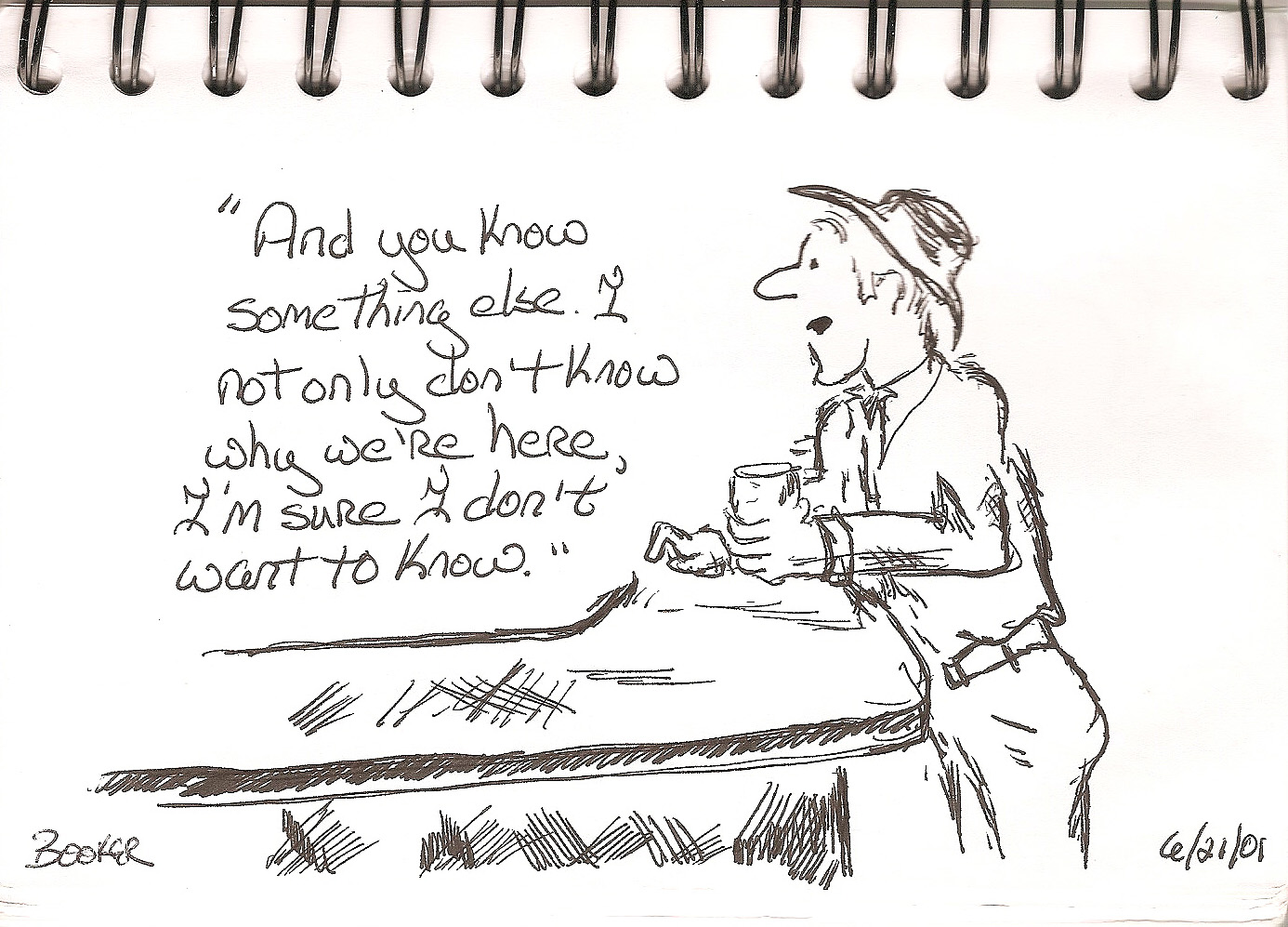
Blathering Idiot and why we are here

Don't know; don't want to know

If the universe was made for me, why doesn’t it fit better?

Or

If I was made for the universe, why do I feel like I was made from all the second-rate spare parts?

Leave a comment

Filed under blathering idiot, Cartoon, fun, humor, the universe, word play

Writer’s Block

Writer’s Block, n.: The place where a writer lives with his/her imaginary friends. Something like the neighborhood of make believe.

4 Comments

Filed under block, word play, writer, Writer's Block, writing, writing tip

Best writing advice you’ve received?

Below is some writing advice gathered by Chip MacGregor of MacGregor Literary. The listing below is from his blog. Website for the agency is http://macgregorliterary.com/.

http://chipmacgregor.typepad.com/main/2011/12/whats-the-best-writing-advice-you-ever-got-.html

December 30, 2011

What’s the best writing advice you ever got?

I’ve had several people write to share the best writing advice they’ve ever received.

Vince Zandri, who has done numerous novels and sold more than a quarter million books, wrote to me and said, “The best writing advice I ever got came from Ernest Hemingway in the form of his memoir, A Moveable Feast. If writers are worried about one thing, it’s the ability to keep a story moving from day to day. To avoid the ‘block,’ as some people call it. Papa wrote slowly and methodically in the early morning hours, and trained himself to stop at a point where he knew what was going to happen next. That way he could be sure of getting started the next day — and it left him the afternoons to play, exercise, fish, drink, or do whatever he wanted.”

Successful nonfiction writer Mel Lawrenz wrote to say, “The best advice? Take the long view. See the long process of publishing as an advantage — the stages of writing, editing, rewriting, and revising make for a more refined end product. Don’t miss the opportunity to rethink what you originally wrote.”

Harlequin author Dana Mentink sent this: “The best writing advice I got as a pre-pubbed author was that I should act like a professional. My mentor encouraged me to treat my writing like a business, not a hobby. Put in the hours, describe yourself to others as a writer, and really put yourself into the mindset of a professional. She explained to me that there’s a big difference between ‘I want to write a book’ and ‘I want to be an author.’ The latter requires professional dedication.”

Children’s author Kayleen Reusser noted, “Believe in yourself, even if no one else does. At my beginning I was the only one who believed I could write and get published. Even my mother told me I could not write — no money, no time, three small children to care for. But I swore I would die trying. (Thank goodness it has not come to that.)”

And novelist Dianne Price wrote to say, “Know your characters. LIve with them. Talk to them. Listen to their words and the cadence of their speech. Make them your constant companions. Argue with them. Commiserate with them. Ask them questions. You must know them to make them believable.”

What about you? What’s the best writing advice you’ve ever heard?

4 Comments

Filed under advice, agents, writing, writing tip