
I kiss your neck on
the back, near the bone ridge. A
freckle beckons me.
Monthly Archives: January 2012
The blathering idiot has questions
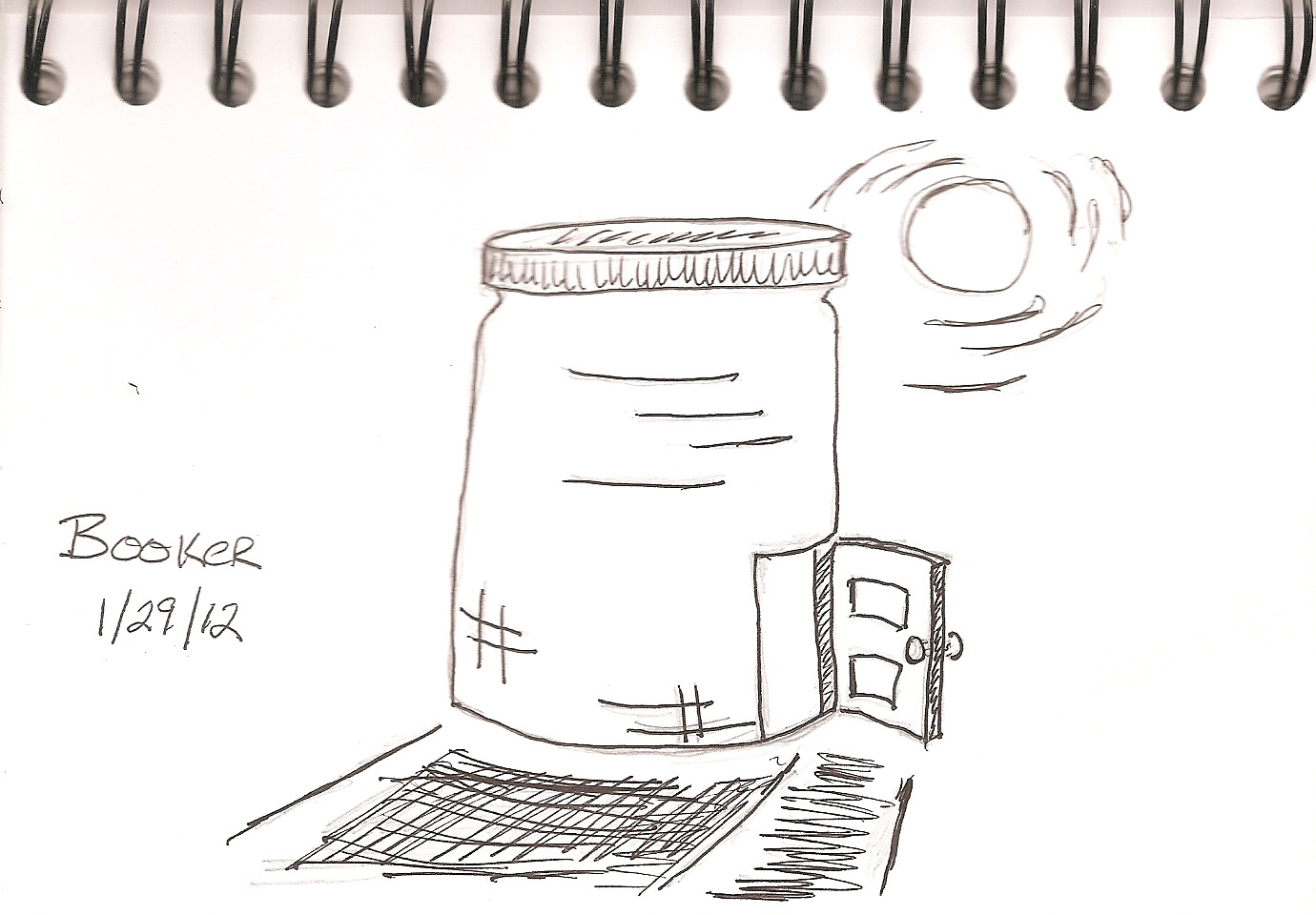
How can a door be a jar?
Just the other day, the blathering idiot had some time to kill, though he wasn’t sure it was alive to begin with, and while pondering the philosophical depths of life, came across questions for which he could not find answers. Below are a few of them.
How can a door be ajar?
How come left behind means you’ve lost it, but right behind means it is still with you?
How come you can be told to sit down and shut up, but never sit up and shut down?
How come you can give a nod, but never take one?
How come when you are taking a bow, you are giving it to somebody else?
How come a house warming doesn’t involve starting a fire?
How come you can give somebody the shirt off your back, but you have to beat the pants off him?
How come politicians run for office, but stand for re-election?
Found story: Santa takes on extra work

Santa hit man bounty hunter
Finding work in the off season hard to come by, Santa takes a job as a bounty hunter and hit man. Using his naughty list, he tracks down the not-so-nice folks and brings them to justice or brings them down.
Filed under Found story, humor, neighborhood, photo, photograph, Santa Claus, villains
Old love and what’s in the box
What’s in the box?
A little old lady went to the grocery store to buy cat food. She picked up four cans and took them to the checkout counter.
The girl at the cash register said, “I’m sorry, but we cannot sell you cat food without proof that you have a cat. A lot of old people buy cat food to eat, and the management wants proof that you are buying the cat food for your cat.”
The little old lady went home, picked up her cat and brought it back to the store.
They sold her the cat food.
The next day, she tried to buy two cans of dog food.
Again the cashier said “I’m sorry, but we cannot sell you dog food without proof that you have a dog. A lot of old people buy dog food to eat, but the management wants proof that you are buying the dog food for your dog.”
So she went home and brought in her dog.
She then was able to buy the dog food.
The next day she brought in a box with a hole in the lid.
The little old lady asked the cashier to stick her finger in the hole.
The cashier said, “No, you might have a snake in there.”
The little old lady assured her that there was nothing in the box that would harm her.
So the cashier put her finger into the box and quickly pulled it out.
She said to the little old lady, “That smells like poop.”
The little old lady said, “It is. I want to buy three rolls of toilet paper.”
Don’t mess with old people.
A different type of box
4th Marriage at 80 years old
The local news station was interviewing an 80-year-old lady because she had just gotten married for the fourth time.
The interviewer asked her questions about her life, about what it felt like to be marrying again at 80, and then about her new husband’s occupation.
“He’s a funeral director,” she answered.
“Interesting,” the newsman said.
He then asked her if she wouldn’t mind telling him a little about her first three husbands and what they did for a living.
She paused for a few moments, needing time to reflect on all those years.
After a short time, a smile came to her face and she answered proudly, explaining that she had first married a banker when she was in her 20s, then a circus ringmaster when in her 40s, and a preacher when in her 60s, and now – in her 80′ – a funeral director.
The interviewer looked at her, quite astonished, and asked why she had married four men with such diverse careers.
(wait for it)
She smiled and explained, “I married
one for the money,
two for the show,
three to get ready,
and four to go.”
And that’s the box you leave in.
Or as the young grocery bagger who introduced the funeral director and the 80-year-old lady put it: “Will that be paper or plastic?”
Quote of the Day
This just in from a church-going Southern Baptist who sends his son to a private Christian school: “I don’t care what he did in his personal life, I want Newt Gingrich to lead our country.”
It appears Newt’s having converted from Southern Baptist to Roman Catholicism doesn’t disturb some Southern Baptists like Roman Catholicism used to disturb them. I guess we can see that as a sign of improvement. John Kennedy would be proud.
Filed under GOP, politicians, politics, religion, satire
The Devil’s Dictionary: Patriot and Patriotism
Every now and then, it is good to revisit a classic, or even a curiosity from the past. The Devil’s Dictionary by Ambrose Bierce was originally published in newspaper installments from 1881 until 1906. You might be surprised how current many of the entries are.
For example, in this political campaign year, here is a definition for the words Patriot and Patriotism. The Old definitions are Bierce’s. The New definition is mine. From time to time, just as it was originally published, we will come back to The Devil’s Dictionary, for a look at it then and how it applies today. Click on Devil’s Dictionary in the tags below to bring up the other entries.
Patriot, n. One to whom the interests of a part seem superior to those of the whole. The dupe of statesmen and the tool of conquerors.
Patriotism, n. Combustible rubbish ready to the torch of any one ambitious to illuminate his name.
In Dr. Johnson’s famous dictionary, patriotism is defined as the last resort of a scoundrel. With all due respect to an enlightened but inferior lexicographer, I beg to submit that is it the first.
Updated definition: has anything changed since these definitions were first published? I think you could add to Patriot: The dupe of statesmen, the tool of conquerors, and the straw man of politicians. Anyone who does not agree with a politician’s stance for saving America is not a patriot (or even worse, a liberal).
It should also go without saying that scoundrel is a synonym for politician, and patriotism is often the first refuge of the politician, particularly when he (or she) doesn’t want to discuss something embarrassing or damaging, such as facts.
One also need remember this that an “-ism” as in patriotism is short for Ideology Stuck (in the) Mind. It has ceased to be a living idea and has become a petrified facsimile (or petrifac) of the real thing.
Filed under Ambrose Bierce, Devil's Dictionary, humor, patriot, patriotism, politicians, politics, satire, scoundrel
Writing tip: Is your ending satisfying?
[Editor’s note: the essay below is taken from an e-mail newsletter sent out by the writer Bruce Hale. you can find his web site at: http://www.brucehalewritingtips.com/. You can also sign up for his e-newsletter at that site. Each electronic newsletter comes with other information, including a writing joke.]
IS YOUR ENDING REALLY SATISFYING READERS?
How many times have you heard that the first page of your story is the most important? Too many, I’d say.
Not that a compelling opening isn’t vital — it is. But with all that focus on crafting a killer beginning, it’s easy to forget about making an awesome ending. Endings may not get as much attention in how-to books as openings, but they are just as hard to do right.
One thing to bear in mind: An effective ending needn’t necessarily be happy, but it must be SATISFYING. In other words, whether or not your hero gets what he wants, the reader must get what *she* wants.
While you’re working on your ending’s SQ (Satisfaction Quotient), here are some key points to keep in mind.
SQ CHECKLIST:
– Has the asked question been answered?
No matter how unstated or simple it may be, every book has a theme. As part of that, the story poses an implicit (sometimes explicit) question that must be answered by the end of the book.
Whether it’s “Can a girl and a vampire find happiness and true love?” or “Will Samantha ever get her big red wagon?” that question has been brewing in the reader’s mind throughout your story. Be sure your ending has conclusively answered it.
– Have all subplots been resolved?
Before you respond with the inevitable, “Duh, of course!” be sure all elements of your story have a true sense of closure. If any
subplots or characters are left hanging, your readers won’t be fully satisfied.
Readers need to know not only that the hero’s main problem has been resolved, but that the supporting characters and villain are taken care of, too. Maybe that’s why so many concluding chapters are stuffed full of, “Dr. Evil was caught at the border, and Hannah? Why she married that cute jockey.” No need to be that blatant, but do be that comprehensive.
– Have you given the reader something expected?
A satisfying ending must fulfill the reader’s expectation. If you’re writing a mystery, the expectation is that the murderer will be brought to justice. If a romance, that the protagonist will find true love. Mess with these expectations at your peril, but also consider…
– Have you given the reader something surprising?
The best endings leave you with an “I knew that would happen, but not like THAT” feeling. A pat, expected ending feels boring, a letdown, even if it delivers on a reader’s expectations. So it’s essential to unearth some kind of surprise in the WAY the story resolves.
I just read an adult mystery where the detective was haunted by an almost supernaturally evil man he’d first met as a child. You expect that man to be defeated by the detective, but instead he was struck by lightning and died in a Biblical wrath-of-God way that was surprising and satisfying — and right for the book. I got the ending I wanted, but not in the way I’d expected it.
– Have you echoed the opening?
This isn’t necessary, but it is a nice-to-have. If you can echo some image or scene from the beginning, but have it take on a different meaning, that’s the icing on the cake. You’ll notice many movies use this technique.
In SAVE THE CAT, his excellent book on story and screenwriting, Blake Snyder says: “The final image of a movie is the opposite of the opening image. It is your proof that chance has occurred and that it’s real.” For example, in the movie Miss Congeniality, the opening image is tomboy Sandra Bullock, surrounded by boys, but not fully fitting in. The final image is of her surrounded by women and fitting in as herself.
And if you can come up with that kind of ending… your SQ will go through the roof, and readers will thank you!
Filed under Bruce Hale, endings, writer, writing, writing tip
Just a thought
Too many politicians, in an attempt to catch fire in the voters’ imagination, do nothing but stoke the fires of the voters’ fears. –from the blog editor
Filed under politicians, politics, Random Access Thoughts, Random thought
If they’re running for office…

Running and yelling don't make sense.
Filed under Cartoon, child, eight year old philosopher, humor, politicians, politics
The Writing Life: The point of the long and winding sentence
Pico Iyer says writing longer phrases is a way to protest the speed of information bites people are subjected to each day.
By Pico Iyer, Special to the Los Angeles Times
January 8, 2012
“Your sentences are so long,” said a friend who teaches English at a local college, and I could tell she didn’t quite mean it as a compliment. The copy editor who painstakingly went through my most recent book often put yellow dashes on-screen around my multiplying clauses, to ask if I didn’t want to break up my sentences or put less material in every one. Both responses couldn’t have been kinder or more considered, but what my friend and my colleague may not have sensed was this: I’m using longer and longer sentences as a small protest against — and attempt to rescue any readers I might have from — the bombardment of the moment.
When I began writing for a living, my feeling was that my job was to give the reader something vivid, quick and concrete that she couldn’t get in any other form; a writer was an information-gathering machine, I thought, and especially as a journalist, my job was to go out into the world and gather details, moments, impressions as visual and immediate as TV. Facts were what we needed most. And if you watched the world closely enough, I believed (and still do), you could begin to see what it would do next, just as you can with a sibling or a friend; Don DeLillo or Salman Rushdie aren’t mystics, but they can tell us what the world is going to do tomorrow because they follow it so attentively.
Yet nowadays the planet is moving too fast for even a Rushdie or DeLillo to keep up, and many of us in the privileged world have access to more information than we know what to do with. What we crave is something that will free us from the overcrowded moment and allow us to see it in a larger light. No writer can compete, for speed and urgency, with texts or CNN news flashes or RSS feeds, but any writer can try to give us the depth, the nuances — the “gaps,” as Annie Dillard calls them — that don’t show up on many screens. Not everyone wants to be reduced to a sound bite or a bumper sticker.
Enter (I hope) the long sentence: the collection of clauses that is so many-chambered and lavish and abundant in tones and suggestions, that has so much room for near-contradiction and ambiguity and those places in memory or imagination that can’t be simplified, or put into easy words, that it allows the reader to keep many things in her head and heart at the same time, and to descend, as by a spiral staircase, deeper into herself and those things that won’t be squeezed into an either/or. With each clause, we’re taken further and further from trite conclusions — or that at least is the hope — and away from reductionism, as if the writer were a dentist, saying “Open wider” so that he can probe the tender, neglected spaces in the reader (though in this case it’s not the mouth that he’s attending to but the mind).
“There was a little stoop of humility,” Alan Hollinghurst writes in a sentence I’ve chosen almost at random from his recent novel “The Stranger’s Child,” “as she passed through the door, into the larger but darker library beyond, a hint of frailty, an affectation of bearing more than her fifty-nine years, a slight bewildered totter among the grandeur that her daughter now had to pretend to take for granted.” You may notice — though you don’t have to — that “humility” has rather quickly elided into “affectation,” and the point of view has shifted by the end of the sentence, and the physical movement through the rooms accompanies a gradual inner movement that progresses through four parallel clauses, each of which, though legato, suggests a slightly different take on things.
Many a reader will have no time for this; William Gass or Sir Thomas Browne may seem long-winded, the equivalent of driving from L.A. to San Francisco by way of Death Valley, Tijuana and the Sierras. And a highly skilled writer, a Hemingway or James Salter, can get plenty of shading and suggestion into even the shortest and straightest of sentences. But too often nowadays our writing is telegraphic as a way of keeping our thinking simplistic, our feeling slogan-crude. The short sentence is the domain of uninflected talk-radio rants and shouting heads on TV who feel that qualification or subtlety is an assault on their integrity (and not, as it truly is, integrity’s greatest adornment).
If we continue along this road, whole areas of feeling and cognition and experience will be lost to us. We will not be able to read one another very well if we can’t read Proust’s labyrinthine sentences, admitting us to those half-lighted realms where memory blurs into imagination, and we hide from the person we care for or punish the thing that we love. And how can we feel the layers, the sprawl, the many-sidedness of Istanbul in all its crowding amplitude without the 700-word sentence, transcribing its features, that Orhan Pamuk offered in tribute to his lifelong love?
To pick up a book is, ideally, to enter a world of intimacy and continuity; the best volumes usher us into a larger universe, a more spacious state of mind akin to the one I feel when hearing Bach (or Sigur Rós) or watching a Terrence Malick film. I cherish Thomas Pynchon’s prose (in “Mason & Dixon,” say), not just because it’s beautiful, but because his long, impeccable sentences take me, with each clause, further from the normal and the predictable, and deeper into dimensions I hadn’t dared to contemplate. I can’t get enough of Philip Roth because the energy and the complication of his sentences, at his best, pull me into a furious debate in which I see a mind alive, self-questioning, wildly controlled in its engagement with the world. His is a prose that banishes all simplicities while never letting go of passion.
Not every fashioner of many-comma’d sentences works for every one of us — I happen to find Henry James unreadable, his fussily unfolding clauses less a reflection of his noticing everything than of his inability to make up his mind or bring anything to closure: a kind of mental stutter. But the promise of the long sentence is that it will take you beyond the known, far from shore, into depths and mysteries you can’t get your mind, or most of your words, around.
When I read the great exemplar of this, Herman Melville — and when I feel the building tension as Martin Luther King’s “Letter from Birmingham Jail” swells with clause after biblical clause of all the things people of his skin color cannot do — I feel as if I’m stepping out of the crowded, overlighted fluorescent culture of my local convenience store and being taken up to a very high place from which I can see across time and space, in myself and in the world. It’s as if I’ve been rescued, for a moment, from the jostle and rush of the 405 Freeway and led back to something inside me that has room for certainty and doubt at once.
Watch Dillard light up and rise up and ease down as she finds, near the end of her 1974 book “Pilgrim at Tinker Creek,” “a maple key, a single winged seed from a pair. Hullo. I threw it into the wind and it flew off again, bristling with animate purpose, not like a thing dropped or windblown, pushed by the witless winds of convection currents hauling round the world’s rondure where they must, but like a creature muscled and vigorous, or a creature spread thin to that other wind, the wind of the spirit which bloweth where it listeth, lighting, and raising up, and easing down.”
I love books; I read and write them for the same reason I love to talk with a friend for 10 hours, not 10 minutes (let alone, as is the case with the average Web page, 10 seconds). The longer our talk goes, ideally, the less I feel pushed and bullied into the unbreathing boxes of black and white, Republican or Democrat, us or them. The long sentence is how we begin to free ourselves from the machine-like world of bullet points and the inhumanity of ballot-box yeas or nays.
There’ll always be a place for the short sentence, and no one could thrill more than I to the eerie incantations of DeLillo, building up menace with each reiterated note, or the compressed wisdom of a Wilde; it’s the elegant conciseness of their phrases that allow us to carry around the ideas of an Emerson (or Lao Tzu) as if they were commandments or proverbs of universal application.
But we’ve got shortness and speed up the wazoo these days; what I long for is something that will sustain me and stretch me till something snaps, take me so far beyond a simple clause or a single formulation that suddenly, unexpectedly, I find myself in a place that feels as spacious and strange as life itself.
The long sentence opens the very doors that a short sentence simply slams shut. Though the sentence I sent my copy editor was as short as possible. No.
Iyer is the author, most recently, of “The Man Within My Head,” published this month.
Copyright © 2012, Los Angeles Times
Filed under long sentence, sentence, writer, writing, writing tip


 Booker's Blog