Monthly Archives: July 2010

The Perils of Writing: Tension

Writing tip: Building a better story: tension

Bookends to death

Tension, what is it, how to get it.

In the last installment, I said there was a difference between conflict and tension. Conflict, as Bob McKey pointed out, is the gap between expectation and result. The gap can be small, such as being overcharged a dime or great, such as losing a loved one when you thought he would survive.

The best way to explain tension is to refer to a small book on writing by the writer and editor Algis Budrys, Lithuanian for “Gordon John Sentry, more or less.” His book, Writing to The Point: A complete guide to selling fiction is only 64 pages long, and may be hard to get. But this Strunk and White-sized guide to writing is worth your time (and it even covers manuscript formatting).

For Gordon John Sentry, more or less, a story consists of seven parts: 1) a character 2) in a context with a 3) problem, who 4) makes an intelligent attempt to solve the problem and 5) fails, tries a second time and fails, tries a third time and finally 6) succeeds or completely fails, and whose actions are then 7) validated by another character in the story.

Sounds simple, doesn’t it? That is the allure of telling a good story. But the execution is often more difficult, for writer as well as story character. Step 4 – 6 above is where in a story you find tension. The key is that the character makes an intelligent attempt and fails. With increased knowledge, he or she tries again, and fails. The increased knowledge increases the stakes in the attempt and thus increases the tension. After all, it should succeed, right? Then there is a third and final attempt. This is, in essence, all or nothing, so the tension should be at its highest here.

Tension, then, is something that builds over the life of the story, fueled by and feeding into the conflict. A well known love story may provide the clearest example. Romeo and Juliet loved each other. Their families, however, were adversaries. Romeo and Juliet attempted to find a way to manifest their love in the midst of this conflict, each time failing until each makes one last effort that leads to both their deaths. In this example, the tension builds in opposition to the conflict, which is fairly clever if you think about, and because of that opposition, the conflict works to heighten the tension.
Leave a comment

Filed under humor, story, the perils of writing, words, writing, writing tip

The Perils of Writing: Building a better story: Conflict

Writing tip: conflict

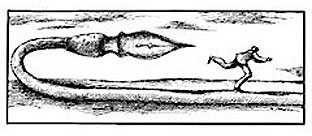
Pen chasing writer

Conflict: expectation vs result

In the last installment of this feature, I put forth a little paradigm about writing that started off with “Drama is conflict….” But what is conflict? Is it open hostilities between two armies? It can be. It is the harsh words a husband has for a wife? It can be that, too. It is dealing with opposing desires or wants, such as deciding between love and honor? Yes, it can be that as well.

But all three examples listed above and in a host of others there is a common thread, something unspoken, and as important as words are, it is often the unspoken or unwritten element that defines a scene in a story and sometimes the story itself.

As I said in the previous article, I learned the paradigm that begins “Drama is conflict …” in 1993. Some twelve years later, and even though I wasn’t looking, I learned from author, screen writer, and teacher Steven Womack a definition of conflict that adds depth and, dare I say, meaning to the word conflict and the entire paradigm. He credits learning it from Bob McKey, a script doctor. McKey has made a living and a small fortune fixing other people’s scripts though he often doesn’t get screen credit for it. All scripts need conflict; conflict drives the story forward. How will the protagonist react? What will she do? But conflict is not car chases, gun battles, or galaxies spiraling out of control. Conflict, McKey said, is the gap between expectation and result. That’s it.

Conflict can be as small as being overcharged a dime and how your protagonist reacts or as great as losing a battle when the protagonist fought hard to win. In both examples, there is a gap between expectations and results. How your protagonist deals with that gap and what steps he takes to close it are what drives a story forward, whether the story is a script, a short story, or a novel. The obstacles in the way preventing the protagonist from easily closing that gap are what are called tension, but that is a discussion for another time.

Leave a comment

Filed under the perils of writing, writing, writing tip

The perils of writing: building a better story

Writing tips

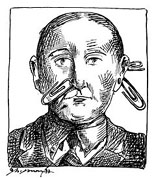
Man with paperclips in his nose and ears.

The perils of writing

My writing is distinctly middle brow. Just ask anybody who has suffered through it. Still, I like to think that even in my middling way, I can still offer some helpful advice when I stumble across it. Therefore, from time to time, I will post some writing advice, but not from me. The advice will come from established sources. I will endeavor not to make it overlong or overreaching, and sometimes it will simply be reminders of what we all probably already know, but it will be some tips I have picked up from reading, from attending writing conferences, or it may even come from you.

The first bit of advice comes from a writing course the Writers’ Guild sponsored way back in 1993. The teacher was Joseph Gunnels and the cost was $75. It was two-day event, May 15 and 16, and we spent part of a pleasant afternoon sitting on the grass outside the Candy Factory on The World’s Fair site in Knoxville, TN. I took over 30 pages of notes, but rather than bore you with details, here is the essence of what I took away from the seminar:

Drama is conflict;
Without conflict no action;
Without action no character;
Without character no story;
Without story, who cares?

In a future issue of this newsletter, I’ll give you a short, crisp definition for conflict that I learned at a more recent one-day writing seminar. It comes from a very highly regarded script doctor in Hollywood, but applies just as well to other forms of fiction writing. Stay turned.

Leave a comment

Filed under how to, the perils of writing, word play, writing, writing tip

The Supercilious Door

Didn’t you know, there’s a secret marketing department office called SuDoo? Their job is to make things super-silly-to-us, or supercilious when said fast enough. They once had a sign that hung on their door that said “Supercilious Department.” Others called it “the SD door” for short. The sign was so heavy that it kept falling off. At first, people walking by would pick it up, knock on the door, and give the sign to whomever answered. Eventually, people got tired of this, especially since the people inside never said thank you. Finally, the sign fell down and nobody picked it up or knocked on the door to tell the SD their sign was down. The work day ended and as the first SD member stepped through the door, he stepped on the sign. It shattered under his weight and shot out in different directions, one piece wedging under the door to the Supercilious Department, preventing them from closing it. Because he had shattered the sign and the door couldn’t be fixed for several weeks, the sign breaker was stationed at the door to keep people out. He became known as the Supercilious Department Door Keeper, which was too long for people in the office to say, so it became shorted to the Supercilious Door Keeper, and eventually SDK. But the head of the Supercilious Department didn’t like that and insisted that the first time people greeted the door keeper, they had to refer to him as the Supercilious Department Door Keeper. Subsequent references during the day could be shorted to Supercilious Door Keeper. One day, a new employee from another department had a package that needed to go immediately to the Supercilious Department Head, but when he got to the door, he found the Supercilious Department Door Keeper would not let him in. The Door Keeper told him he could send a note inside the department, and the person for whom the package was addressed, could come forward and get it. The new employee pulled and pen and a scrap piece of paper out of his pocket and began his note. Unfortunately, the pen ran out of ink, and so the employee couldn’t finish his note, and since this employee was late for another meeting, he left the package outside the door. The Door Keeper forgot about the package, and eventually it was time to leave work. As the head of the department left, he saw the package, picked it up, recognized its importance, and looked around. When he spotted the Door Keeper making his way to the elevator, he yelled out, “Hey, you, Supercilious Door K—.” It was then that the package exploded. The Department head lost his, and as it turned out, the package was not what he thought it was, but in loving tribute to the Department head who lost his, the rest of the department and eventually those throughout the building referred to the Supercilious Door Keeper as the Supercilious Dork. Over time, the Supercilious Dork rose to be head of the department and because he was so stigmatized and traumatized by what happened that day, he has forever more made it his mission to shorten the names of things. And he never picks up strange packages, especially ones addressed to Supercilious Dork.

Leave a comment

Filed under story, words, writing

The Painted Beast

There once was an ex-cop who did poorly
At being a father and what’s more he
Killed his ex-wife
But then offered up his life
To save his daughter from a life in pornography.

[Editor’s note: this is a distillation of my novel The Painted Beast into a short limerick form. It does not capture all the twists and turns of the novel, but if I had to describe at least one main feature of it in 50 words or less, this would probably do.]

1 Comment

Filed under limerick, poem, poetry, story, words, writing